Load Centre of Gravity: How to Calculate It for a Truck Load
The centre of gravity of a load is the weighted average of every item's position. Learn the formula, a worked truck example and checks for lateral offset.
Load planning basics · · 5 min read
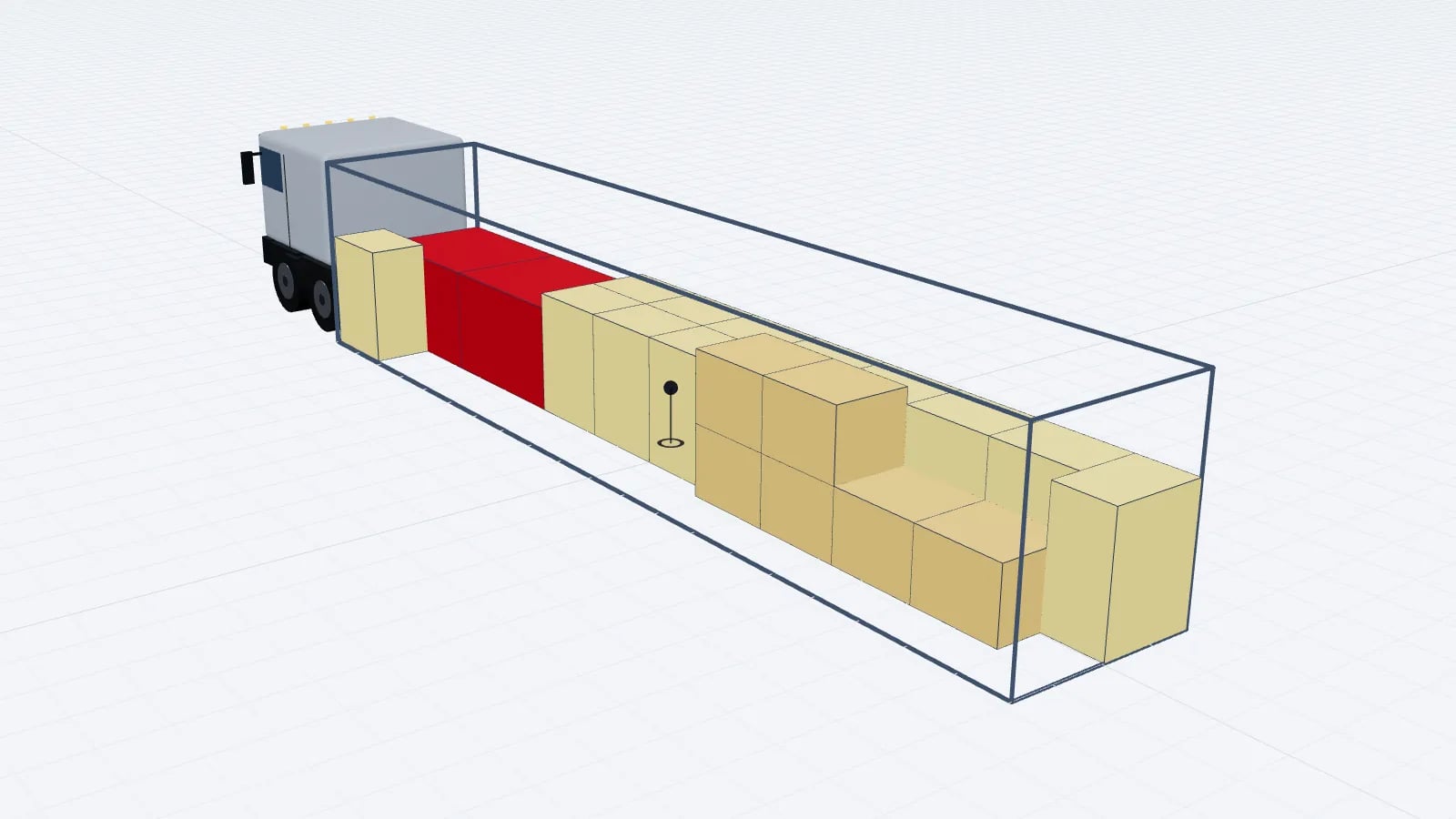
The centre of gravity (CoG) of a load is the point where its total weight can be considered to act. For a truck load you calculate it as a weighted average: multiply each item's weight by the position of its own centre, add the results, and divide by the total weight. Do this along the length, across the width and in height, and you know whether the load is front- or rear-heavy, leaning to one side, or top-heavy.
Planners care about the CoG for two reasons: its position along the length decides the axle loads, and its offset across the width and its height decide how stable the vehicle is in corners and under braking.
The formula
Pick a reference point, usually the front-left corner of the load floor. For each item, find the position of its own centre of gravity. For a uniform pallet or box, that is the middle of the box; for machinery, use the CoG mark on the crate or the manufacturer's data.
- Along the length: X = (w₁·x₁ + w₂·x₂ + … ) ÷ (w₁ + w₂ + …)
- Across the width: Z = (w₁·z₁ + w₂·z₂ + … ) ÷ total weight
- Height: Y = (w₁·y₁ + w₂·y₂ + … ) ÷ total weight
Here w is each item's weight and x, z and y its centre position. The lateral offset is Z minus half the internal width: zero means the load is centred, a negative value means it leans to the left (with this reference point), positive to the right.
Worked example
Say a 13.6 m trailer, 2.45 m wide inside (centre line at 1.225 m from the left wall), carries four groups of cargo. Positions are the centres of each group, measured from the front-left corner of the floor:
Item: Machine crate
- Weight
- 4,000 kg
- x (length)
- 2.0 m
- z (width)
- 1.225 m
- y (height)
- 0.7 m
Item: Block of drinks pallets
- Weight
- 6,000 kg
- x (length)
- 6.0 m
- z (width)
- 1.225 m
- y (height)
- 0.6 m
Item: Steel coils
- Weight
- 2,000 kg
- x (length)
- 10.0 m
- z (width)
- 0.6 m
- y (height)
- 0.5 m
Item: Carton pallets
- Weight
- 1,000 kg
- x (length)
- 10.0 m
- z (width)
- 1.85 m
- y (height)
- 1.0 m
| Item | Weight | x (length) | z (width) | y (height) |
|---|---|---|---|---|
| Machine crate | 4,000 kg | 2.0 m | 1.225 m | 0.7 m |
| Block of drinks pallets | 6,000 kg | 6.0 m | 1.225 m | 0.6 m |
| Steel coils | 2,000 kg | 10.0 m | 0.6 m | 0.5 m |
| Carton pallets | 1,000 kg | 10.0 m | 1.85 m | 1.0 m |
Total weight: 13,000 kg.
- 1X: 4,000 × 2.0 + 6,000 × 6.0 + 2,000 × 10.0 + 1,000 × 10.0 = 8,000 + 36,000 + 20,000 + 10,000 = 74,000. Divided by 13,000 = 5.69 m from the front wall.
- 2Z: 4,000 × 1.225 + 6,000 × 1.225 + 2,000 × 0.6 + 1,000 × 1.85 = 4,900 + 7,350 + 1,200 + 1,850 = 15,300. Divided by 13,000 = 1.177 m. Lateral offset 1.177 − 1.225 = −0.048 m, about 5 cm to the left.
- 3Y: 4,000 × 0.7 + 6,000 × 0.6 + 2,000 × 0.5 + 1,000 × 1.0 = 2,800 + 3,600 + 1,000 + 1,000 = 8,400. Divided by 13,000 = 0.65 m above the floor.
A 5 cm lateral offset is small. Now suppose the warehouse loads the 6,000 kg of drinks as a single row of pallets along the left wall, centred at z = 0.6 m instead of in the middle. Z becomes 4,900 + 3,600 + 1,200 + 1,850 = 11,550, divided by 13,000 = 0.888 m. The offset is now −0.337 m, about 34 cm to the left, with the same cargo and the same weight. That trailer will lean in every right-hand bend.
The X position also gives the axle split. Using the hypothetical trailer from the weight distribution guide (kingpin 1.0 m and axle group 9.6 m from the front wall, 8.6 m apart), the cargo CoG is 5.69 − 1.0 = 4.69 m behind the kingpin. Trailer axles: 13,000 × 4.69 ÷ 8.6 ≈ 7,090 kg. Kingpin: about 5,910 kg. Cargo only, excluding the vehicle's own weight.
Why lateral offset and height are risky
- Rollover. A high CoG combined with a sideways offset reduces the cornering speed at which the vehicle starts to tip. Liquids, hanging goods and tall stacks make this worse.
- Uneven tyre and suspension load. One side of each axle carries more than the other, which can overload individual tyres and affect braking.
- Load shift. A load leaning to one side puts more force on the curtains or side walls on that side, which are not designed as load restraint unless certified as such.
- Container handling. For sea containers, a strongly off-centre CoG makes lifting by crane or reach stacker harder and is a safety concern; container guidelines (such as the CTU Code) ask for the CoG to be kept near the middle.
Good to know
Exact stability limits depend on the vehicle, the suspension and the road, so there is no single acceptable offset. Aim for as close to zero as the cargo allows and treat any noticeable offset as something to fix, not to accept.
Practical checks without a calculator
- Rows of three: if each row has a similar weight on the left, middle and right, the lateral offset is close to zero.
- Heaviest down the middle: when you have a few very heavy items, put them on the centre line and fill the sides with lighter goods.
- Pairs balance: a heavy pallet on the left should be matched by a similar one on the right in the same or the next row.
- Low and heavy first: put dense goods on the floor and light goods on top to keep the CoG low.
- Check after each drop: in multi-drop loads, the CoG moves every time goods come off.
Getting the item data right
The calculation is only as good as the weights and positions you use. Weigh unknown items rather than estimating. For machinery and crates with an uneven mass, use the CoG marked on the crate (the ISO 780 centre-of-gravity symbol) rather than the geometric centre. And remember that a load CoG excludes the vehicle: the combined vehicle CoG is higher, because the trailer floor is already well above the road.
Tip
EveryLoading shows the cargo's centre of gravity as a marker in the 3D view, next to the axle load estimates. The marker turns red and the stats show a warning when the load is badly off-centre or too far forward or back, and it moves as you drag heavy items. See weight, axle loads and centre of gravity.
Frequently asked questions
How do you calculate the centre of gravity of a load?
Multiply each item's weight by the position of its centre, add the products, and divide by the total weight. Do it separately for length, width and height.
What is lateral offset?
The distance between the load's centre of gravity and the vehicle's centre line, across the width. A large offset makes the vehicle lean and more likely to roll in bends.
Where is the centre of gravity of a pallet?
For a uniformly packed pallet it is near the middle of the box, so at roughly half its height. For mixed or uneven pallets, it is closer to the heavier part.
Does the centre of gravity affect axle loads?
Yes. Its position along the length decides how the cargo weight is shared between the kingpin and the trailer axles, or between the front and rear axle of a rigid truck.
Keep reading
Load planning basics · · 5 min read
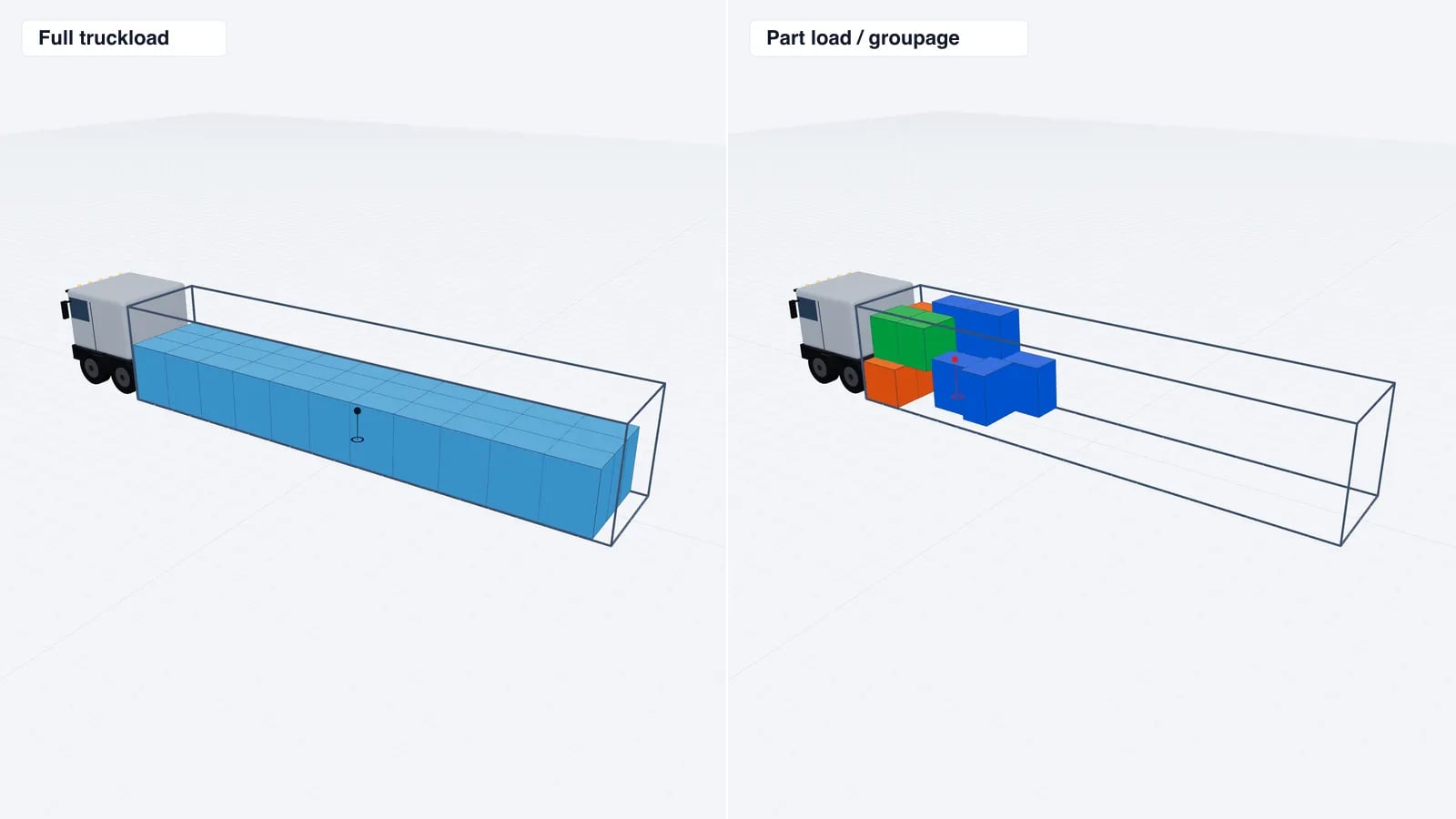
FTL vs LTL: Full Truckload, Part Load or Groupage?
FTL books a whole truck; LTL and groupage share it with other shippers. Compare cost, speed and handling, see how LDM drives LTL price and find your break-even.
Read article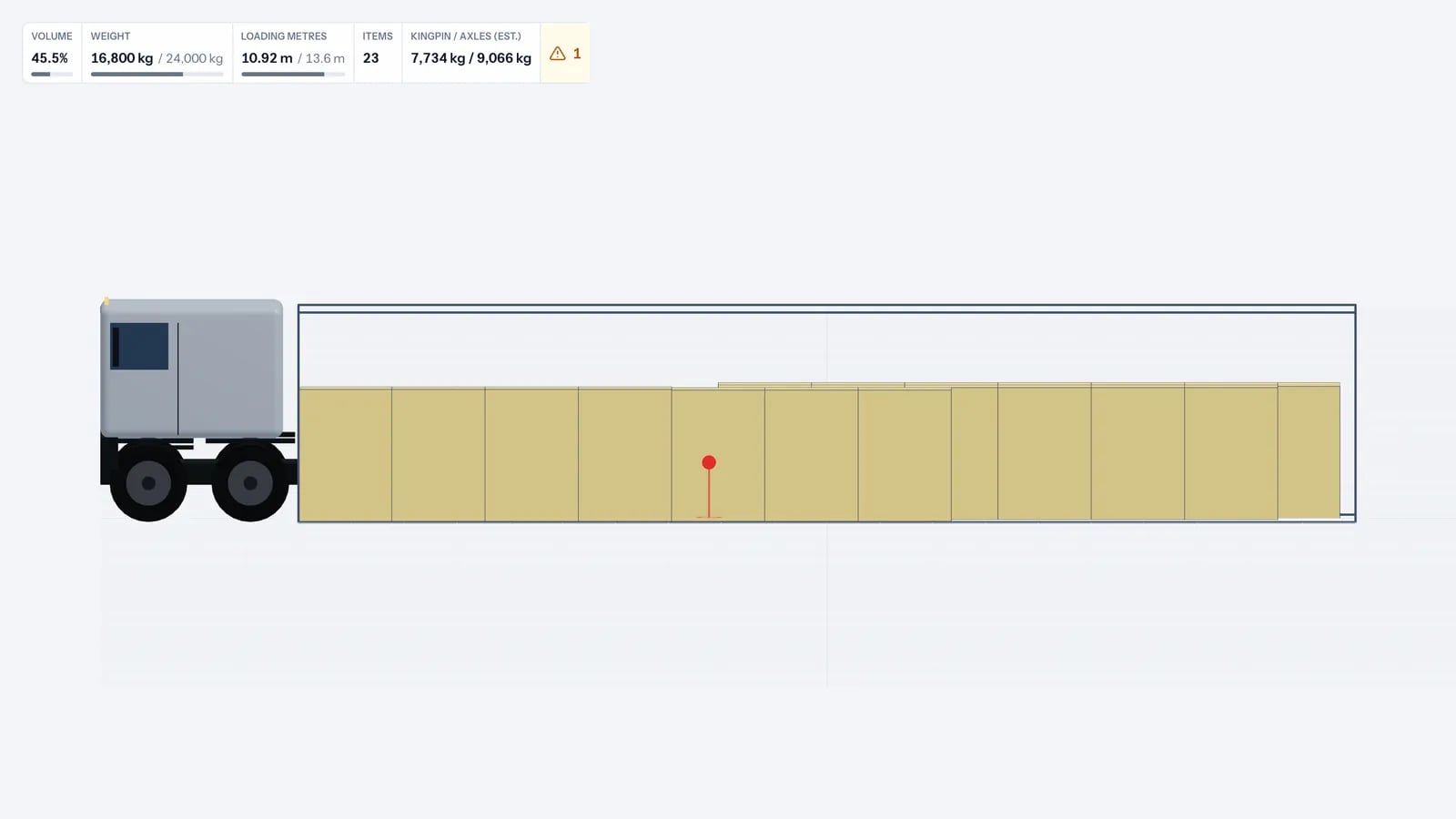
Load planning basics · · 6 min read
Weight Distribution in a Trailer: Axle Loads Made Simple
Where you put heavy cargo decides the load on each axle. Learn how trailer weight distribution works, how to estimate axle loads and how to avoid overloading.
Read article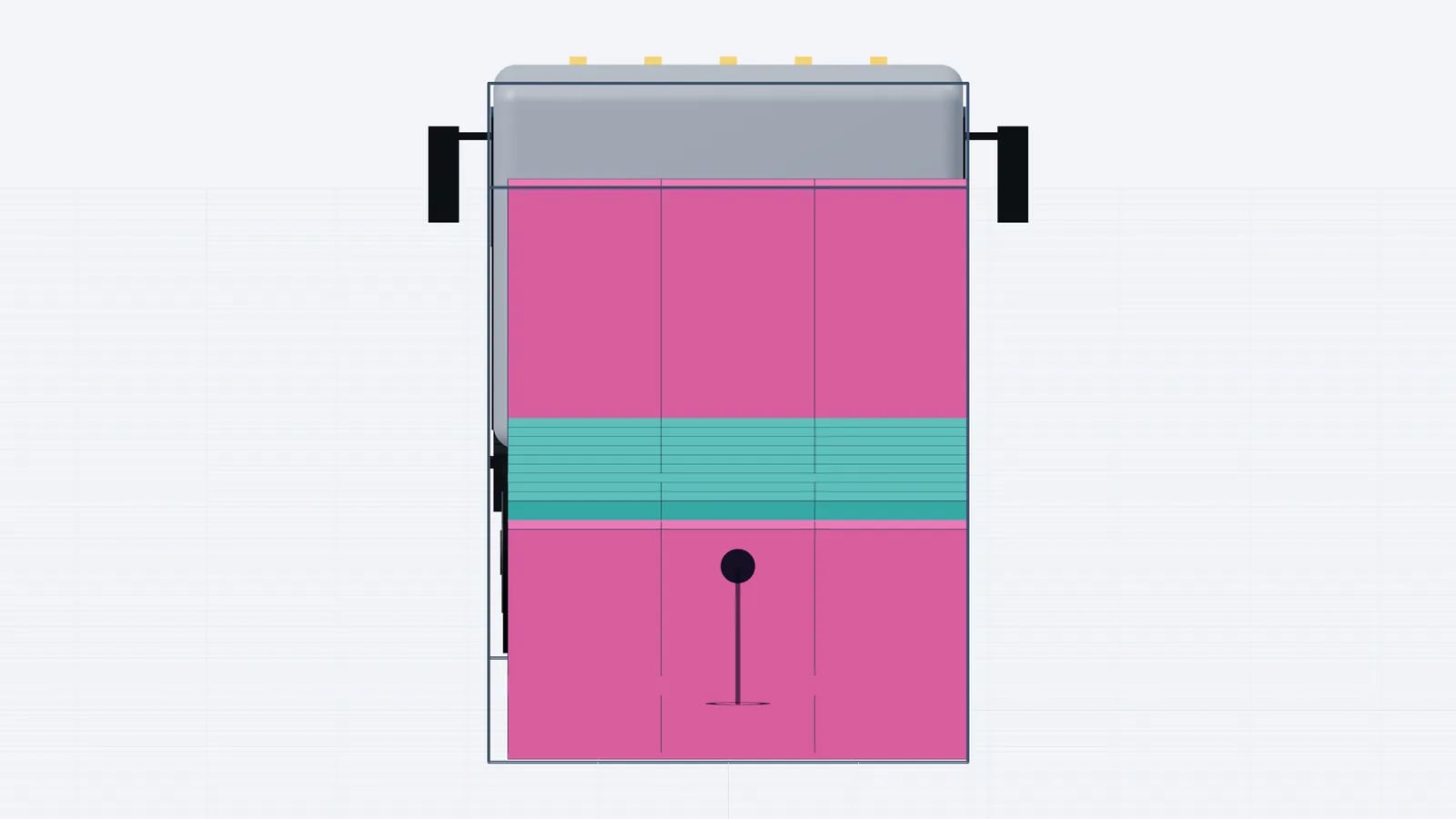
Load planning basics · · 6 min read
Pallet Stacking Rules: Stackability, Weight on Top and Support
Which pallets can be stacked, how much weight can go on top and how much support a top pallet needs. Practical pallet stacking rules for trucks and containers.
Read article