FTL vs LTL: Full Truckload, Part Load or Groupage?
FTL books a whole truck; LTL and groupage share it with other shippers. Compare cost, speed and handling, see how LDM drives LTL price and find your break-even.
Load planning basics · · 5 min read
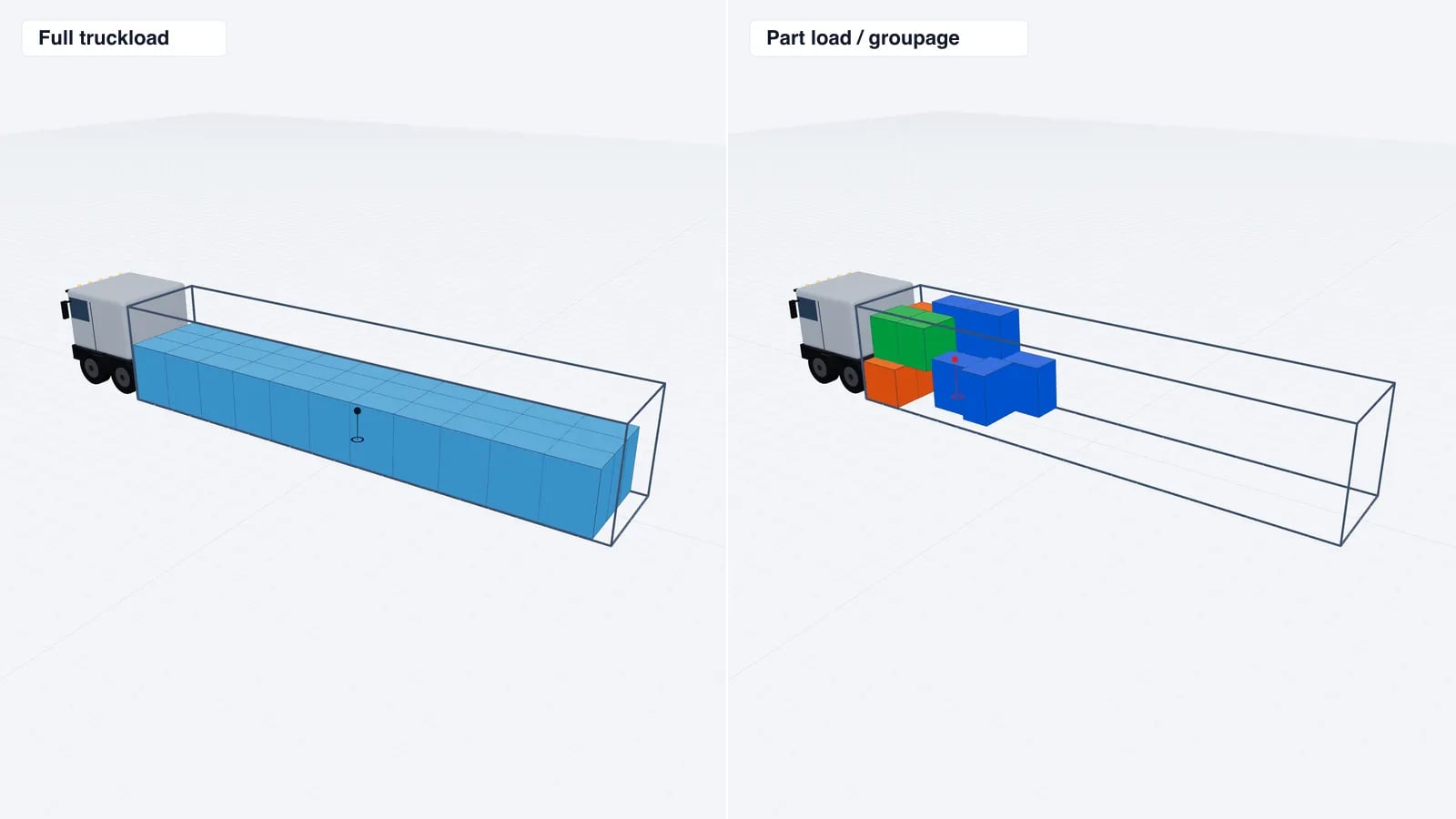
FTL (full truckload) means you book the whole vehicle: the goods go directly from loading point to destination and you pay one price for the truck. LTL (less than truckload), called groupage or part load in much of Europe, means you pay only for the space or weight you use and share the truck with other shippers. FTL is usually cheaper per pallet once you fill a large share of the trailer; LTL is cheaper for small shipments but slower and involves more handling.
The choice is not only about size. Transit time, fragility, delivery windows and how the carrier measures your freight (by weight, volume or loading metres) all move the break-even point.
The three options
What you book
- FTL
- The whole vehicle
- Part load (direct)
- Part of a vehicle on a direct run
- Groupage / LTL
- Space in a network of trucks and hubs
Routing
- FTL
- Direct
- Part load (direct)
- Direct or with a few stops
- Groupage / LTL
- Collection, hub, line-haul, hub, delivery
Handling
- FTL
- Loaded once, unloaded once
- Part load (direct)
- Usually loaded once
- Groupage / LTL
- Cross-docked one or more times
Transit time
- FTL
- Fastest
- Part load (direct)
- Fast
- Groupage / LTL
- Slower, often a day or more extra
Price basis
- FTL
- Per truck (lane, distance)
- Part load (direct)
- LDM, weight or pallet places
- Groupage / LTL
- Chargeable weight, LDM or pallet places, with weight bands
Best for
- FTL
- Large or sensitive shipments
- Part load (direct)
- Medium shipments that need speed
- Groupage / LTL
- Small, regular shipments
| FTL | Part load (direct) | Groupage / LTL | |
|---|---|---|---|
| What you book | The whole vehicle | Part of a vehicle on a direct run | Space in a network of trucks and hubs |
| Routing | Direct | Direct or with a few stops | Collection, hub, line-haul, hub, delivery |
| Handling | Loaded once, unloaded once | Usually loaded once | Cross-docked one or more times |
| Transit time | Fastest | Fast | Slower, often a day or more extra |
| Price basis | Per truck (lane, distance) | LDM, weight or pallet places | Chargeable weight, LDM or pallet places, with weight bands |
| Best for | Large or sensitive shipments | Medium shipments that need speed | Small, regular shipments |
Terms vary by market. In the US, LTL is a distinct industry of networked carriers; in Europe, groupage operators run hub networks, and part loads are often sold by hauliers filling a truck with two or three customers' goods on the same route.
How LTL and groupage are priced
Groupage carriers have to fill their trucks with many shipments, so they charge for whichever resource your freight uses most:
- Actual weight, for dense goods.
- Volume weight, cubic metres × a carrier factor, for bulky goods.
- Loading-metre weight, LDM × a carrier factor, for goods that use floor space without stacking.
- Pallet places, a flat rate per pallet by size and weight band, common in pallet networks.
Conversion factors are set by each carrier; commonly quoted ranges are around 1,500–1,850 kg per LDM and 250–333 kg per m³ for road groupage, but check your tariff. The loading metres guide has worked examples.
The practical consequence: if your pallets are non-stackable, light and tall, LTL pricing will treat them as if they were heavy, because they block floor space that the carrier cannot resell. Making goods stackable, or reducing pallet height so two fit, can cut a groupage bill more than negotiating the rate.
Finding the break-even
The cleanest way to compare is cost per unit of what limits your shipment. Use your own quotes; the figures below are hypothetical to show the method.
Say an FTL quote on a lane is 1,500 and the groupage rate on the same lane works out at 160 per Euro pallet place (any currency; your rates will differ). Each pallet is 450 kg and not stackable.
Pallets: 4
- Groupage cost
- 640
- FTL cost
- 1,500
- FTL cost per pallet
- 375
- Cheaper
- Groupage
Pallets: 8
- Groupage cost
- 1,280
- FTL cost
- 1,500
- FTL cost per pallet
- 188
- Cheaper
- Groupage
Pallets: 9
- Groupage cost
- 1,440
- FTL cost
- 1,500
- FTL cost per pallet
- 167
- Cheaper
- Groupage (just)
Pallets: 10
- Groupage cost
- 1,600
- FTL cost
- 1,500
- FTL cost per pallet
- 150
- Cheaper
- FTL
Pallets: 20
- Groupage cost
- 3,200
- FTL cost
- 1,500
- FTL cost per pallet
- 75
- Cheaper
- FTL
Pallets: 33
- Groupage cost
- 5,280
- FTL cost
- 1,500
- FTL cost per pallet
- 45
- Cheaper
- FTL
| Pallets | Groupage cost | FTL cost | FTL cost per pallet | Cheaper |
|---|---|---|---|---|
| 4 | 640 | 1,500 | 375 | Groupage |
| 8 | 1,280 | 1,500 | 188 | Groupage |
| 9 | 1,440 | 1,500 | 167 | Groupage (just) |
| 10 | 1,600 | 1,500 | 150 | FTL |
| 20 | 3,200 | 1,500 | 75 | FTL |
| 33 | 5,280 | 1,500 | 45 | FTL |
Break-even = FTL price ÷ groupage price per pallet = 1,500 ÷ 160 = 9.4 pallets. From 10 pallets, the full truck is cheaper, even though it leaves 23 of 33 places empty. In practice many shippers book a part load in this zone: a haulier carries your 10–20 pallets directly and fills the rest with another customer, at a price between the two.
Weight can change the picture. 33 pallets × 450 kg = 14,850 kg, comfortably within payload. With 800 kg pallets, 33 × 800 = 26,400 kg exceeds a typical 24 t payload, so the truck reaches its weight limit at 30 pallets (24,000 ÷ 800 = 30) and the FTL cost per pallet rises.
When FTL pays beyond price
- Fragile or high-value goods. Every cross-dock is another forklift movement and another chance of damage or loss.
- Tight delivery windows. Direct trucks are more predictable than hub networks.
- Non-standard items. Long, heavy or oddly shaped goods may not be accepted by groupage networks or may attract surcharges.
- Temperature control or dedicated equipment.
- Secure chains, where the shipper wants a seal from loading to delivery.
When LTL or groupage pays
- Small, regular shipments of a few pallets to many destinations.
- Robust, standard pallets that cope with handling.
- Flexible lead times, where an extra day does not matter.
- Lanes where you have no volume to justify a dedicated truck.
Planning tips that cut the bill either way
- 1Add up the LDM and weight of everything moving on a lane in the same week. Two half-loads to nearby customers can become one FTL with two drops; see multi-drop load planning.
- 2Ask the shipper whether goods can be stacked, and record maximum load on top. Stackable freight uses half the floor.
- 3Standardise pallet heights so two fit under the trailer roof; see double stacking pallets.
- 4For FTL, plan the full trailer before booking. If it does not fit, you need two trucks, and it is better to know at quote time.
- 5For groupage, measure and weigh accurately. Carriers re-measure at the hub and charge the difference.
Tip
A quick test in the planner: load the week's orders into one 13.6 m trailer and optimise. The stats show the loading metres and weight used, which is what you need to compare an FTL quote with a groupage tariff.
Frequently asked questions
What is the difference between FTL and LTL?
FTL books a whole truck for one shipper on a direct run. LTL shares the truck with other shippers and charges only for the space or weight used, usually via hubs.
Is groupage the same as LTL?
Broadly, yes. Groupage is the common European term for consolidated part loads moved through a hub network; LTL is the North American term.
How many pallets make a full truckload worthwhile?
Divide the FTL price by the groupage price per pallet on the same lane. Above that number of pallets, FTL is cheaper, often well before the trailer is full.
What is a part load?
A shipment that takes part of a truck on a direct or near-direct run, shared with one or two other customers. It sits between groupage and FTL in price and speed.
Keep reading
Load planning basics · · 6 min read
Weight Distribution in a Trailer: Axle Loads Made Simple
Where you put heavy cargo decides the load on each axle. Learn how trailer weight distribution works, how to estimate axle loads and how to avoid overloading.
Read article
Load planning basics · · 5 min read
Load Centre of Gravity: How to Calculate It for a Truck Load
The centre of gravity of a load is the weighted average of every item's position. Learn the formula, a worked truck example and checks for lateral offset.
Read article
Load planning basics · · 6 min read
Pallet Stacking Rules: Stackability, Weight on Top and Support
Which pallets can be stacked, how much weight can go on top and how much support a top pallet needs. Practical pallet stacking rules for trucks and containers.
Read article