Loading Metres (LDM) Explained: Formula, Examples and Pricing
A loading metre is one metre of trailer floor length at full width. See the LDM formula, worked pallet examples and how carriers turn LDM into a freight price.
Load planning basics · · 6 min read
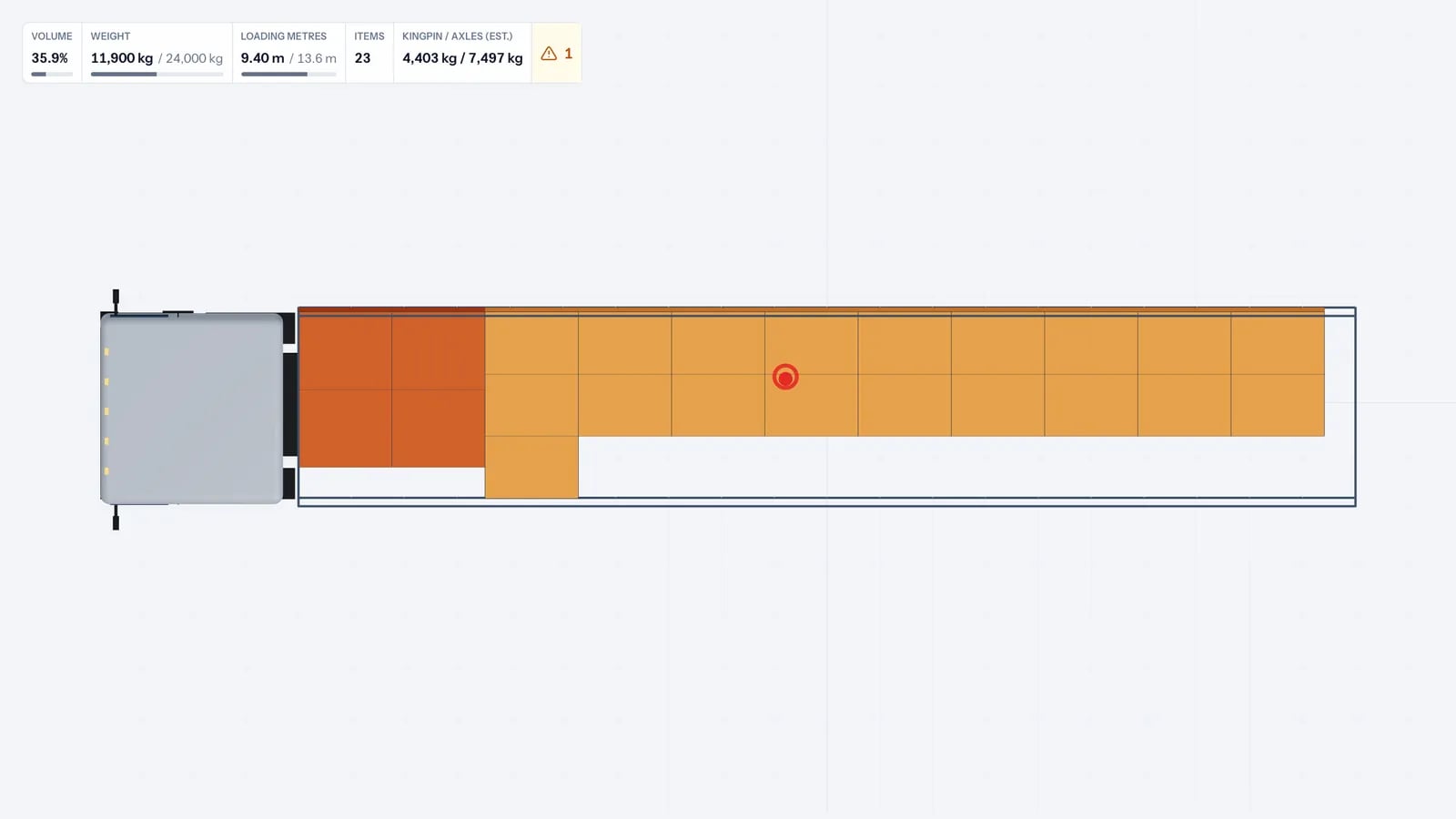
A loading metre (LDM) is one metre of a trailer's floor length used across its full width. To calculate it, multiply the cargo's length by its width in metres and divide by 2.4, the standard internal width of a European trailer: LDM = length × width ÷ 2.4. A Euro pallet (1.2 × 0.8 m) takes 0.4 LDM, and a full 13.6 m trailer is 13.6 LDM.
Loading metres matter because road freight in Europe is often sold by floor space, not by weight or volume. A pallet that cannot have anything stacked on it blocks the floor above it, so the carrier charges for that floor regardless of how light the goods are.
The LDM formula and why it uses 2.4
Most European semitrailers are about 2.45–2.48 m wide inside, and three Euro pallets side by side (3 × 0.8 m) or two industrial pallets crosswise (2 × 1.2 m) fill 2.4 m. The industry therefore uses 2.4 m as the reference width. One loading metre is 1 m × 2.4 m = 2.4 m² of floor.
- 1Measure the footprint of each item in metres (length × width), including any overhang.
- 2Multiply length by width to get the floor area in m².
- 3Divide by 2.4 to get loading metres.
- 4If items are stacked, count only the bottom layer; anything on top uses no extra floor.
- 5Add the results for all items in the shipment.
Good to know
Some carriers round up to the next 0.1 LDM, and some count any non-stackable item as using the full height of the trailer. Read the tariff before quoting.
LDM of common pallets and items
Item: Euro pallet (EUR / EPAL)
- Footprint (m)
- 1.2 × 0.8
- Floor area (m²)
- 0.96
- LDM
- 0.40
Item: Industrial pallet
- Footprint (m)
- 1.2 × 1.0
- Floor area (m²)
- 1.20
- LDM
- 0.50
Item: Half pallet
- Footprint (m)
- 0.8 × 0.6
- Floor area (m²)
- 0.48
- LDM
- 0.20
Item: Quarter pallet
- Footprint (m)
- 0.6 × 0.4
- Floor area (m²)
- 0.24
- LDM
- 0.10
Item: US pallet (48 × 40 in)
- Footprint (m)
- 1.219 × 1.016
- Floor area (m²)
- 1.24
- LDM
- about 0.52
Item: Full 13.6 m trailer
- Footprint (m)
- 13.6 × 2.4
- Floor area (m²)
- 32.64
- LDM
- 13.6
| Item | Footprint (m) | Floor area (m²) | LDM |
|---|---|---|---|
| Euro pallet (EUR / EPAL) | 1.2 × 0.8 | 0.96 | 0.40 |
| Industrial pallet | 1.2 × 1.0 | 1.20 | 0.50 |
| Half pallet | 0.8 × 0.6 | 0.48 | 0.20 |
| Quarter pallet | 0.6 × 0.4 | 0.24 | 0.10 |
| US pallet (48 × 40 in) | 1.219 × 1.016 | 1.24 | about 0.52 |
| Full 13.6 m trailer | 13.6 × 2.4 | 32.64 | 13.6 |
The table assumes items can be placed efficiently next to each other. In reality a single industrial pallet in a part load blocks 1.2 m of length on one side of the trailer, and it only makes sense to count 0.5 LDM if another pallet can share that row. Some carriers price a lone pallet that cannot be paired as using the full row. For more sizes, see the pallet sizes guide.
Worked examples
Example 1: Euro pallets, not stackable. Say you ship 12 Euro pallets of glassware that cannot be stacked. 12 × 0.4 = 4.8 LDM. Loaded three abreast lengthwise, that is 4 rows of 1.2 m, which is exactly 4.8 m of trailer floor.
Example 2: Euro pallets, double-stacked. Same 12 pallets, but they are 110 cm high and can carry another pallet. Six go on the floor and six on top, so the floor use is 6 × 0.4 = 2.4 LDM. Whether the carrier charges 2.4 or 4.8 depends on the tariff: some price the floor used, others price per pallet place.
Example 3: mixed shipment. You ship 5 industrial pallets and 7 Euro pallets, none stackable. 5 × 0.5 + 7 × 0.4 = 2.5 + 2.8 = 5.3 LDM. In the trailer, the industrial pallets loaded two abreast use 3 rows of 1.0 m (the last row has one pallet and a gap), and the Euro pallets use 3 rows of 1.2 m (two full rows of three, one row of one). That is 3.0 + 3.6 = 6.6 m of floor, not 5.3. The gaps in the part-filled rows are real floor that a carrier may charge for or fill with someone else's freight.
Example 4: long item. A crate of 4.0 × 1.1 m: 4.0 × 1.1 ÷ 2.4 = 1.83 LDM. But a 1.1 m wide crate leaves only 1.35–1.38 m beside it, enough for one Euro pallet crosswise (1.2 m) but not two side by side. If nothing fits beside it, the effective use is 4.0 LDM.
Tip
The formula gives floor area. The question that matters for the carrier is how much trailer length your goods block. When in doubt, sketch the rows or let a planner draw them.
How carriers price by loading metre
For part loads and groupage, many European carriers calculate a chargeable weight from three measures and charge whichever is highest:
- Actual weight in kg.
- Volume weight: cubic metres × a factor, commonly in the range of about 250–333 kg per m³ for road freight.
- Loading-metre weight: LDM × a factor, commonly in the range of about 1,500–1,850 kg per LDM.
These factors vary by carrier, country and contract, so treat them as typical ranges rather than standards. Here is how it works with a hypothetical factor of 1,750 kg per LDM and 330 kg per m³:
Shipment: 6 Euro pallets, 1.8 m high, 150 kg each, not stackable
- Actual weight
- 900 kg
- Volume weight
- 6 × 1.728 m³ × 330 = 3,421 kg
- LDM weight
- 2.4 × 1,750 = 4,200 kg
- Chargeable
- 4,200 kg
Shipment: 6 Euro pallets, 1.0 m high, 700 kg each
- Actual weight
- 4,200 kg
- Volume weight
- 6 × 0.96 m³ × 330 = 1,901 kg
- LDM weight
- 2.4 × 1,750 = 4,200 kg
- Chargeable
- 4,200 kg
Shipment: 6 Euro pallets, 1.0 m high, 900 kg each
- Actual weight
- 5,400 kg
- Volume weight
- 1,901 kg
- LDM weight
- 4,200 kg
- Chargeable
- 5,400 kg
| Shipment | Actual weight | Volume weight | LDM weight | Chargeable |
|---|---|---|---|---|
| 6 Euro pallets, 1.8 m high, 150 kg each, not stackable | 900 kg | 6 × 1.728 m³ × 330 = 3,421 kg | 2.4 × 1,750 = 4,200 kg | 4,200 kg |
| 6 Euro pallets, 1.0 m high, 700 kg each | 4,200 kg | 6 × 0.96 m³ × 330 = 1,901 kg | 2.4 × 1,750 = 4,200 kg | 4,200 kg |
| 6 Euro pallets, 1.0 m high, 900 kg each | 5,400 kg | 1,901 kg | 4,200 kg | 5,400 kg |
Light, bulky, non-stackable freight is charged by LDM; dense freight is charged by weight. A pallet of 1.2 × 0.8 × 1.8 m has a volume of 1.728 m³, which is why the volume weight in row one is 6 × 1.728 × 330 ≈ 3,421 kg. For when it is cheaper to book the whole truck, see FTL vs LTL.
Using LDM to plan a full truck
LDM is also the quickest way to see whether a set of orders fits on one trailer. Add the LDM of all non-stacked floor items. If the total is under about 13.2–13.4 LDM for a 13.6 m trailer, it probably fits on the floor, leaving a little tolerance for rows that do not divide evenly. Then check payload, because LDM says nothing about weight.
33 Euro pallets use 33 × 0.4 = 13.2 LDM, which is why 33 is the standard full load for a 13.6 m trailer. The detail of orientations is in how many Euro pallets fit in a trailer.
In EveryLoading, the stats bar above the 3D view shows the loading metres a plan uses next to volume and weight, so you can quote LDM from the plan rather than the formula. The weight and stats manual page explains each figure.
Common mistakes with loading metres
- Counting stacked pallets as floor. Only the bottom layer uses floor.
- Ignoring partial rows. One industrial pallet alone in a row blocks 1.0 m (or 1.2 m) of length on both sides of the trailer if nothing else fits beside it.
- Using external dimensions. Measure the goods including overhang and wrapping, not the pallet alone.
- Forgetting non-stackable rules. A non-stackable item may be priced as if it occupies the full height, which is how LDM pricing already works.
- Assuming every trailer is 13.6 m. Rigid trucks, vans and some trailers are shorter; use the actual internal length.
Frequently asked questions
How many loading metres is a Euro pallet?
0.4 LDM: 1.2 m × 0.8 m = 0.96 m², divided by 2.4. An industrial pallet of 1.2 × 1.0 m is 0.5 LDM.
How many loading metres is a full truck?
A standard semitrailer is about 13.6 m long inside, so a full trailer is 13.6 LDM. Rigid trucks have fewer, depending on body length.
Do stacked pallets count towards loading metres?
Only the bottom layer uses floor space, so stacked pallets add no LDM. Some carriers price per pallet place instead, so check the tariff.
What is the LDM-to-kg conversion factor?
It is set by each carrier, commonly somewhere between about 1,500 and 1,850 kg per loading metre. The carrier charges the highest of actual, volume and LDM weight.
Keep reading
Load planning basics · · 5 min read
FTL vs LTL: Full Truckload, Part Load or Groupage?
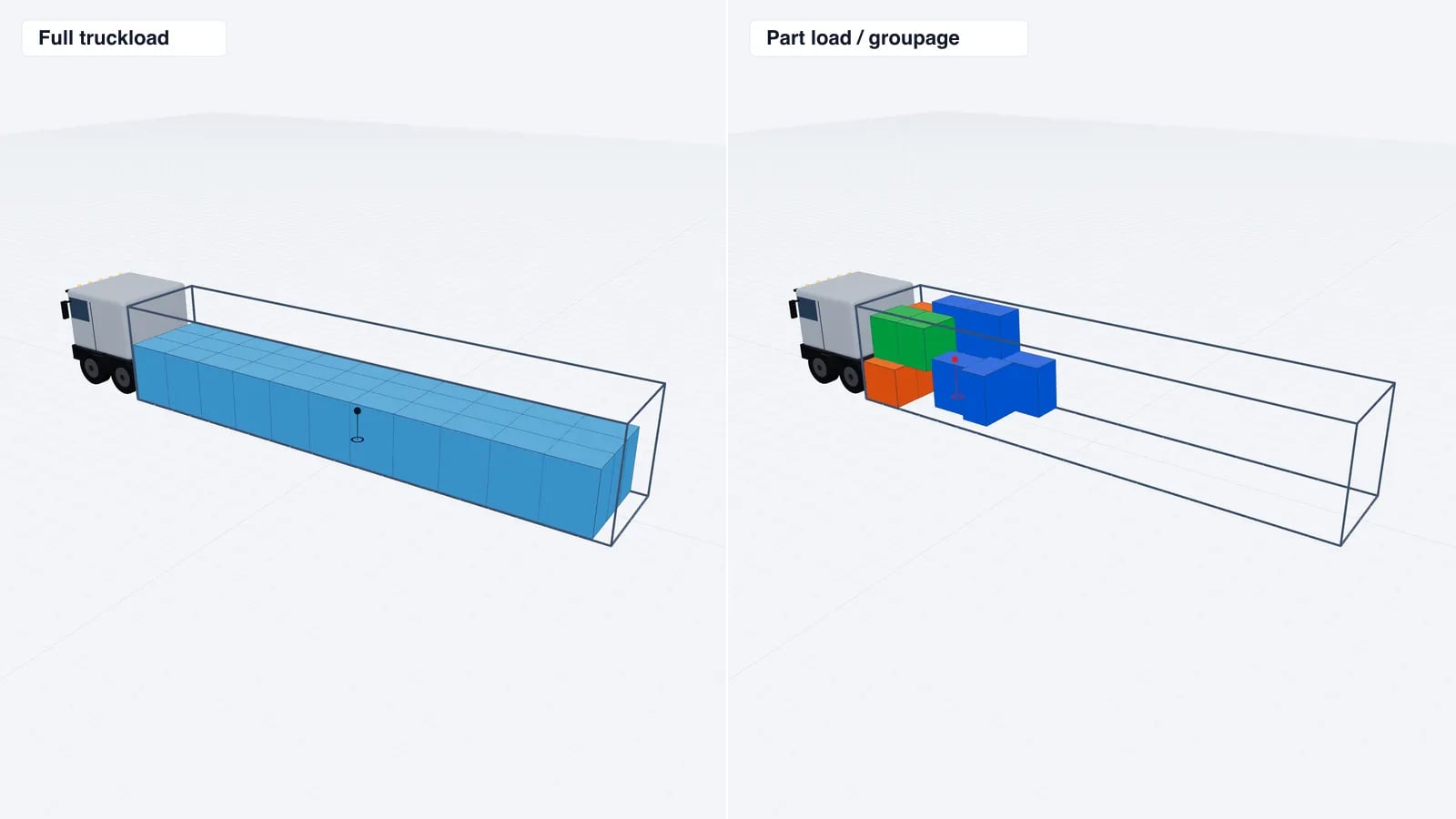
FTL books a whole truck; LTL and groupage share it with other shippers. Compare cost, speed and handling, see how LDM drives LTL price and find your break-even.
Read article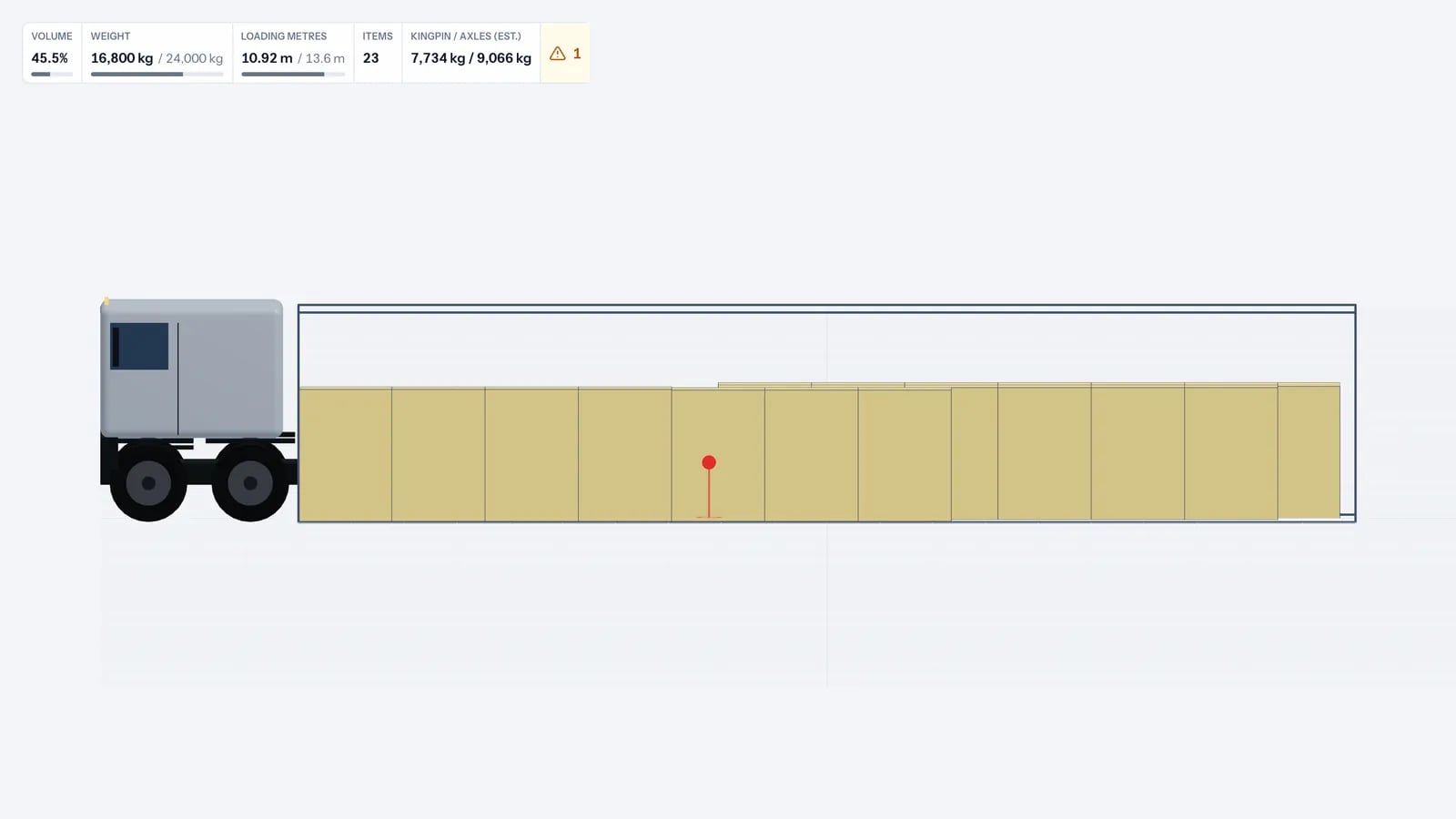
Load planning basics · · 6 min read
Weight Distribution in a Trailer: Axle Loads Made Simple
Where you put heavy cargo decides the load on each axle. Learn how trailer weight distribution works, how to estimate axle loads and how to avoid overloading.
Read article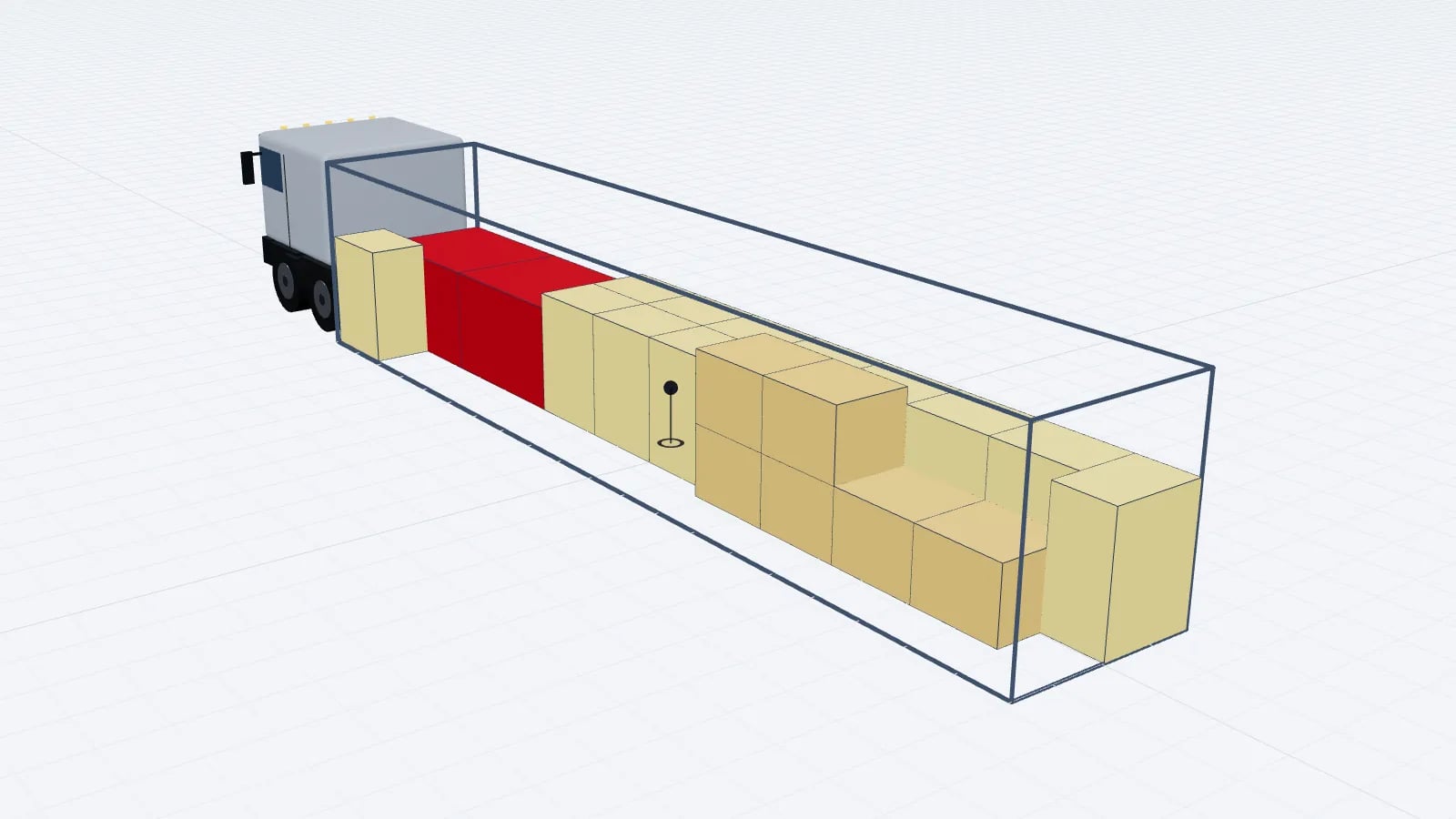
Load planning basics · · 5 min read
Load Centre of Gravity: How to Calculate It for a Truck Load
The centre of gravity of a load is the weighted average of every item's position. Learn the formula, a worked truck example and checks for lateral offset.
Read article