Pallet Sizes Guide: Euro, Industrial, US and Asian Pallets
Standard pallet sizes compared: EUR/EPAL 1200×800, industrial 1200×1000, half and quarter pallets, US 48×40 and Asian 1100×1100, with loads and truck counts.
Load planning basics · · 6 min read
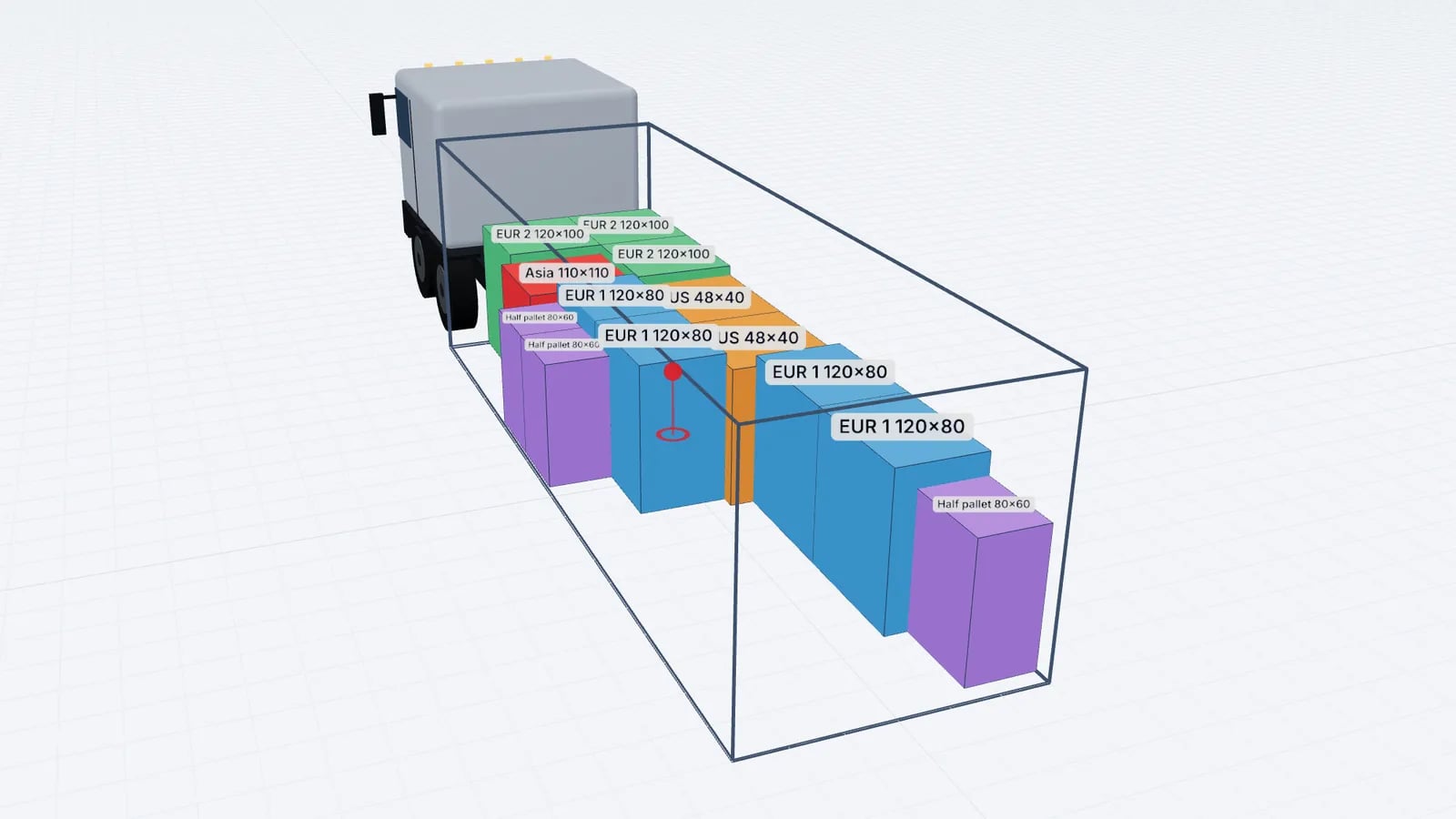
The most common pallet sizes are the Euro pallet (EUR / EPAL, 1200 × 800 mm) and the industrial pallet (1200 × 1000 mm) in Europe, the 48 × 40 inch pallet (1219 × 1016 mm) in North America, and 1100 × 1100 mm in parts of Asia. ISO 6780 recognises six standard footprints, and half and quarter pallets are widely used for retail deliveries.
Pallet size decides how many pallets fit on a truck or in a container, how much floor space you pay for and how well a mixed load can be packed. Getting the footprint right in the packing list is the first step of any load plan.
Standard pallet dimensions at a glance
Pallet: Euro pallet (EUR 1 / EPAL 1)
- Size (mm)
- 1200 × 800 × 144
- Main regions
- Europe
- Notes
- The reference pallet for European road freight
Pallet: Industrial pallet (EUR 2 / EPAL 2)
- Size (mm)
- 1200 × 1000
- Main regions
- Europe, UK, Asia
- Notes
- Common for chemicals, paper, export
Pallet: EUR 3 / EPAL 3
- Size (mm)
- 1000 × 1200
- Main regions
- Europe
- Notes
- Same footprint as industrial, boards run the other way
Pallet: Half pallet (EUR 6)
- Size (mm)
- 800 × 600
- Main regions
- Europe
- Notes
- Retail and display, store deliveries
Pallet: Quarter pallet
- Size (mm)
- 600 × 400
- Main regions
- Europe
- Notes
- Promotional displays, often plastic
Pallet: North American (GMA)
- Size (mm)
- 1219 × 1016 (48 × 40 in)
- Main regions
- USA, Canada
- Notes
- Most common US grocery pallet
Pallet: Square 42 in
- Size (mm)
- 1067 × 1067
- Main regions
- North America, some others
- Notes
- Drums, paint, telecoms
Pallet: Asian square
- Size (mm)
- 1100 × 1100
- Main regions
- Japan, Korea, parts of Asia
- Notes
- Fits Asian container patterns
Pallet: Australian
- Size (mm)
- 1165 × 1165
- Main regions
- Australia
- Notes
- Matched to Australian rail and freight
| Pallet | Size (mm) | Main regions | Notes |
|---|---|---|---|
| Euro pallet (EUR 1 / EPAL 1) | 1200 × 800 × 144 | Europe | The reference pallet for European road freight |
| Industrial pallet (EUR 2 / EPAL 2) | 1200 × 1000 | Europe, UK, Asia | Common for chemicals, paper, export |
| EUR 3 / EPAL 3 | 1000 × 1200 | Europe | Same footprint as industrial, boards run the other way |
| Half pallet (EUR 6) | 800 × 600 | Europe | Retail and display, store deliveries |
| Quarter pallet | 600 × 400 | Europe | Promotional displays, often plastic |
| North American (GMA) | 1219 × 1016 (48 × 40 in) | USA, Canada | Most common US grocery pallet |
| Square 42 in | 1067 × 1067 | North America, some others | Drums, paint, telecoms |
| Asian square | 1100 × 1100 | Japan, Korea, parts of Asia | Fits Asian container patterns |
| Australian | 1165 × 1165 | Australia | Matched to Australian rail and freight |
The six ISO 6780 footprints are 1200 × 800, 1200 × 1000, 1219 × 1016, 1165 × 1165, 1100 × 1100 and 1067 × 1067 mm. Heights vary by design; an EPAL Euro pallet is 144 mm high. Pallet weight also varies: a wooden Euro pallet is typically around 25 kg, an industrial pallet somewhat more, and plastic pallets can be much lighter or heavier depending on the design.
Good to know
In the UK, a 1200 × 1000 mm pallet is often called a GKN pallet, a name that comes from the original pooled-pallet operator. If a UK customer says GKN, plan it as 1200 × 1000.
Load capacity: what a pallet can carry
Pallet capacity is usually given in three ways, and they differ a lot:
- Dynamic load: what the pallet can carry while being moved by a forklift or pallet truck. For an EPAL Euro pallet the safe working load is commonly quoted as 1,500 kg evenly distributed.
- Static load: what it can carry standing on a flat floor, which is much higher. For the Euro pallet, up to about 4,000 kg is commonly quoted for the bottom pallet of a stack on a flat, level surface.
- Racking load: what it can carry when supported only at its edges in a rack, which is lower and depends on the rack design.
These figures are for the pallet only and come from the pallet maker or pool operator, so check the specification for the pallets you use. In practice, the goods on the pallet are usually weaker than the pallet: a stack of cartons often limits what can go on top long before the wood does. See pallet stacking rules.
How pallet size affects truck and container capacity
Pallet: Euro 1200 × 800
- 13.6 m semitrailer (floor)
- 33
- LDM per pallet
- 0.40
- 20 ft container (floor)
- 11
- 40 ft container (floor)
- 23 to 25
Pallet: Industrial 1200 × 1000
- 13.6 m semitrailer (floor)
- 26
- LDM per pallet
- 0.50
- 20 ft container (floor)
- 9 or 10
- 40 ft container (floor)
- 20 or 21
Pallet: US 48 × 40 in
- 13.6 m semitrailer (floor)
- 24 to 26
- LDM per pallet
- about 0.52
- 20 ft container (floor)
- 9 or 10
- 40 ft container (floor)
- 20 or 21
Pallet: Half 800 × 600
- 13.6 m semitrailer (floor)
- 66 (as half-pallet pairs)
- LDM per pallet
- 0.20
- 20 ft container (floor)
- depends on pattern
- 40 ft container (floor)
- depends on pattern
| Pallet | 13.6 m semitrailer (floor) | LDM per pallet | 20 ft container (floor) | 40 ft container (floor) |
|---|---|---|---|---|
| Euro 1200 × 800 | 33 | 0.40 | 11 | 23 to 25 |
| Industrial 1200 × 1000 | 26 | 0.50 | 9 or 10 | 20 or 21 |
| US 48 × 40 in | 24 to 26 | about 0.52 | 9 or 10 | 20 or 21 |
| Half 800 × 600 | 66 (as half-pallet pairs) | 0.20 | depends on pattern | depends on pattern |
Trailer figures assume a standard internal size of about 13.6 × 2.45 m; container figures assume about 2.35 m internal width and vary with the pattern and the exact container. US pallets in a European trailer are tricky because two 1219 mm sides add up to 2.44 m, which leaves almost no tolerance in a 2.45 m wide trailer; one more centimetre of overhang and the pattern fails. Details are in how many Euro pallets fit in a trailer and how many pallets fit in a container.
Half and quarter pallets
A half pallet (800 × 600 mm) is exactly half a Euro pallet, and a quarter pallet (600 × 400 mm) is a quarter. Two half pallets side by side occupy the footprint of one Euro pallet, so they slot into the standard 3-abreast trailer pattern without loss.
Their downside is weight per floor area. A half pallet built to 1.6 m high is tall and narrow and can tip in transit, so loaders often band two together or keep them in blocks. Some carriers charge half and quarter pallets as a fraction of a Euro pallet place, others charge a minimum; check the tariff.
Worked example: choosing the right pallet for an export order
Say a manufacturer ships cartons of 40 × 30 × 25 cm, 8 kg each, and can build them on either Euro or industrial pallets to a height of 1.2 m including the pallet.
- Usable stack height: 120 − 14.4 = 105.6 cm, so 4 layers of 25 cm (100 cm), giving a 114.4 cm total height.
- Euro pallet (120 × 80): 120 ÷ 30 = 4 and 80 ÷ 40 = 2, so 8 cartons per layer, which is also the maximum by area (9,600 cm² ÷ 1,200 cm²). 4 layers = 32 cartons, 256 kg plus the pallet.
- Industrial pallet (120 × 100): a simple pattern gives 9 per layer (3 × 3, using 90 cm of the width). A mixed pattern does better: one strip of 40 cm holding 4 cartons turned 30 cm along the length, plus two strips of 30 cm holding 3 cartons each (40 + 30 + 30 = 100 cm). That is 10 per layer, 40 cartons, 320 kg plus the pallet.
Per trailer: 33 Euro pallets × 32 = 1,056 cartons; 26 industrial pallets × 40 = 1,040 cartons. The Euro pallet wins narrowly, even though each industrial pallet carries more, and only because the industrial pallet uses the mixed pattern; with the simple 3 × 3 pattern it would be 26 × 36 = 936. For a different carton the answer can flip, so run the numbers for your own carton size.
Tip
When a customer can choose the pallet, test both footprints against the vehicle you actually use. A pallet that packs well on its own can still lose a whole row in the truck.
Practical tips
- Record the footprint, not the pallet name, in your packing list. Call it 120 × 80 rather than EUR, so there is no confusion with EUR 3 or a US pallet.
- Include overhang. If cartons overhang the pallet edge, the pallet's footprint for planning is the carton footprint.
- Include the pallet height (around 14–16 cm for wooden pallets) in the total height.
- Note pallet type for exports. Many countries require heat-treated, ISPM 15 marked wooden pallets for imports; check the destination rules.
Frequently asked questions
What is the size of a Euro pallet?
1200 × 800 mm with a height of 144 mm for the EPAL Euro pallet. It uses 0.4 loading metres in a European trailer.
What is the difference between a Euro pallet and an industrial pallet?
The industrial pallet is 200 mm wider: 1200 × 1000 mm instead of 1200 × 800 mm. A 13.6 m trailer takes 26 industrial pallets against 33 Euro pallets.
What is the standard US pallet size?
48 × 40 inches, which is 1219 × 1016 mm. It is slightly larger than an industrial pallet and tight to fit two abreast in European trailers.
How much weight can a Euro pallet hold?
A safe working load of 1,500 kg evenly distributed is commonly quoted for the EPAL Euro pallet when moved, and more when standing on a flat floor. The goods on the pallet often limit stacking before the pallet does.
Keep reading
Load planning basics · · 5 min read
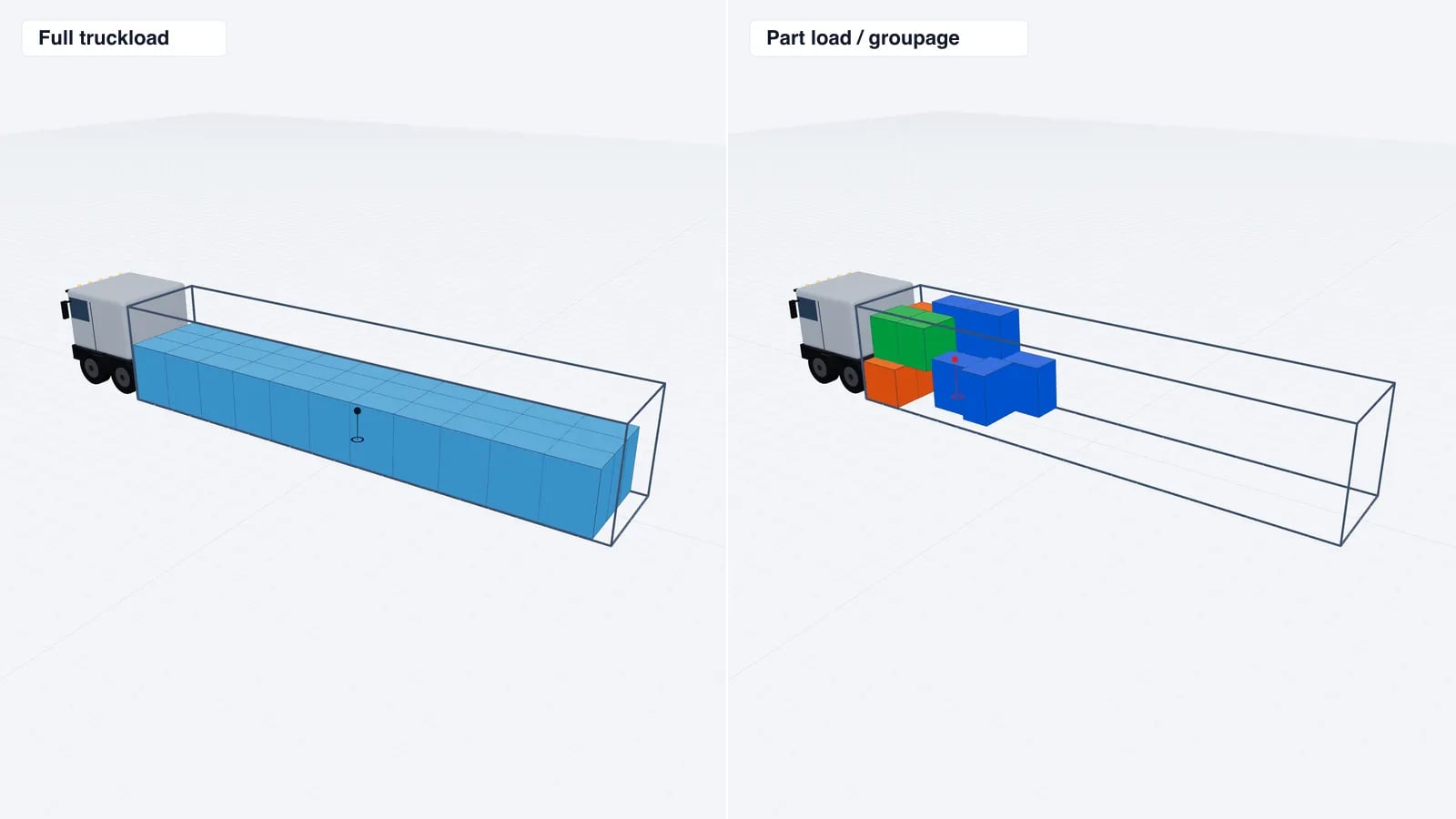
FTL vs LTL: Full Truckload, Part Load or Groupage?
FTL books a whole truck; LTL and groupage share it with other shippers. Compare cost, speed and handling, see how LDM drives LTL price and find your break-even.
Read article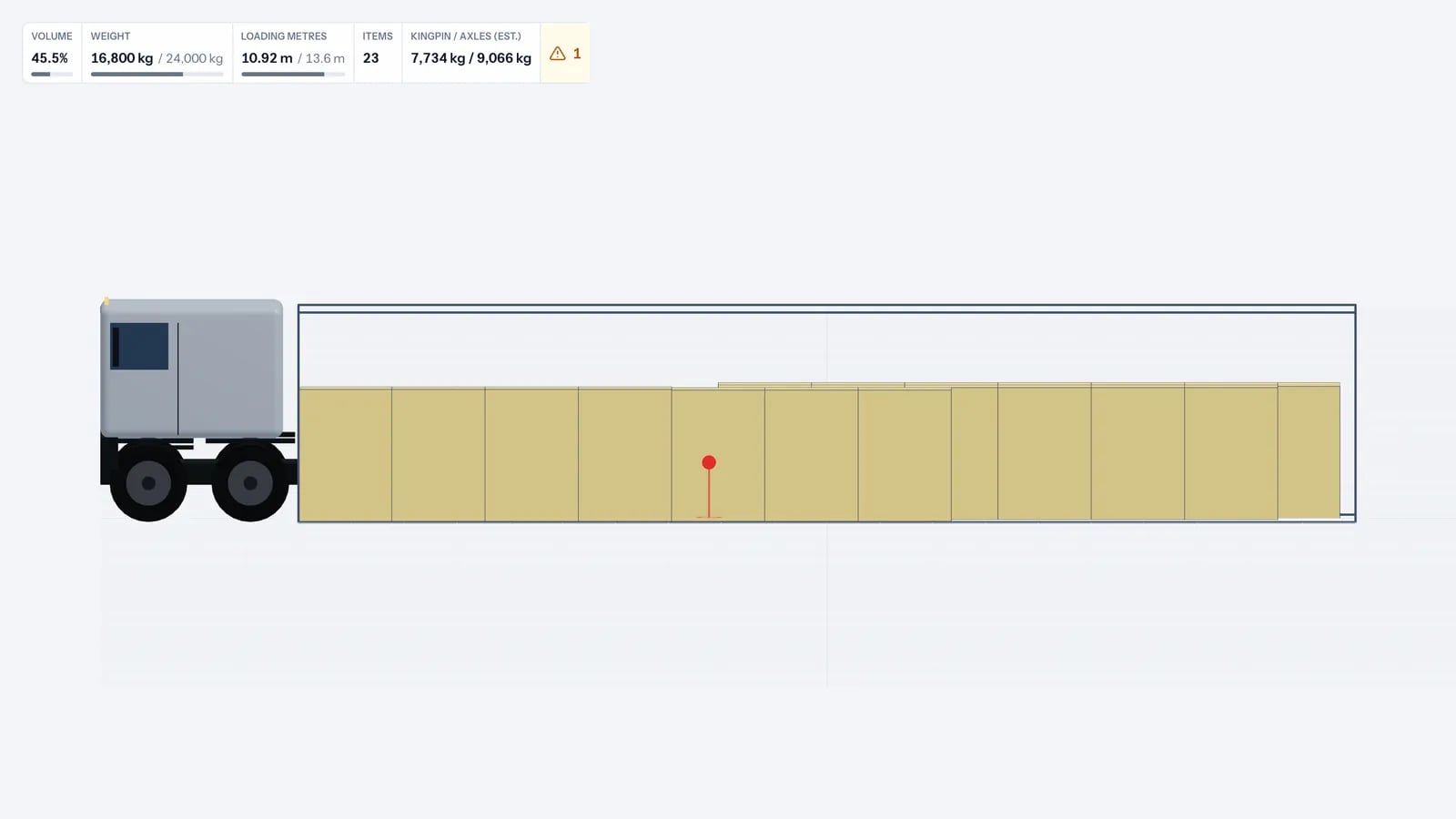
Load planning basics · · 6 min read
Weight Distribution in a Trailer: Axle Loads Made Simple
Where you put heavy cargo decides the load on each axle. Learn how trailer weight distribution works, how to estimate axle loads and how to avoid overloading.
Read article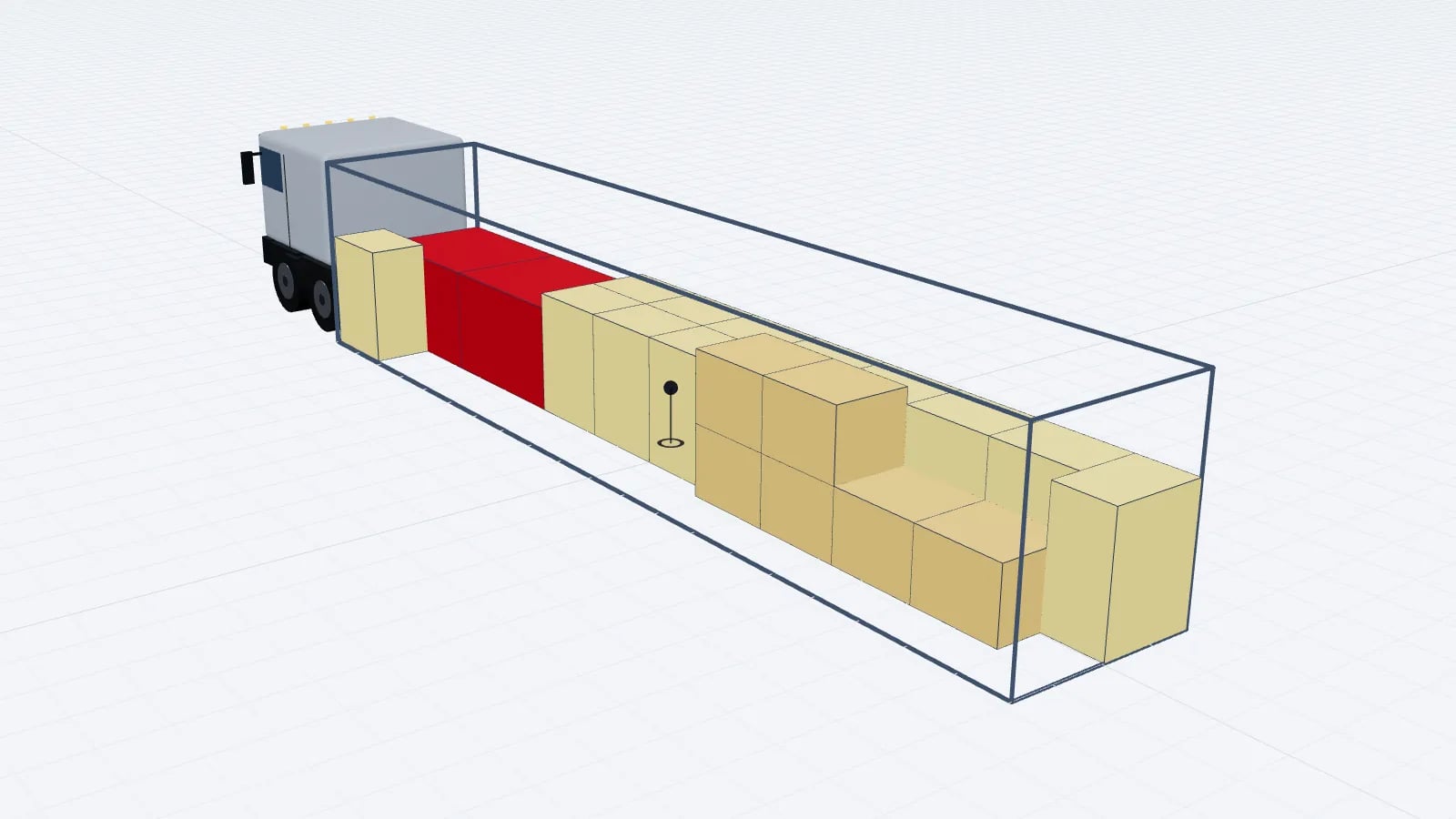
Load planning basics · · 5 min read
Load Centre of Gravity: How to Calculate It for a Truck Load
The centre of gravity of a load is the weighted average of every item's position. Learn the formula, a worked truck example and checks for lateral offset.
Read article