Truck Fill Rate: How to Reduce Empty Space in Trucks
Why trucks leave half empty and how to raise truck fill rate: measure floor, volume and weight use, fix mixed pallet heights, rotate items, combine part loads.
Road freight · · 5 min read
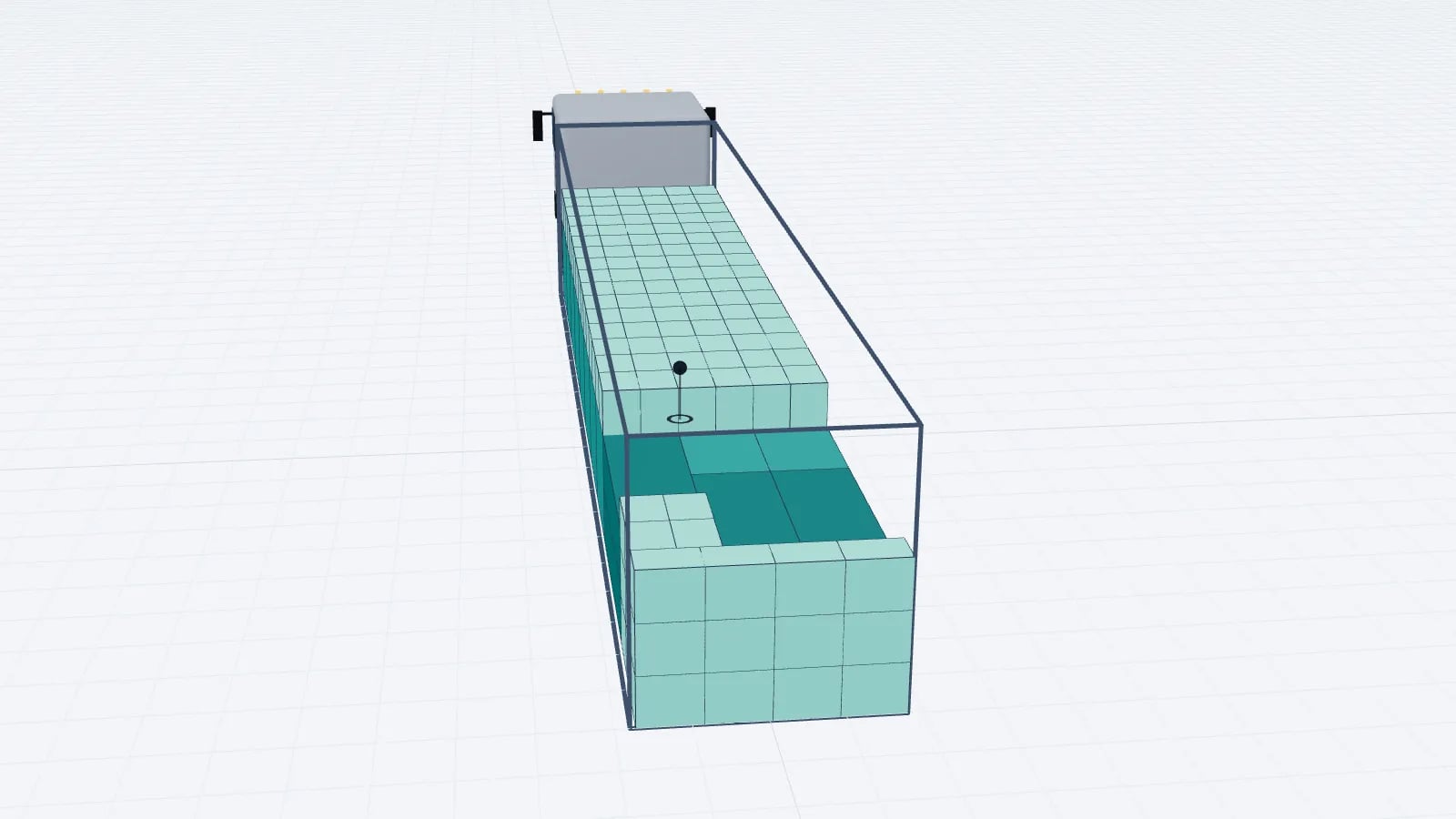
Truck fill rate is how much of a vehicle's capacity a load actually uses, measured by floor (loading metres), volume or weight. To reduce empty space, first find out which of the three limits the load, then attack the causes: low pallets that cannot be stacked, awkward sizes, poor rotation and part loads that are never combined.
There is no single "right" fill rate. A trailer full of beverages is full on weight with half the volume empty, and that is correct. Empty space is only waste when you could have used it.
Three ways to measure fill
Measure: Floor (LDM) fill
- Formula
- loading metres used ÷ loading metres available
- Good for
- Palletised goods that cannot be stacked
Measure: Volume fill
- Formula
- cargo volume ÷ internal volume
- Good for
- Light, stackable cartons and bulky goods
Measure: Weight fill
- Formula
- cargo weight ÷ payload
- Good for
- Dense goods: drinks, steel, paper, building materials
| Measure | Formula | Good for |
|---|---|---|
| Floor (LDM) fill | loading metres used ÷ loading metres available | Palletised goods that cannot be stacked |
| Volume fill | cargo volume ÷ internal volume | Light, stackable cartons and bulky goods |
| Weight fill | cargo weight ÷ payload | Dense goods: drinks, steel, paper, building materials |
Track all three and report the highest one as the "binding" constraint. A load that is at 98% of payload is full, whatever its volume figure says. For the KPI side of this, see truck fill rate KPI; for loading metres, see loading metres explained.
Worked example: why volume fill looks bad
Say a 13.6 × 2.45 × 2.7 m curtainsider carries 24 Euro pallets, each 1.20 m high, non-stackable.
- 1Trailer volume: 13.6 × 2.45 × 2.7 ≈ 89.96 m³.
- 2Cargo volume: 24 × (1.2 × 0.8 × 1.2) = 24 × 1.152 = 27.65 m³, so volume fill is about 31%.
- 3Floor: 24 × 0.4 = 9.6 loading metres of 13.6, so floor fill is about 71%.
- 4If the pallets were stackable, 12 floor positions double-stacked (2.40 m plus clearance fits under 2.7 m) would use 4.8 loading metres and leave 8.8 m for other freight.
The 31% volume figure is not wrong, but it tells you nothing useful: the real lever here is stackability, not packing smarter on the floor.
The usual causes of wasted space
- Non-stackable by default. Items flagged "do not stack" because nobody checked, when the packaging could carry a second pallet. See pallet stacking rules.
- Mixed pallet heights. A 1.0 m pallet next to a 1.8 m pallet leaves a 0.8 m gap on top of the short one. Pairing low pallets on top of each other closes that gap.
- Wrong orientation. Industrial pallets (1200 × 1000 mm) loaded lengthwise, two abreast, use only 2.0 m of the width and 1.2 m of length per row: 11 rows, 22 pallets. Turned crosswise they use 2.4 m of width and 1.0 m per row: 13 rows, 26 pallets.
- No rotation of cartons. Cartons that may lie on their side often fill the last gap by the doors.
- Oversized packaging. Pallets with overhang, or cartons with air inside, push otherwise good loads over the limit.
- Part loads never combined. Two trucks each 55% full on the same lane on the same day.
- Loading by hand without a plan. The forklift driver loads what arrives first, and the last pallets do not fit.
Practical ways to raise fill rate
- 1Record real dimensions, weights and stackability for every item. You cannot plan with "approx. one pallet".
- 2Check which limit binds for each load (floor, volume or weight) before trying to improve it.
- 3Allow rotation where the goods permit it, and set "this side up" only where it is genuinely needed.
- 4Group pallets by height so low pallets stack together and tall ones go side by side.
- 5Use the trailer that suits the cargo: a mega trailer for light, tall pallets; a standard trailer for dense loads. See mega trailer vs standard trailer.
- 6Combine part loads on the same lane, and offer spare loading metres as groupage.
- 7Review loads that left with significant free space and find out why.
Mixed heights: a quick example
Say a load has 10 Euro pallets at 1.80 m and 10 at 1.00 m, all stackable, in a 2.70 m trailer. Loaded as they come, that is 20 floor positions, or 8.0 loading metres. Stacking the low pallets in pairs (2.00 m plus clearance) turns 10 positions into 5, and the tall pallets cannot take anything on top (1.80 + 1.00 = 2.80 m). The result is 15 positions and 6.0 loading metres: 2 m of floor freed by sorting pallets by height, without any change to the goods.
Why 100% is unrealistic
Even a perfect plan leaves some space: pallets are not exact multiples of the trailer width, items need a little clearance to be loaded with a forklift, stacking height is limited by the weakest packaging, and payload usually runs out on dense goods. Multi-drop routes also trade some fill for unloading order. Aim for a fill that is close to the binding limit for each load, not for an arbitrary number across all of them.
Partial loads: the space you can sell
When a load really does use only part of the trailer, the free floor is a product. Plan the load tightly against the front wall, record the free loading metres and the remaining payload, and pass that to whoever sells groupage. That only works if the plan is accurate: a figure of "about 4 metres free" that turns out to be 3.2 m costs you the next load. For pricing logic see FTL vs LTL.
Tip
In EveryLoading the stats bar shows volume used, weight against payload and loading metres together, so you can see the binding limit at a glance. Mark items as non-stackable or non-rotatable only where needed in cargo settings, then press Optimize load.
Frequently asked questions
How do you calculate truck fill rate?
Divide what the load uses by what the vehicle offers, for floor (loading metres), volume and weight separately. The highest of the three shows which limit binds.
What is a good truck fill rate?
One that is close to the binding limit for that load. A trailer at full payload is full even if its volume fill looks low.
Why do trucks run with empty space?
Common reasons are pallets that cannot or are not allowed to stack, mixed heights, poor orientation, and part loads that are not combined with other freight on the same lane.
Does rotating pallets increase capacity?
Often. Industrial pallets loaded crosswise fit 26 in a 13.6 m trailer against 22 lengthwise. For cartons, allowing rotation lets the planner fill gaps by the doors and under the roof.
Keep reading
Road freight · · 5 min read
Multi Drop Loading: How to Plan a Truck for Several Stops
Plan a multi-drop truck so every stop unloads without moving other cargo: LIFO order, lanes, stop numbers, axle loads after each drop and a worked example.
Read article
Road freight · · 5 min read
Load Securing Basics: EN 12195-1, Friction, Lashing, Blocking
The principles of load securing under EN 12195-1: design forces, friction, blocking, lashing, body strength, and how a gap-free load plan cuts securing effort.
Read article
Road freight · · 5 min read
Double Stacking Pallets in Trailers: Height, Weight, Stability
When you can double stack pallets in a trailer: maximum pallet heights in standard and mega trailers, weight on the bottom pallet, payload and stability.
Read article