Rigid Truck vs Articulated Lorry: Capacity and When to Use Each
Rigid truck vs articulated lorry: body lengths, Euro pallet counts, typical payloads, access and cost logic, with worked examples to pick the right vehicle.
Road freight · · 5 min read
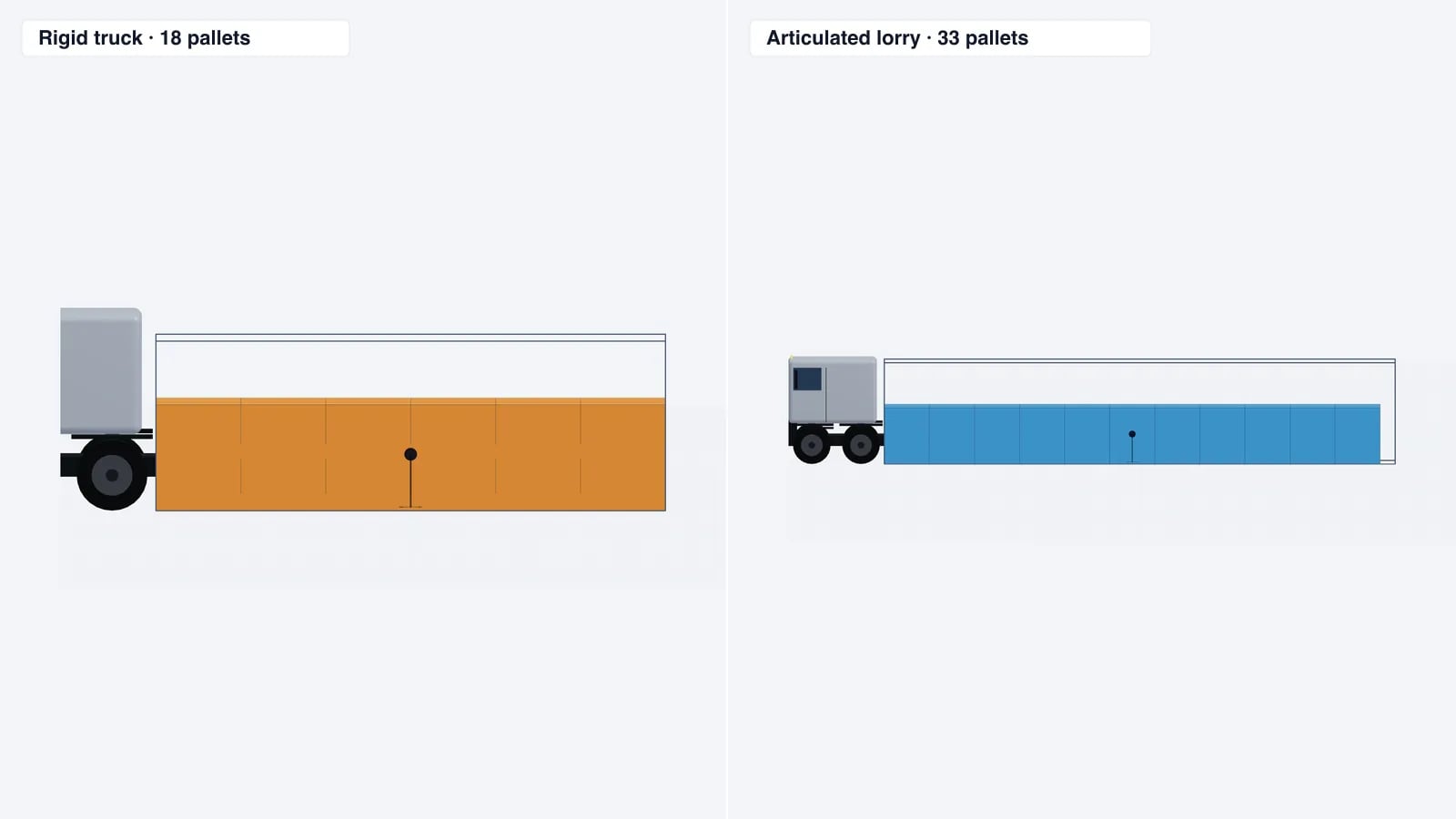
A rigid (solo) truck carries its body on one chassis, typically 6–8 m long with room for 12–19 Euro pallets and 5–15 t of cargo depending on its size. An articulated lorry (tractor and semitrailer) carries 33 Euro pallets and around 24–25 t. Choose the rigid when the load is small, the access is tight or the route has many drops in town; choose the artic when the load needs the space or the weight.
Typical capacities
Vehicle: 7.5 t rigid
- Typical body length
- 5.5–6.2 m
- Euro pallets (floor)
- 12–15
- Typical payload
- 2.5–3.5 t
Vehicle: 12 t rigid (two axles)
- Typical body length
- 6.0–7.2 m
- Euro pallets (floor)
- 14–18
- Typical payload
- 4–6 t
Vehicle: 18 t rigid (two axles)
- Typical body length
- 7.2–7.7 m
- Euro pallets (floor)
- 18–19
- Typical payload
- 8–10 t
Vehicle: 26 t rigid (three axles)
- Typical body length
- 7.7–9.5 m
- Euro pallets (floor)
- 19–23
- Typical payload
- 13–16 t
Vehicle: Rigid with drawbar trailer (road train)
- Typical body length
- 2 × 7.2–7.7 m
- Euro pallets (floor)
- 36–38
- Typical payload
- 22–25 t
Vehicle: Articulated (tractor and 13.6 m semitrailer)
- Typical body length
- 13.6 m
- Euro pallets (floor)
- 33
- Typical payload
- 24–25 t
| Vehicle | Typical body length | Euro pallets (floor) | Typical payload |
|---|---|---|---|
| 7.5 t rigid | 5.5–6.2 m | 12–15 | 2.5–3.5 t |
| 12 t rigid (two axles) | 6.0–7.2 m | 14–18 | 4–6 t |
| 18 t rigid (two axles) | 7.2–7.7 m | 18–19 | 8–10 t |
| 26 t rigid (three axles) | 7.7–9.5 m | 19–23 | 13–16 t |
| Rigid with drawbar trailer (road train) | 2 × 7.2–7.7 m | 36–38 | 22–25 t |
| Articulated (tractor and 13.6 m semitrailer) | 13.6 m | 33 | 24–25 t |
Good to know
Payloads vary widely with body type, tail lift, cab and fuel tanks, so take these as typical ranges. Check the plated weights of the actual vehicle.
How the pallet counts work
The internal width of most rigid bodies is about 2.45–2.48 m, the same as a semitrailer, so Euro pallets go three abreast lengthwise (1.2 m per row) or two abreast crosswise (0.8 m per row). Mixing the two orientations squeezes the most out of each body length:
- 7.2 m body: 6 lengthwise rows (6 × 1.2 = 7.2 m) give 18 pallets.
- 7.45 m swap body: still 18. The best mixes, such as 4 lengthwise and 3 crosswise rows (4.8 + 2.4 = 7.2 m), reach 18, and the remaining 25 cm is too short for another row.
- 7.7 m body: 5 lengthwise rows and 2 crosswise rows (6.0 + 1.6 = 7.6 m) give 15 + 4 = 19 pallets.
- 8.0 m body: 10 crosswise rows (10 × 0.8 = 8.0 m) give 20 pallets.
For the semitrailer equivalents, see how many Euro pallets fit in a trailer.
When a rigid truck is the better choice
- The load is small. Ten pallets in a 33-pallet trailer means paying to move two-thirds of empty space, unless you can add groupage.
- Access is tight. City centres, narrow yards, retail delivery bays and building sites often cannot take a 16.5 m artic. Some urban areas restrict vehicle length or weight.
- There are many drops. A shorter vehicle parks and manoeuvres faster, and a tail lift lets the driver unload where there is no dock or forklift.
- Unloading equipment is needed. Tail lifts, loader cranes and moffett mounts are much more common on rigids.
- Licensing. Vehicles up to 7.5 t can be driven on a C1 licence in the EU, which widens the pool of drivers.
When the articulated lorry wins
- Full or near-full loads over longer distances: one driver moves 33 pallets instead of 18.
- Heavy loads: an artic carries about 24–25 t against 8–10 t for an 18 t rigid.
- Long items: anything over about 7.5 m needs the trailer's 13.6 m floor.
- Flexibility: the tractor can drop a trailer for loading and leave with another, so the truck does not wait at the dock.
A rigid with a drawbar trailer sits in between: 36–38 pallets, often more than an artic, and the option to leave the trailer and do the last kilometres with the rigid alone. It is longer, harder to reverse and needs a driver used to it.
Worked example: 16 pallets, weight first
Say you need to deliver 16 Euro pallets of bottled water, 750 kg each, to a supermarket with a small rear yard.
- 1Floor: 16 pallets fit on a 7.2 m body (capacity 18).
- 2Weight: 16 × 750 = 12,000 kg. An 18 t rigid with a payload around 9 t cannot carry it.
- 3Options: a 26 t three-axle rigid (payload around 14 t) if the yard allows it; or an artic, which carries the weight easily but uses only 6.4 of 13.6 loading metres and may not fit the yard.
- 4If neither fits the site, split into two rigid trips: 10 pallets (7,500 kg) and 6 pallets (4,500 kg).
Dense loads like this hit weight before floor space, so always check payload as well as pallet count. Light, bulky loads tend to run out of height and floor first.
Cost logic without guessing prices
Rates vary too much by country and lane to quote, but the comparison is always the same. Work out the cost per pallet or per loading metre for each option: the trip price divided by what the load actually uses. An artic carrying 30 pallets spreads its cost over three times as many pallets as a rigid carrying 10, so it wins on full loads. A rigid carrying 16 pallets to a city-centre shop it can actually reach often wins on part loads, because the artic would run mostly empty or need a transshipment. For a structured way to compare, see FTL vs LTL.
Planning tips
- Watch both axles on a rigid. The front axle usually has a much lower plated limit than the rear, too little weight on it hurts steering and braking, and a tail lift adds weight behind the rear axle.
- On a part-loaded rigid, keep heavy pallets near the middle of the body, not all at the doors or the headboard. See weight distribution in a trailer.
- If you regularly have 18–20 pallet loads, compare a 7.7 m body (19 pallets) with a 7.2 m body (18). One extra pallet per trip adds up.
- When a load does not fit one vehicle, see whether two rigids or one artic is cheaper on that lane, not only which one fits.
Tip
EveryLoading has presets for solo trucks as well as semitrailers. Plan the same cargo in both and compare the stats bar; for a rigid, the axle estimate shows front and rear axle loads. See choosing a vehicle.
Frequently asked questions
How many pallets fit in an 18 tonne truck?
Usually 18 Euro pallets on a 7.2 m body and 19 on a 7.7 m body. The payload of roughly 8–10 t often limits heavy loads before floor space does.
Is a rigid truck cheaper than an articulated lorry?
Per trip it is usually cheaper to run, but per pallet a full artic is normally more economical. For small loads, tight access or many drops the rigid often wins overall.
What is a drawbar combination?
A rigid truck towing a separate drawbar trailer. With two bodies of about 7.2–7.7 m it takes 36–38 Euro pallets and can uncouple the trailer for city deliveries.
Can a rigid truck carry 33 pallets?
Not on a single body within EU length limits. You need a semitrailer or a rigid with a drawbar trailer.
Keep reading
Road freight · · 5 min read
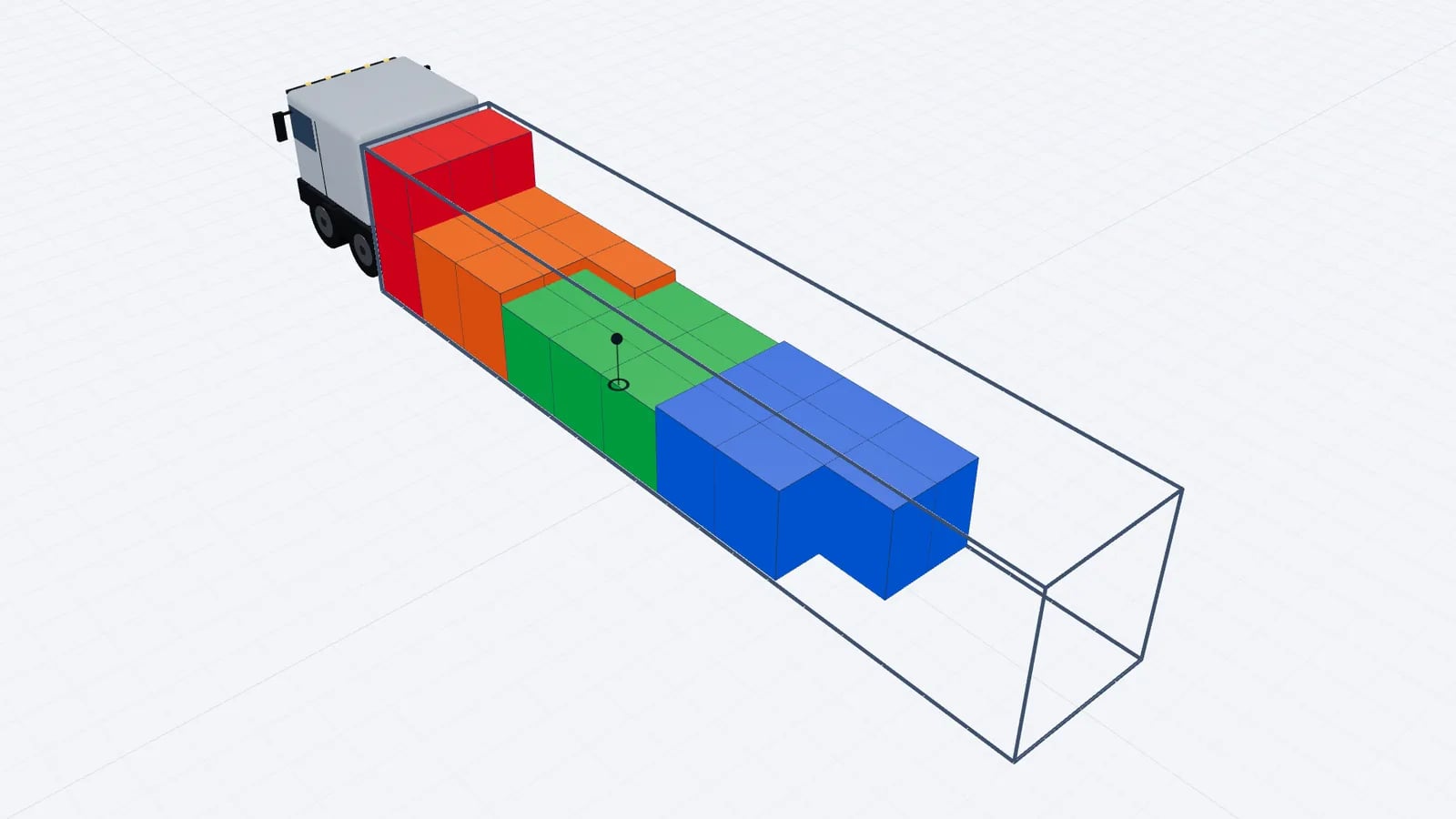
Multi Drop Loading: How to Plan a Truck for Several Stops
Plan a multi-drop truck so every stop unloads without moving other cargo: LIFO order, lanes, stop numbers, axle loads after each drop and a worked example.
Read article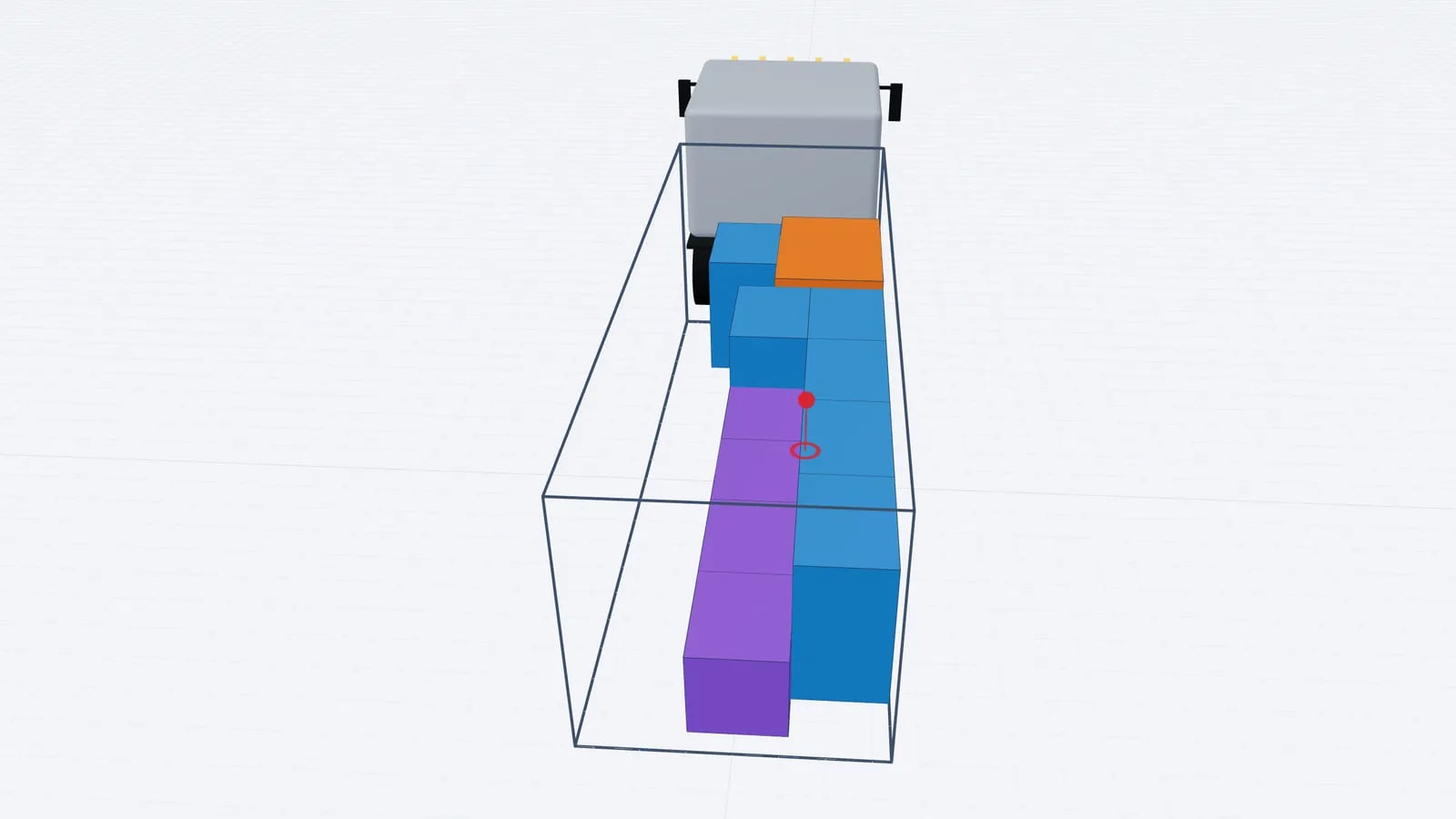
Road freight · · 5 min read
Load Securing Basics: EN 12195-1, Friction, Lashing, Blocking
The principles of load securing under EN 12195-1: design forces, friction, blocking, lashing, body strength, and how a gap-free load plan cuts securing effort.
Read article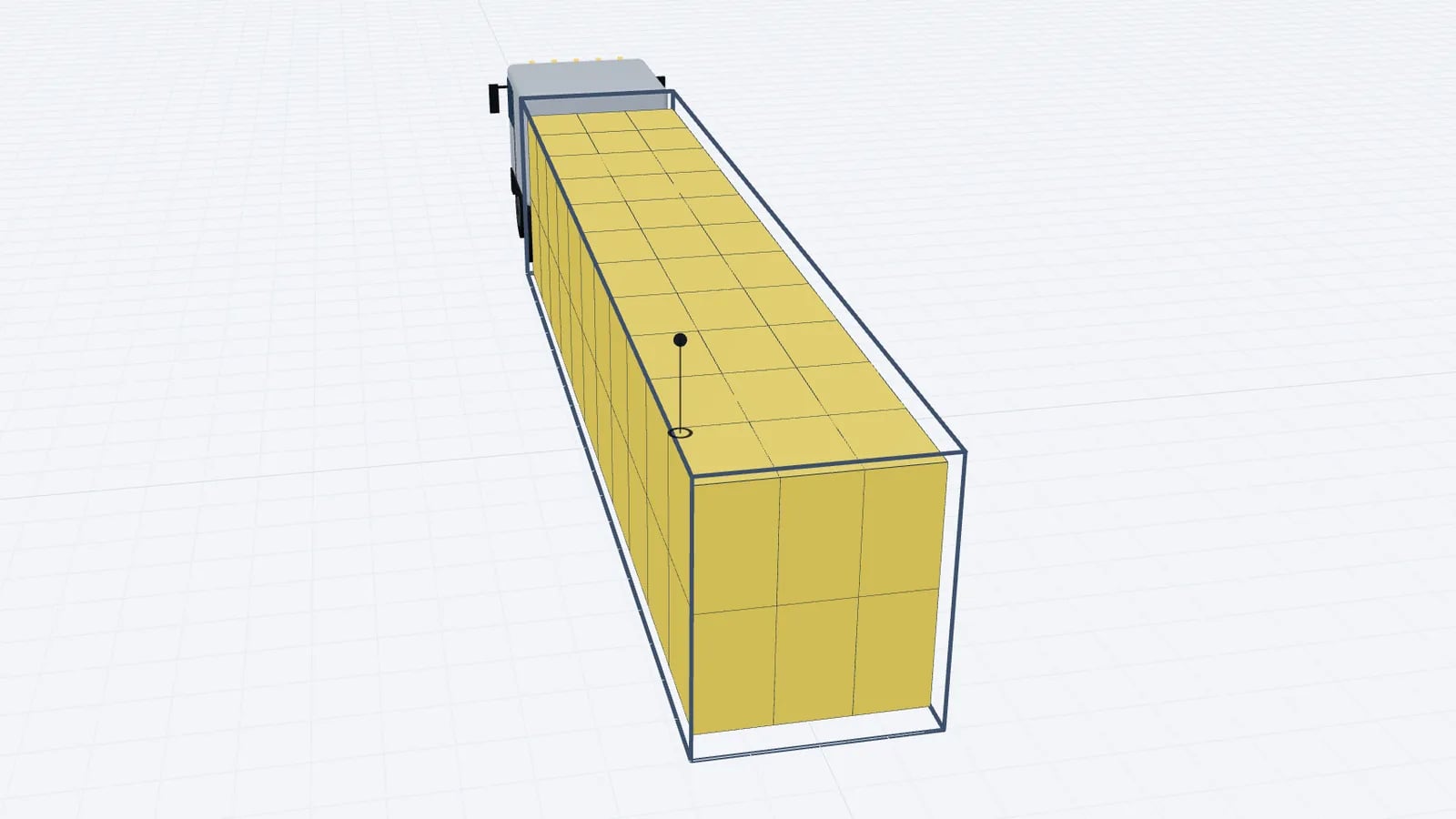
Road freight · · 5 min read
Double Stacking Pallets in Trailers: Height, Weight, Stability
When you can double stack pallets in a trailer: maximum pallet heights in standard and mega trailers, weight on the bottom pallet, payload and stability.
Read article