Beverage Pallet Loading: Plan for Weight Before Volume
Beverage pallets run out of payload long before the trailer is full. How to work out the pallet count, spread the weight over the axles and decide on stacking.
Industry guides · · 6 min read
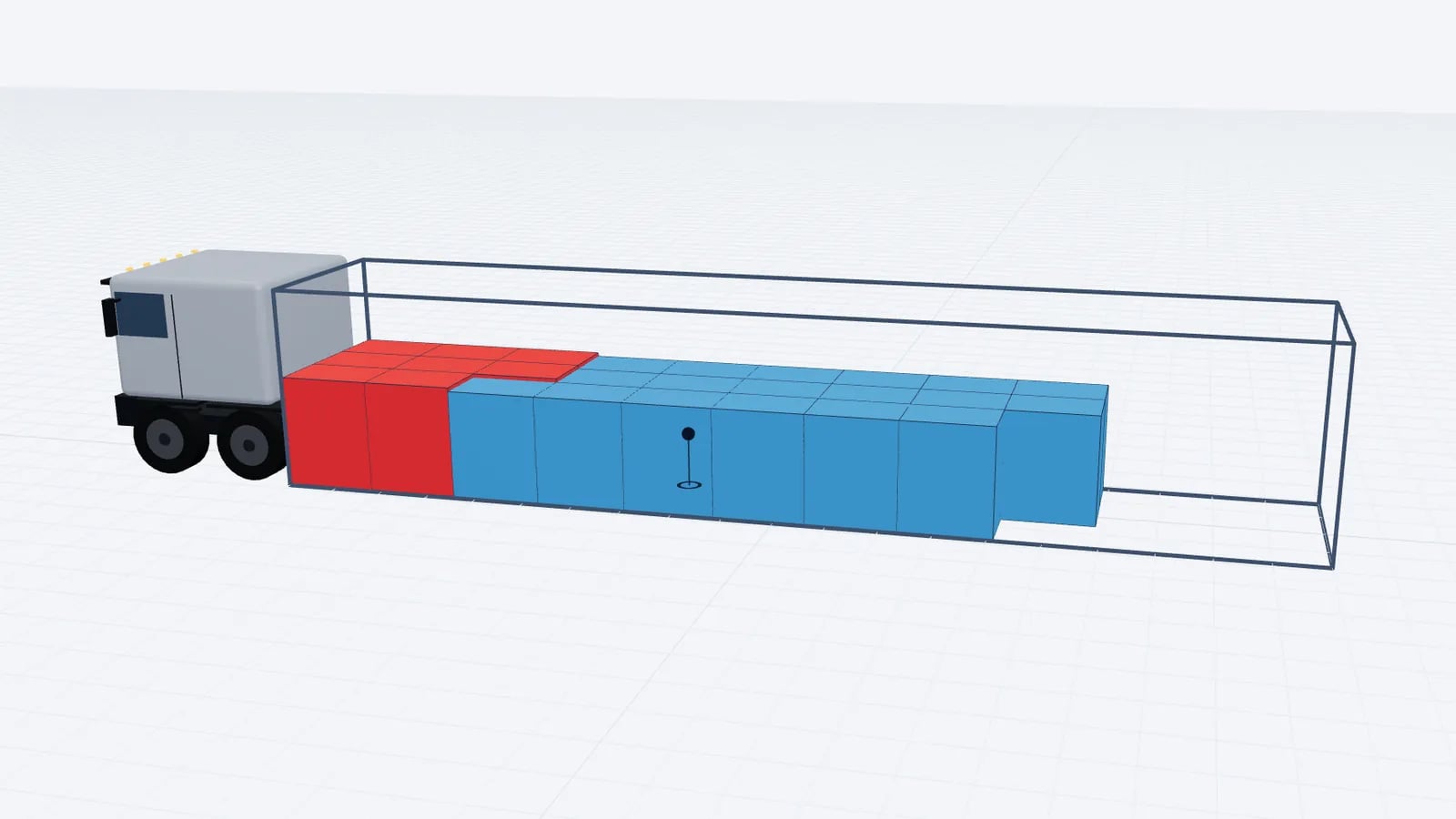
Beverage loads are almost always limited by weight, not space. A full Euro pallet of bottled water or canned drinks commonly weighs 700–1,000 kg, so a standard semitrailer reaches its payload with empty floor positions left over. Good beverage pallet loading starts with the payload sum, then spreads the pallets so neither the tractor nor the trailer axles are overloaded.
Why drinks weigh out before they cube out
A standard 13.6 m semitrailer takes 33 Euro pallets single-stacked. Its payload depends on the tractor and trailer tare weights, but with a 40 t gross combination in most EU countries it usually lands somewhere around 24–26 t. Divide that by 33 and you get the break-even pallet weight: at 24,000 kg payload it is about 727 kg per pallet.
Anything heavier than that and the trailer cannot be filled. Water, juice, beer, glass bottles and full kegs are above the line on almost every order. Light products such as empty cans, preforms or crisps sit well below it and are limited by space instead.
Average pallet weight: 700 kg
- Pallets by payload (24,000 kg)
- 34, capped at 33 by floor space
- Floor positions used of 33
- 33
- Load weight
- 23,100 kg
Average pallet weight: 800 kg
- Pallets by payload (24,000 kg)
- 30
- Floor positions used of 33
- 30
- Load weight
- 24,000 kg
Average pallet weight: 900 kg
- Pallets by payload (24,000 kg)
- 26
- Floor positions used of 33
- 26
- Load weight
- 23,400 kg
Average pallet weight: 1,000 kg
- Pallets by payload (24,000 kg)
- 24
- Floor positions used of 33
- 24
- Load weight
- 24,000 kg
| Average pallet weight | Pallets by payload (24,000 kg) | Floor positions used of 33 | Load weight |
|---|---|---|---|
| 700 kg | 34, capped at 33 by floor space | 33 | 23,100 kg |
| 800 kg | 30 | 30 | 24,000 kg |
| 900 kg | 26 | 26 | 23,400 kg |
| 1,000 kg | 24 | 24 | 24,000 kg |
Use your own payload figure, not the 24 t in the table. Weigh the empty combination or take the figure from the registration documents, and remember fuel, driver and equipment such as straps and bars count against it too. For the background on gross and axle limits see axle weight limits in the EU.
Worked example: 26 pallets of water
Say you have an order for still water on Euro pallets at 920 kg each, and your semitrailer has 24,000 kg payload. 24,000 / 920 = 26.08, so the most you can take is 26 pallets (23,920 kg). That leaves 7 of the 33 floor positions empty.
The tempting layout is to load 26 pallets nose-to-tail from the headboard: eight full rows of three and one row of two, about 10.8 m of floor. That puts the whole load forward and the empty 2.8 m at the doors. The cargo's centre of gravity ends up roughly 5.2 m from the headboard, well forward of the middle of a 13.6 m trailer, which pushes more weight through the kingpin onto the tractor's drive axle.
A better plan spreads the missing positions along the trailer. For example, load rows of three at the front and rear and use rows of two centred across the width in the middle section, then block the side gaps. The pallet count is the same, but the load's centre of gravity moves back towards the middle and the axle loads even out. Whatever pattern you use, check the result against the axle estimate rather than guessing; centre of gravity of a load shows how to calculate it.
Tip
Gaps are where heavy pallets slide. If you leave empty positions, plan how they will be blocked (empty pallets, blocking bars, airbags) before the truck arrives, not at the dock.
Keeping axle loads legal
On a five-axle articulated vehicle the weight of the load is shared between the tractor (through the fifth wheel) and the trailer's axle group. Where the cargo's centre of gravity sits along the trailer decides that split. In most EU countries the single drive axle is limited to 11.5 t and a triaxle group on the trailer to 24 t, though national rules and spacing details vary, so check the rules for each country on the route.
- Load too far forward and the drive axle goes over its limit even though the gross weight is legal.
- Load too far back and the trailer bogie carries too much, and the tractor can lose traction on wet ramps.
- Partial unloading changes everything. If the first drop takes pallets from the rear, re-check what the remaining load does to the drive axle.
Many trailer manufacturers publish a load distribution diagram that shows the allowed payload for a given position of the load's centre of gravity. If you have one, plan the beverage load's centre of gravity inside that envelope. Weight distribution in a trailer covers the principle in more detail.
When double-stacking drinks makes sense
Double-stacking only helps when you are short of floor space, and with full beverage pallets you rarely are. Two 920 kg pallets stacked still count as 1,840 kg against the same payload. Stacking also raises the centre of gravity, increases the load on the bottom pallet's packaging and makes securing harder.
It can be the right call in a few cases:
- Light beverage-related goods, such as empty cans, closures, labels or PET preforms, where the trailer would otherwise cube out.
- Half-height pallets of heavy product (for example a single layer of kegs or a short pallet of glass) with a strong, flat top and a load board between tiers, where the combined height stays under the internal height.
- Mixed orders where a light pallet on top of a heavy one lets you keep the heavy pallets on the floor and still use the volume.
Never put a heavy pallet on a light one, and do not stack on shrink-wrapped bottle packs unless the supplier confirms the top-load the packs can take. The general rules are in pallet stacking rules and double stacking pallets in trailers.
Beverage-specific risks to plan around
| Product | What to watch in the plan |
|---|---|
| Glass bottles | Breakage from shifting; keep them on the floor, block tightly, avoid weight on top. |
| PET bottles and shrink packs | Packs compress and lean; good stretch-wrap and corner boards matter more than the plan itself. |
| Cans | Relatively stable and strong in compression; often the best candidates if anything is stacked. |
| Kegs | Very dense; heavy point loads on the pallet; usually loaded single-tier and centred. |
| Returned empties | Light and bulky; good for filling the space behind a weight-limited outbound load on the return leg. |
A quick checklist for drinks dispatchers
- 1Get the real pallet weights from the warehouse system, not a standard figure per product. Pallets of the same SKU can differ by layer count.
- 2Divide your real payload by the average pallet weight to get the maximum pallet count.
- 3Decide which floor positions stay empty and spread them along the trailer, centred across the width.
- 4Check the drive axle and trailer axle estimate for the full load and again after each planned drop.
- 5Only consider stacking for light or half-height pallets, with load boards and confirmed top-load strength.
- 6Plan how gaps are blocked and how many straps or bars the driver needs.
In EveryLoading you can enter each pallet's real weight, let the optimizer stop at the payload, and read the axle estimate in the stats bar; see weight, axle loads and centre of gravity. The figures are estimates for the cargo only, so a weighbridge check is still the final word on heavy beverage loads.
Frequently asked questions
How many pallets of water fit on a semitrailer?
Usually fewer than the 33 floor positions. Divide the trailer payload by the actual pallet weight; with about 24 t payload and 920 kg pallets that is 26 pallets.
Should heavy beverage pallets be loaded at the front of the trailer?
Not all of them. Loading every pallet tight to the headboard can overload the tractor drive axle; spreading the empty positions along the trailer keeps the centre of gravity nearer the middle.
Can you double-stack pallets of drinks?
Only when you are limited by space rather than weight, which is rare with full beverage pallets. It suits light goods or half-height pallets with a strong flat top and a load board between tiers.
What pallet weight makes a trailer weigh out before it is full?
Divide your payload by 33. With 24,000 kg payload, any average pallet weight above roughly 727 kg means you will hit the weight limit before the floor is full.
Keep reading
Industry guides · · 5 min read
Fresh Produce Transport: Planning Crates, Bins and Reefers
Fresh produce transport planning: crates and bins, temperature and ventilation in general terms, product compatibility, airflow and when produce weighs out.
Read article
Industry guides · · 5 min read
Removal Truck Loading: Survey, Size and Load a Household Move
Removal truck loading for movers: turning a volume survey into the right vehicle, loading order for furniture and boxes, protection, and shared-load moves.
Read article
Industry guides · · 5 min read
FMCG Distribution: Load Planning for Multi-Drop Retail Runs
Load planning for FMCG distribution: mixed pallets of uneven height, multi-drop store deliveries, delivery windows, axle loads that change as drops come off.
Read article