Semi Truck and Trailer Dimensions: US Length, Width, Height
Semi truck dimensions in the US: overall length, width and height, 53 ft and 48 ft dry vans, reefers and flatbeds, in feet and metric, with pallet counts.
Road freight · · 8 min read
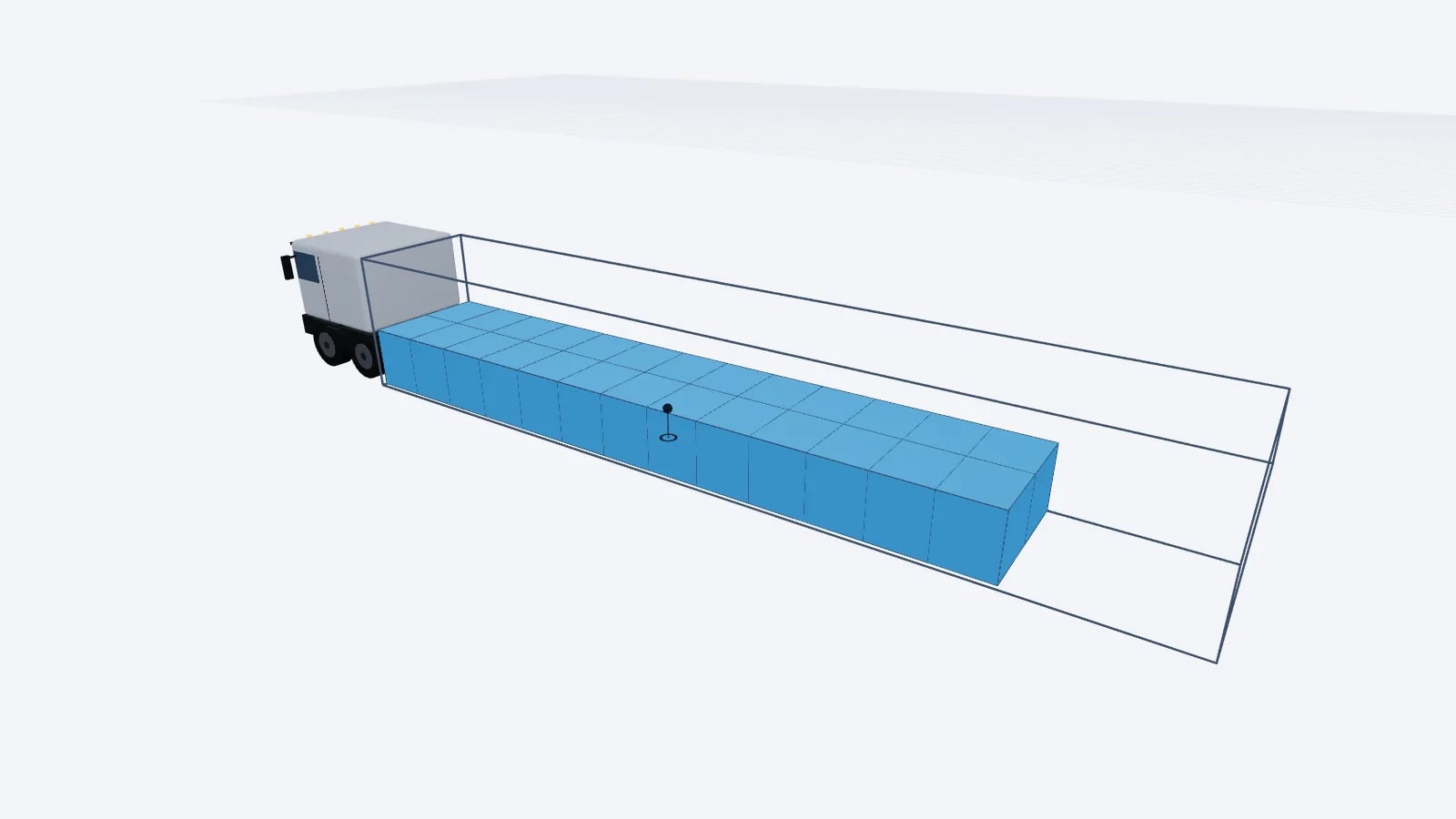
A typical US semi truck with a 53 ft trailer is about 70 to 80 ft long (21–24 m), 102 in wide (2.59 m) and 13 ft 6 in tall (4.11 m), and may weigh up to 80,000 lb (36,287 kg) on the Interstate. The 53 ft dry van is the most common trailer, with about 52 ft 6 in (1600 cm) of usable floor inside.
Those are typical figures. Trailers differ by manufacturer and year, and size limits differ by state, so check the spec sheet of your own equipment and the rules on your route. If you plan European freight, read the companion guide to 13.6 m semi trailer dimensions instead, because the sizes and pallets are different.
Semi truck dimensions at a glance
Measure: Overall length with 53 ft trailer
- Typical or legal figure
- About 70–80 ft
- Metric
- 21–24 m
- Where it comes from
- Tractor length plus trailer; no single federal limit
Measure: Tractor alone
- Typical or legal figure
- About 18–25 ft
- Metric
- 5.5–7.6 m
- Where it comes from
- Day cabs are shorter, sleepers longer
Measure: Width
- Typical or legal figure
- 102 in (8 ft 6 in)
- Metric
- 2.59 m
- Where it comes from
- Federal width on the Interstate and National Network
Measure: Height
- Typical or legal figure
- 13 ft 6 in to 14 ft
- Metric
- 4.11–4.27 m
- Where it comes from
- Set by states; no federal limit
Measure: Gross weight
- Typical or legal figure
- 80,000 lb
- Metric
- 36,287 kg
- Where it comes from
- Federal limit on the Interstate
Measure: Single axle
- Typical or legal figure
- 20,000 lb
- Metric
- 9,072 kg
- Where it comes from
- Federal limit on the Interstate
Measure: Tandem axle
- Typical or legal figure
- 34,000 lb
- Metric
- 15,422 kg
- Where it comes from
- Federal limit on the Interstate
| Measure | Typical or legal figure | Metric | Where it comes from |
|---|---|---|---|
| Overall length with 53 ft trailer | About 70–80 ft | 21–24 m | Tractor length plus trailer; no single federal limit |
| Tractor alone | About 18–25 ft | 5.5–7.6 m | Day cabs are shorter, sleepers longer |
| Width | 102 in (8 ft 6 in) | 2.59 m | Federal width on the Interstate and National Network |
| Height | 13 ft 6 in to 14 ft | 4.11–4.27 m | Set by states; no federal limit |
| Gross weight | 80,000 lb | 36,287 kg | Federal limit on the Interstate |
| Single axle | 20,000 lb | 9,072 kg | Federal limit on the Interstate |
| Tandem axle | 34,000 lb | 15,422 kg | Federal limit on the Interstate |
How long is a semi trailer?
Most semi trailers in US freight are 53 ft long (16.15 m) on the outside, and 48 ft (14.63 m) is the older, shorter size still in use. Federal rules work the other way round from what many people expect: they set a 48 ft minimum that states must allow for semitrailers, not a national maximum. Many states allow 53 ft, and limits vary by state.
Federal rules also stop states from capping the overall length of a tractor and single semitrailer on the National Network. Overall length therefore comes from the tractor you use, which is why the figure is a range rather than a single number. A day cab with a 53 ft trailer sits near the low end, and a large sleeper near the high end.
The rule that catches 53 ft trailers is often kingpin to rear axle distance. Many states limit how far the rear axles may sit behind the kingpin, with published limits often around 40 to 43 ft. On a trailer with sliding tandems, that limit decides how far back the axles can go, which in turn affects how weight is shared between the tractor and the trailer axles. Check the state table for your route.
How wide is a semi?
A semi is 102 in wide (8 ft 6 in, 2.59 m). That is the federal width on the Interstate and other designated routes, and mirrors and certain safety devices do not count towards it. Inside a dry van you lose the wall thickness, which leaves about 98–100 in (249–254 cm).
That inside width explains US pallet loading. Two 48 × 40 in pallets side by side take 80 in with the 40 in side across, or 96 in with the 48 in side across. Both fit in a 98–100 in van, but the second leaves very little play, so a dented wall or a damaged pallet can stop it going in.
How tall is a semi truck?
A loaded dry van rig is usually 13 ft 6 in tall (4.11 m). Federal law sets no height limit, and states typically set 13 ft 6 in to 14 ft (4.27 m), with some roads and bridges lower. Treat 13 ft 6 in as your working figure and check the route, because clearance signs are what actually limit you.
Inside height matters more to a planner. A 53 ft dry van offers about 108–110 in (274–279 cm), but the rear door opening is lower, at about 105 in (267 cm), and that is the tallest item you can load through the back.
53 ft and 48 ft dry van inside dimensions
Plan with inside dimensions, not the trailer's name. These are typical values for US trailers, with counts for 48 × 40 in pallets on the floor.
Equipment: 53 ft dry van
- Inside L × W × H (typical)
- 630 × 98–100 × 108–110 in
- Metric
- 1600 × 254 × 274–279 cm
- Volume (approx.)
- 3,900 cu ft (111 m³)
- 48 × 40 in pallets
- 26 straight, up to 30 turned
- Typical payload
- Up to about 45,000 lb (20 t)
Equipment: 48 ft dry van
- Inside L × W × H (typical)
- 570 × 98–100 × 108–110 in
- Metric
- 1448 × 254 × 274–279 cm
- Volume (approx.)
- 3,550 cu ft (101 m³)
- 48 × 40 in pallets
- 22 straight, up to 28 turned
- Typical payload
- Up to about 45,000 lb (20 t)
Equipment: 53 ft reefer
- Inside L × W × H (typical)
- 600–624 × 96–98 × 103–105 in
- Metric
- 1524–1585 × 244–249 × 262–267 cm
- Volume (approx.)
- Varies by build
- 48 × 40 in pallets
- 24–26 straight; check turned
- Typical payload
- Less than a dry van
Equipment: 26 ft box truck
- Inside L × W × H (typical)
- 312 × 96 × 96 in
- Metric
- 792 × 244 × 244 cm
- Volume (approx.)
- 1,660 cu ft (47 m³)
- 48 × 40 in pallets
- 12 straight, 14 turned
- Typical payload
- About 10,000 lb (4.5 t)
| Equipment | Inside L × W × H (typical) | Metric | Volume (approx.) | 48 × 40 in pallets | Typical payload |
|---|---|---|---|---|---|
| 53 ft dry van | 630 × 98–100 × 108–110 in | 1600 × 254 × 274–279 cm | 3,900 cu ft (111 m³) | 26 straight, up to 30 turned | Up to about 45,000 lb (20 t) |
| 48 ft dry van | 570 × 98–100 × 108–110 in | 1448 × 254 × 274–279 cm | 3,550 cu ft (101 m³) | 22 straight, up to 28 turned | Up to about 45,000 lb (20 t) |
| 53 ft reefer | 600–624 × 96–98 × 103–105 in | 1524–1585 × 244–249 × 262–267 cm | Varies by build | 24–26 straight; check turned | Less than a dry van |
| 26 ft box truck | 312 × 96 × 96 in | 792 × 244 × 244 cm | 1,660 cu ft (47 m³) | 12 straight, 14 turned | About 10,000 lb (4.5 t) |
Straight means the 48 in side runs along the trailer, two pallets to a row. Turned means the 48 in side runs across the trailer, which takes 40 in of floor per row instead of 48 in. Turned loading gets more pallets on, but it needs the full width, so it is the first thing to fail in a narrow or worn trailer. These counts are geometric. Check them for your pallet and trailer with the pallet fit calculator.
Good to know
Payload is what remains after the tractor, trailer, fuel and driver are subtracted from 80,000 lb. An empty tractor with a 53 ft van commonly weighs about 30,000–35,000 lb, and your own combination may differ. Weigh it rather than assume.
Reefer dimensions
A 53 ft reefer has the same outside size as a dry van but less room inside. Insulated walls take width, and the cooling unit and front bulkhead take length, so usable floor is often about 50–52 ft and inside width about 96–98 in. Inside height is commonly around 103–105 in (262–267 cm), and on some models the ceiling is lower at the door than at the nose.
Check the door opening separately and keep cargo below any load line, because air has to move around the load. Reefers also lose payload to their own weight, which matters for dense frozen or bottled goods.
Flatbed and step deck dimensions
Trailer: Flatbed
- Deck length
- 48–53 ft (14.6–16.2 m)
- Width
- 102 in (2.59 m)
- Deck height
- About 5 ft (1.5 m)
- Typical freight height
- Up to about 8 ft 6 in (2.6 m)
- Typical payload
- 46,000–48,000 lb (21–22 t)
Trailer: Step deck
- Deck length
- 48–53 ft overall (14.6–16.2 m)
- Width
- 102 in (2.59 m)
- Deck height
- About 3 ft 6 in lower deck (1.1 m)
- Typical freight height
- Up to about 10 ft (3 m) on lower deck
- Typical payload
- Varies by trailer
| Trailer | Deck length | Width | Deck height | Typical freight height | Typical payload |
|---|---|---|---|---|---|
| Flatbed | 48–53 ft (14.6–16.2 m) | 102 in (2.59 m) | About 5 ft (1.5 m) | Up to about 8 ft 6 in (2.6 m) | 46,000–48,000 lb (21–22 t) |
| Step deck | 48–53 ft overall (14.6–16.2 m) | 102 in (2.59 m) | About 3 ft 6 in lower deck (1.1 m) | Up to about 10 ft (3 m) on lower deck | Varies by trailer |
The freight height limit is simple arithmetic: 13 ft 6 in minus the deck height. A flatbed has no walls, so the whole 102 in is usable, and anything wider usually needs an oversize permit. Rules on overhang past the end of the deck vary by state, so ask before you plan it.
Worked example: will this load fit a 53 ft dry van?
Say you have 24 pallets of 48 × 40 in, each 60 in tall and 1,700 lb, plus 2 pallets of the same footprint that are 90 in tall and 900 lb.
- 1Floor: 26 pallets is exactly the straight capacity of a 53 ft van, so 13 rows of 48 in take 624 in of the 630 in available. It fits, with 6 in spare.
- 2Height: 60 in and 90 in are both under the 105 in door. Two 60 in pallets stacked would be 120 in, so the 60 in pallets stay single.
- 3Weight: 24 × 1,700 + 2 × 900 = 40,800 + 1,800 = 42,600 lb, under the 45,000 lb planning figure, though you still need to check your own tare.
- 4Axles: a full floor spreads the weight well, but a load this heavy leaves little margin, so check the scale ticket against the 34,000 lb limit on both the drive and trailer tandems. See weight distribution in a trailer.
If the 48 ft van were the only one available, 22 straight would leave 4 pallets behind. Turning them would fit the floor count, at the cost of a tighter load and less room to secure it.
How US and European trailers compare
A 53 ft dry van is longer than the European 13.6 m trailer and about the same height inside as a standard one. The pallets differ too: the European trailer holds 33 Euro pallets, while the US van is usually counted in 48 × 40 in pallets. Do not carry numbers from one market to the other. The European semi trailer guide has the 13.6 m figures, and pallet sizes compares the footprints.
Planning tips
- Keep the measured inside size of your own trailers, because catalogue values are often generous.
- Check the door opening before you plan tall freight. It is lower than the ceiling.
- Use the road transport planning tools to test straight and turned patterns before the truck arrives.
- Plan by the state with the tightest limit on your route, not the state you start in.
- If you plan loads every day, see what truck loading software can do for you.
Tip
EveryLoading has presets for the 53 ft dry van, 48 ft dry van and 26 ft box truck. Paste your packing list from Excel, click Optimize load and it builds the plan in 3D, with top, side and rear views and an axle load estimate.
Frequently asked questions
How long is a semi trailer?
Most US semi trailers are 53 ft long on the outside (16.15 m), with about 52 ft 6 in of usable floor. The older 48 ft size (14.63 m) is still in use.
How tall is a semi truck?
Usually 13 ft 6 in (4.11 m). Federal law sets no height limit, and states typically allow 13 ft 6 in to 14 ft, so check your route.
How wide is a semi?
102 in, or 8 ft 6 in (2.59 m), not counting mirrors and certain safety devices. Inside, a dry van is about 98–100 in wide.
How long is a semi truck with a trailer?
About 70 to 80 ft (21–24 m) with a 53 ft trailer. The total depends mostly on the tractor, because a sleeper cab is longer than a day cab.
How many pallets fit in a 53 ft trailer?
26 of the 48 × 40 in size loaded straight, and up to 30 turned if the trailer is wide enough. Check your own trailer, because turned loading leaves very little play.
Keep reading
Road freight · · 7 min read
How to Load a Truck: Axles, Heavy Low, Securing and Safety
How to load a truck step by step: plan first, keep heavy items low and spread over the axles, load towards the doors, secure the load and check the weight.
Read article
Road freight · · 7 min read
Truck Loading Diagram: What to Show and How to Read One
A truck loading diagram shows where every item goes. What it must include, how to read top, side and rear views, and how to make a trailer loading diagram.
Read article
Road freight · · 5 min read
Multi Drop Loading: How to Plan a Truck for Several Stops
Plan a multi-drop truck so every stop unloads without moving other cargo: LIFO order, lanes, stop numbers, axle loads after each drop and a worked example.
Read article