Ti-Hi Pallet Calculation: Cases per Layer and Layers High
What Ti-Hi means and how to calculate it: cases per layer times layers, worked on 48×40 in and 120×80 cm pallets, with height, weight and crush checks.
Load planning basics · · 8 min read
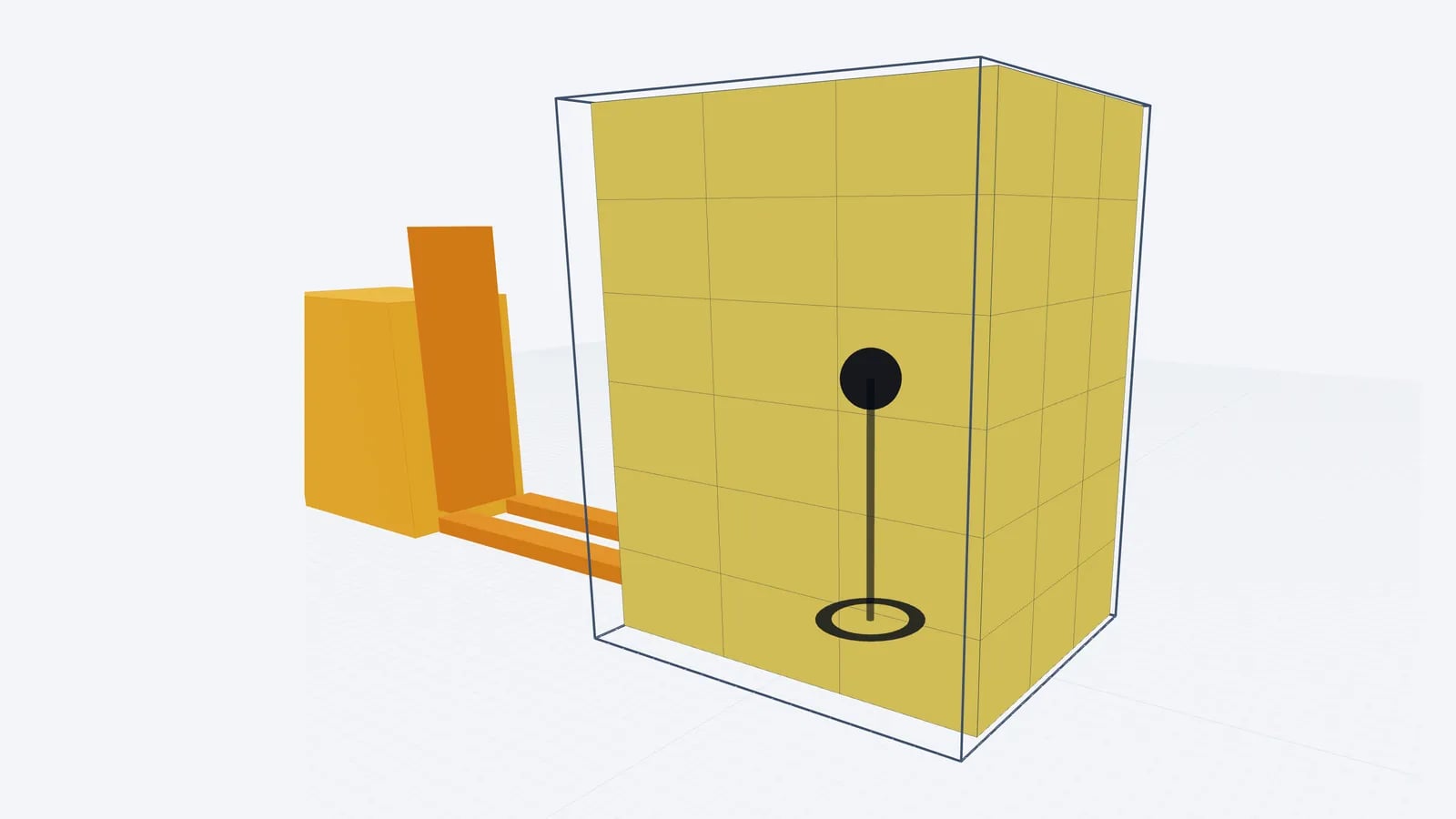
Ti-Hi describes how cases are stacked on a pallet: Ti is the number of cases in one layer (the tier) and Hi is the number of layers high. Multiply them and you get the cases per pallet, so a Ti-Hi of 10 × 5 means 10 cases per layer, 5 layers, 50 cases.
The term is used mostly in North American warehousing and retail, but the idea is the same everywhere. Suppliers put it on item set-up forms, warehouses load it into their systems, and buyers order in full pallets based on it. A wrong Ti-Hi means wrong orders, wasted space and sometimes crushed cases.
The terms
| Term | Meaning |
|---|---|
| Ti (tier) | Cases in one layer |
| Hi (high) | Number of layers |
| Cases per pallet | Ti × Hi |
| Layer efficiency | Area of the cases in one layer ÷ area of the pallet deck |
| Overhang | Cases sticking out past the pallet edge. Avoid it |
| Underhang | Gap between the cases and the pallet edge. A little is fine |
Ti-Hi says how many, not how. The arrangement inside the layer is the stacking pattern, such as column or interlock. Patterns are covered in detail in pallet stacking patterns. Ti-Hi is the count that comes out of choosing one.
How to calculate Ti by hand
Start with the pallet footprint and the case footprint. Work in the same unit for both.
- 1Grid one way. Divide the pallet length by the case length, and the pallet width by the case width. Round both down and multiply.
- 2Grid the other way. Turn the case 90 degrees and repeat.
- 3Try a mixed layer. If neither grid fills the pallet, see whether the pallet width can be split into rows of different case orientations, for example one row with the case one way and two rows with it turned.
- 4Take the highest count that does not overhang. Check the layer efficiency: above about 90 % is good.
Worked example 1: a 48 × 40 in pallet
The common North American pallet is 48 × 40 inches, often called the GMA pallet, with a deck height of about 5.5 to 6 in. Take a case of 16 × 12 × 10 in weighing 25 lb.
Layout: Grid, 16 in along the 48 in side
- Calculation
- (48 ÷ 16 = 3) × (40 ÷ 12 = 3.3 → 3)
- Cases per layer
- 9
Layout: Grid, 12 in along the 48 in side
- Calculation
- (48 ÷ 12 = 4) × (40 ÷ 16 = 2.5 → 2)
- Cases per layer
- 8
Layout: Mixed rows
- Calculation
- One row of 4 cases turned (16 in deep) + two rows of 3 (12 in deep each): 16 + 12 + 12 = 40 in
- Cases per layer
- 10
| Layout | Calculation | Cases per layer |
|---|---|---|
| Grid, 16 in along the 48 in side | (48 ÷ 16 = 3) × (40 ÷ 12 = 3.3 → 3) | 9 |
| Grid, 12 in along the 48 in side | (48 ÷ 12 = 4) × (40 ÷ 16 = 2.5 → 2) | 8 |
| Mixed rows | One row of 4 cases turned (16 in deep) + two rows of 3 (12 in deep each): 16 + 12 + 12 = 40 in | 10 |
The mixed layer fills the deck exactly: 10 cases × 16 × 12 in = 1,920 sq in, the same as 48 × 40 in. Layer efficiency is 100 %, against 90 % for the simple grid of 9. So Ti = 10.
Next, the height. Suppose the customer allows 60 in including the pallet.
- 1Space for cases: 60 − 6 in pallet = 54 in.
- 2Layers: 54 ÷ 10 in = 5.4, so Hi = 5.
- 3Cases per pallet: 10 × 5 = 50.
- 4Height: 6 + 5 × 10 = 56 in.
- 5Weight: 50 × 25 lb = 1,250 lb, plus about 40 to 50 lb for a wooden pallet, so about 1,300 lb.
The Ti-Hi is 10 × 5. Notice the mixed layer: if the warehouse built 9 per layer out of habit, the pallet would carry 45 cases, and 10 % more pallets would be needed for the same order.
Worked example 2: a 120 × 80 cm Euro pallet
The Euro pallet is 120 × 80 cm, 14.4 cm high. Take a carton of 40 × 30 × 22 cm weighing 9 kg, and a height limit of 180 cm including the pallet.
Layout: 30 cm along the 120 cm side
- Calculation
- (120 ÷ 30 = 4) × (80 ÷ 40 = 2)
- Cartons per layer
- 8
Layout: 40 cm along the 120 cm side
- Calculation
- (120 ÷ 40 = 3) × (80 ÷ 30 = 2.7 → 2)
- Cartons per layer
- 6
| Layout | Calculation | Cartons per layer |
|---|---|---|
| 30 cm along the 120 cm side | (120 ÷ 30 = 4) × (80 ÷ 40 = 2) | 8 |
| 40 cm along the 120 cm side | (120 ÷ 40 = 3) × (80 ÷ 30 = 2.7 → 2) | 6 |
The first grid fills the deck exactly (8 × 40 × 30 = 9,600 cm², the same as 120 × 80), so Ti = 8. No mixed layer can do better.
- 1Space for cartons: 180 − 14.4 = 165.6 cm.
- 2Layers: 165.6 ÷ 22 = 7.5, so Hi = 7.
- 3Cartons per pallet: 8 × 7 = 56.
- 4Height: 14.4 + 7 × 22 = 168.4 cm.
- 5Weight: 56 × 9 kg = 504 kg, plus about 25 kg for the pallet, so about 529 kg.
The pallet fit calculator does these steps for any case and pallet size, including the turned and mixed layouts.
Height limits: where Hi comes from
The Hi is almost always set by a height limit, not by the case. The limit comes from one of these places, and the lowest one wins:
- The customer's specification. Retailers and distribution centres often set a maximum pallet height. In Europe limits of about 120 to 180 cm are common; in North America, about 48 to 72 in. They vary widely, so ask.
- The racking. The clear height of a rack beam level, minus a gap for the forklift to lift and place the pallet.
- The vehicle. A trailer about 2.7 m high inside, or a 53 ft dry van about 108 to 110 in, sets the limit if pallets are to be stacked two high.
- Stability. Tall, narrow stacks of light cases sway. Some goods need a lower limit than the space allows.
The vehicle check often changes the answer. In example 2, one 168.4 cm pallet is fine, but two of them (336.8 cm) do not fit in a 270 cm trailer. With Hi = 5, each pallet is 124.4 cm, and two high is 248.8 cm, which fits. The pallet then holds 40 cartons instead of 56, but the trailer may hold far more cartons in total. The same logic is behind double stacking pallets in trailers.
Tip
Work out the Ti-Hi with the vehicle in mind, not just the warehouse. A slightly lower Hi that allows double stacking can cut the number of trucks, as long as the bottom pallet can carry the top one.
Weight check
After the height, check the weight. Three limits matter:
- The pallet's rating. A standard Euro pallet is commonly rated around 1,500 kg for a load spread evenly over the deck. Ratings for 48 × 40 in pallets vary with the build and timber, so check with the supplier.
- The handling equipment. Pallet trucks and forklifts have rated capacities, often lower at height.
- The customer's maximum. Many receivers set a maximum pallet weight for safety and racking, often lower than the pallet could carry.
If the full Ti-Hi is too heavy, reduce Hi, not Ti. A full layer keeps the pallet square and stable; a part layer on top makes it uneven.
Compression of the bottom cases
The bottom layer of cases carries every layer above it. If the pallets are stacked, it also carries the whole pallet on top. This check is often skipped, and it is where crushed cases come from.
- 1In example 1, each bottom case has 4 cases above it in a column stack: 4 × 25 lb = 100 lb.
- 2If a second identical pallet is stacked on top, its 1,300 lb spreads over the 10 columns below, adding about 130 lb per column. The bottom case now carries about 230 lb.
- 3Compare that with the case's box compression test (BCT) value, divided by a safety factor. Factors of about 3 to 5 are common for warehouse storage, because humidity, time under load, handling and interlocking all reduce strength.
- 4If the case's BCT is 800 lb and you use a factor of 4, the safe load is 200 lb. The single pallet is fine. Stacked two high, it is not.
Interlocking the layers ties the pallet together but lowers compression strength, because case corners sit over the weaker middle of the walls below. A column stack is stronger. That is why the pattern behind the Ti matters, not only the number. For mixed approaches and the trade-off, see pallet stacking patterns and stacking rules for pallets.
Common Ti-Hi mistakes
- Only trying one grid. Turning the case, or mixing rows, often adds a case or two per layer.
- Ignoring the pallet height in the height limit, which leaves the pallet one layer too tall.
- Using outer case sizes from a catalogue that do not match the real case. Measure a sample, including any bulge.
- Allowing overhang to fit one more case. Overhanging cases lose strength and get damaged.
- Skipping the weight and compression checks because the layout fits.
- Setting one Ti-Hi for every route. A pallet for racking and a pallet for double stacking in a trailer may need different Hi values.
From Ti-Hi to a full truck
Ti-Hi gives you the size and weight of one pallet. The next question is how many of those pallets go in a truck or container, and whether they can be stacked. See how many Euro pallets fit in a trailer, the palletizing use case, and what palletization means if you are new to the topic.
Tip
In EveryLoading, Build pallets (Pro) stacks your cartons onto pallets within the Max height (with pallet) and Max load you set, and turns identical pallets into cargo rows. Mark them as stackable or set Max kg on top, then click Optimize load to see how many fit in the vehicle and whether double stacking works. The plan goes out as a PDF or share link.
Frequently asked questions
What does Ti-Hi mean?
Ti is the number of cases in one layer on a pallet, and Hi is the number of layers. Ti × Hi gives the number of cases per pallet, for example 10 × 5 = 50.
How do you calculate Ti-Hi?
Divide the pallet length and width by the case length and width, round down and multiply to get Ti, then try the case turned and in mixed rows. For Hi, take the height limit minus the pallet height and divide by the case height, rounded down. Then check weight and compression.
What is a good Ti for a 48 × 40 pallet?
One that fills the deck with little gap and no overhang, usually above about 90 % layer efficiency. A 16 × 12 in case, for example, gives 10 per layer with mixed rows, which fills the deck exactly.
What limits the Hi of a pallet?
Usually a height limit set by the customer, the racking or the vehicle. The weight limit of the pallet and the compression strength of the bottom cases can lower it further.
Is Ti-Hi the same as a stacking pattern?
No. Ti-Hi is the count of cases per layer and layers. The stacking pattern, such as column or interlock, is how the cases are arranged within and between layers.
Keep reading
Load planning basics · · 7 min read
What Is Palletization? Meaning, Methods and When to Use It
Palletization means stacking and securing goods on a pallet so they move as one unit. What it involves, the main methods, and when loose loading fits more.
Read article
Load planning basics · · 7 min read
Pallet Stacking Patterns: Column, Brick, Pinwheel and Row
How to stack boxes on a pallet: column, interlock or brick, pinwheel and row patterns compared, with layer examples and advice on strength and stability.
Read article
Load planning basics · · 5 min read
FTL Meaning: Full Truckload vs LTL, Part Load and Groupage
FTL means full truckload: one shipper books the whole truck. How it compares with LTL, part load and groupage on cost, speed and handling, with a break-even.
Read article