Automotive Parts Loading: Racks, GitterBoxes and JIT Sequence
Automotive parts loading in practice: returnable racks and GitterBoxes, mixed heights, rotating boxes to gain floor space, and loading in JIT sequence order.
Industry guides · · 5 min read
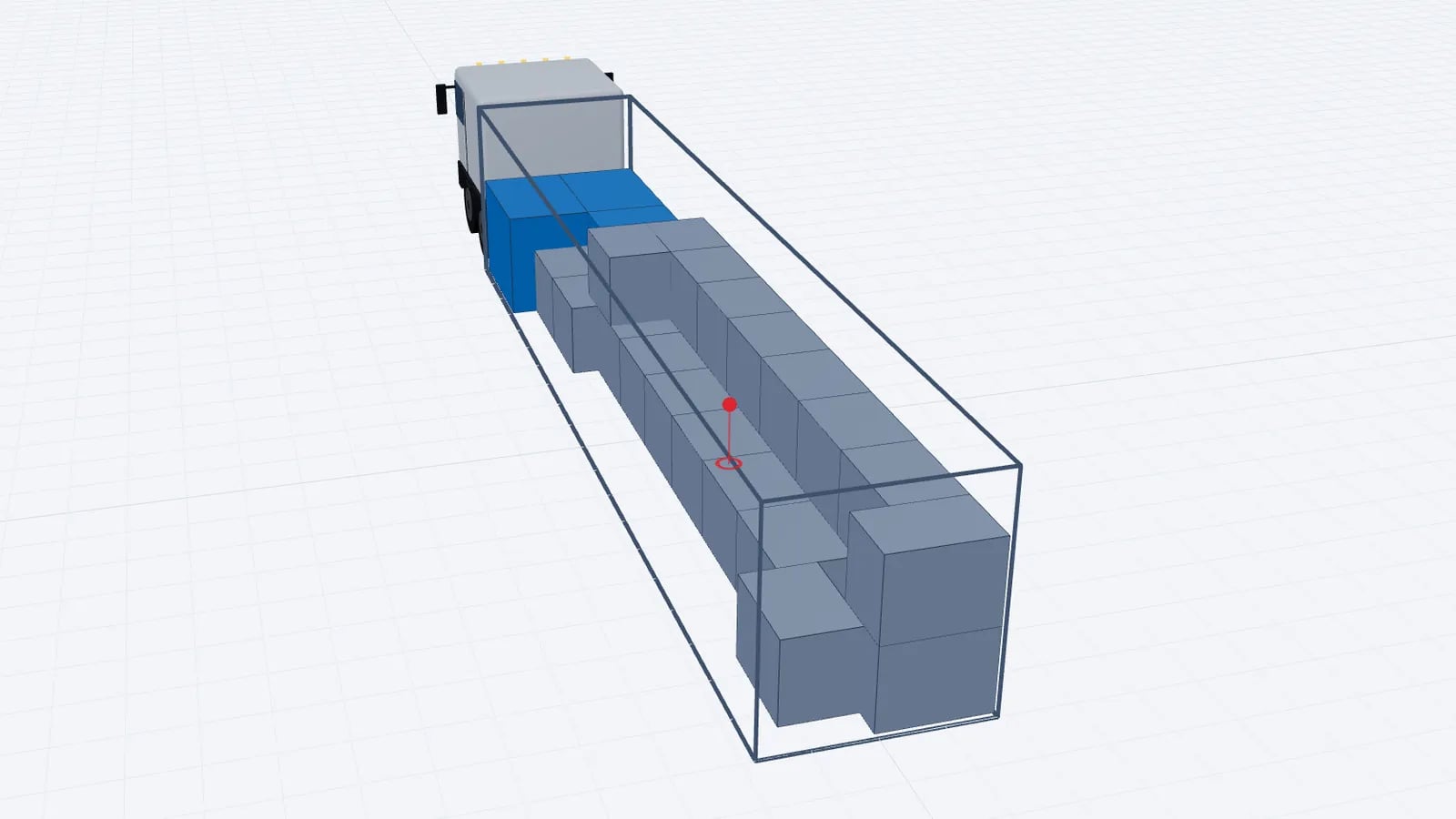
Automotive parts loading is built around returnable packaging: steel mesh boxes, special racks and plastic small-load carriers that do not match Euro pallet sizes. The plan has to fit these units into the trailer efficiently, stack them within their rated limits, and load them in the order the plant or supplier needs them, often to a delivery window measured in minutes.
The load carriers you will meet
Most automotive flows use a small set of standard carriers plus project-specific racks. Dimensions vary by manufacturer and design, so always use the measured outer dimensions from the packaging specification.
Carrier: Mesh box pallet (GitterBox type)
- Typical outer size
- About 1240 × 835 mm, just under 1 m high
- Planning notes
- Larger than a Euro pallet; stackable when loaded within its rating
Carrier: Small-load carriers (KLT)
- Typical outer size
- Common footprints 600 × 400, 400 × 300, 300 × 200 mm
- Planning notes
- Built into stacks on a pallet or base, then handled as one unit
Carrier: Large-load carriers (GLT)
- Typical outer size
- Often 1200 × 1000 mm or 1200 × 800 mm footprints
- Planning notes
- Plastic pallet boxes; rated stack heights
Carrier: Special racks
- Typical outer size
- Project-specific, e.g. for doors, bumpers, glass
- Planning notes
- Odd shapes, often non-stackable, sometimes high
Carrier: Empties
- Typical outer size
- Same carriers, empty or collapsed
- Planning notes
- Very light and bulky on the return leg
| Carrier | Typical outer size | Planning notes |
|---|---|---|
| Mesh box pallet (GitterBox type) | About 1240 × 835 mm, just under 1 m high | Larger than a Euro pallet; stackable when loaded within its rating |
| Small-load carriers (KLT) | Common footprints 600 × 400, 400 × 300, 300 × 200 mm | Built into stacks on a pallet or base, then handled as one unit |
| Large-load carriers (GLT) | Often 1200 × 1000 mm or 1200 × 800 mm footprints | Plastic pallet boxes; rated stack heights |
| Special racks | Project-specific, e.g. for doors, bumpers, glass | Odd shapes, often non-stackable, sometimes high |
| Empties | Same carriers, empty or collapsed | Very light and bulky on the return leg |
The packaging specification normally states the maximum stack in transport. Treat that figure as a hard limit in the plan; a warehouse stacking rating is not the same as a transport rating, because a trailer brakes, corners and bounces.
Worked example: GitterBoxes in a semitrailer
Say you are loading mesh boxes with an outer footprint of 1240 × 835 mm and a height of 970 mm into a trailer with a 13.6 × 2.45 m floor and 2.7 m internal height. The boxes are rated to stack two high in transport.
The obvious layout puts every box the same way: 1240 mm along the trailer, two abreast across the width (2 × 835 = 1,670 mm). Rows are 1.24 m long, so 10 rows fit (12.4 m), giving 20 boxes per tier. Turning them the other way does not work: two boxes with the 1240 mm side across need 2,480 mm, wider than the floor.
Now mix the orientations by lane. Lane A has boxes turned crosswise (1240 mm across, 835 mm along): 16 boxes fit in 13.36 m. Lane B has boxes lengthwise (835 mm across, 1240 mm along): 10 boxes fit in 12.4 m. Lane widths add up to 1,240 + 835 = 2,075 mm, inside 2,450 mm. That is 26 boxes per tier, six more than the uniform layout.
Layout: All lengthwise, two abreast
- Per tier
- 20
- Two tiers (1.94 m high)
- 40
Layout: Mixed lanes: one crosswise, one lengthwise
- Per tier
- 26
- Two tiers (1.94 m high)
- 52
| Layout | Per tier | Two tiers (1.94 m high) |
|---|---|---|
| All lengthwise, two abreast | 20 | 40 |
| Mixed lanes: one crosswise, one lengthwise | 26 | 52 |
Check weight before you celebrate. At an average of 400 kg per loaded box, 52 boxes weigh 20,800 kg, which fits a 24 t payload. At 500 kg per box it would be 26,000 kg, so the trailer weighs out at 48 boxes. With a mega trailer of about 3 m internal height a third tier (2.91 m) can fit, but only if the boxes are rated for three high in transport and the weight allows.
Tip
A few centimetres of trailer width decide these layouts. Measure the usable width between stanchions or straps, not the nominal body width, and leave handling clearance.
Mixed heights and mixed carriers
A typical inbound load from a supplier park mixes mesh boxes, KLT stacks on pallets and one or two special racks. The heights rarely match, which leaves wasted space above shorter units.
- Pair heights. Put two units whose combined height is close to the internal height on top of each other, if both are stackable and the lower one is rated for the upper one's weight.
- Keep special racks on the floor and plan them first; they often cannot be rotated and dictate the lanes.
- Group by stackability. A non-stackable rack in the middle of a stacked lane breaks the tier and creates a void that needs blocking.
- Plan empties on the return. Collapsed or nested empties can usually be stacked much higher than full units; the planner should know the collapsed height.
Loading in JIT and JIS order
Plants working just-in-time (JIT) or just-in-sequence (JIS) expect parts to arrive in a set order, sometimes matching the build sequence on the line. Unloading must happen quickly at a specific dock, so the loading order is part of the plan, not an afterthought.
- 1Get the call-off or sequence list with the delivery point (dock, gate or line-side area) for each unit.
- 2Group units by delivery point and by sequence number.
- 3Load the last-needed units first, at the front; the first-needed units go last, at the doors.
- 4Keep each sequence group in its own lane or block so the unloader does not have to dig.
- 5Print or share the plan with sequence numbers so the loader and the receiving dock work from the same document.
Milk runs that collect from several suppliers work the same way in reverse: the first pickup goes to the front, and each later pickup must still leave room for the units that follow. Planning the full run before the first collection avoids the last supplier's racks not fitting. Multi-drop load planning covers the general loading-order logic.
Tips for automotive load planners
- Keep a master list of carrier dimensions, tare weights and stack limits, and paste it into the planner rather than typing sizes per order.
- Plan with the real loaded weight per carrier. Two mesh boxes of the same size can differ by hundreds of kilograms.
- Mark racks that must not rotate and units that must stay upright, then let the optimizer handle the rest.
- Record the load plan with each shipment; it helps when a plant disputes damaged or missing units.
EveryLoading takes each carrier type as a row with its stackable and rotation settings, and the loading sequence slider shows the order units go in. For a supplier list kept in Excel, see importing cargo and packing list to load plan.
Frequently asked questions
How many GitterBoxes fit in a semitrailer?
It depends on the trailer width and orientation. In the example with a 2.45 m floor, mixing one crosswise and one lengthwise lane gives 26 per tier instead of 20, so 52 when stacked two high, subject to payload.
Can automotive mesh boxes be stacked in a truck?
Usually yes, up to the transport stack limit in the packaging specification and only when loaded within their weight rating. A warehouse stacking rating is not automatically valid in transport.
What does JIS mean for load planning?
Just-in-sequence means parts must arrive in the order the line uses them. The plan loads the last-needed units at the front and keeps each sequence group together at the doors.
How should empty returnable packaging be loaded?
Collapse or nest it where the design allows and plan it with its collapsed height and real weight. Empties are light, so the return leg is limited by volume, not payload.
Keep reading
Industry guides · · 5 min read
Fresh Produce Transport: Planning Crates, Bins and Reefers
Fresh produce transport planning: crates and bins, temperature and ventilation in general terms, product compatibility, airflow and when produce weighs out.
Read article
Industry guides · · 6 min read
Beverage Pallet Loading: Plan for Weight Before Volume
Beverage pallets run out of payload long before the trailer is full. How to work out the pallet count, spread the weight over the axles and decide on stacking.
Read article
Industry guides · · 5 min read
Removal Truck Loading: Survey, Size and Load a Household Move
Removal truck loading for movers: turning a volume survey into the right vehicle, loading order for furniture and boxes, protection, and shared-load moves.
Read article