Load Planning with Mixed Pallets: Euro, Industrial, Half, US
Load planning with mixed pallets: how Euro, industrial, half and US pallets share a 13.6 m trailer, which rows to turn, and a worked example in loading metres.
Load planning basics · · 8 min read
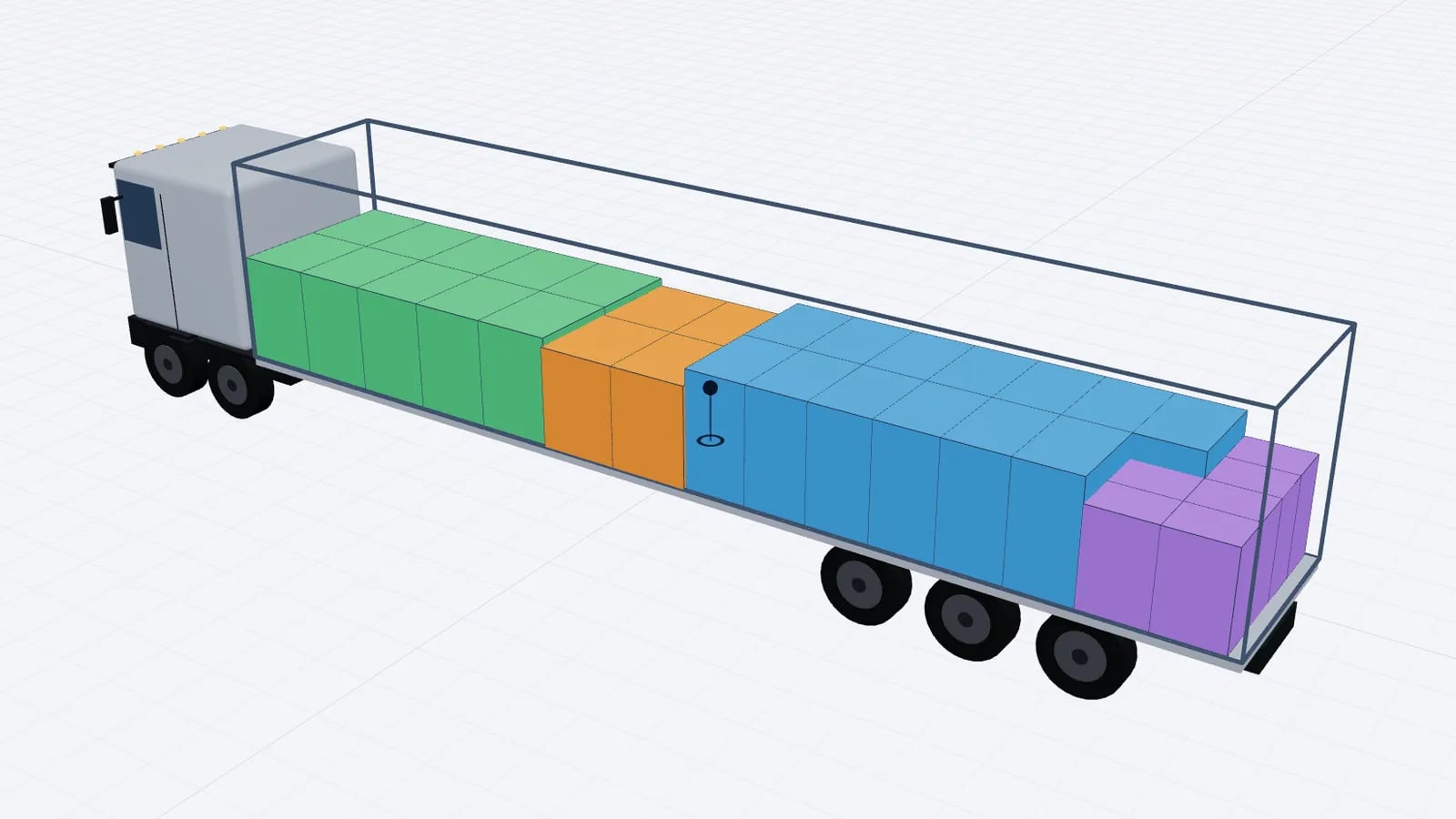
Load planning with mixed pallets comes down to one idea: every footprint has a row pattern that uses the trailer width with almost no waste, and the planner's job is to choose that pattern per type and join the blocks so no row is left half-empty. In a 13.6 m trailer, Euro pallets need 0.4 loading metres each, industrial pallets 0.5, half pallets 0.2 and US pallets just over 0.5, but only if each sits the right way round.
This article works through those patterns and then plans one real-looking mixed order, step by step, so you can see where a metre of floor is lost and how to get it back. For the plain Euro-only and Euro-plus-industrial counts, see how many Euro pallets fit in a trailer.
The four footprints and their best rows
All numbers below are for a standard semi-trailer with 245 cm inside width and 1,360 cm inside length. A pallet's "lengthwise" orientation has its long side along the trailer; "crosswise" has it across.
Pallet: Euro (EUR/EPAL)
- Size (cm)
- 120 × 80
- Best row
- Lengthwise or crosswise
- Pallets per row
- 3 or 2
- Row depth
- 1.20 m or 0.80 m
- Floor per pallet
- 0.40 m
Pallet: Industrial
- Size (cm)
- 120 × 100
- Best row
- Crosswise
- Pallets per row
- 2
- Row depth
- 1.00 m
- Floor per pallet
- 0.50 m
Pallet: Half Euro
- Size (cm)
- 80 × 60
- Best row
- Lengthwise (4 across) or crosswise (3)
- Pallets per row
- 4 or 3
- Row depth
- 0.80 m or 0.60 m
- Floor per pallet
- 0.20 m
Pallet: US (48 × 40 in)
- Size (cm)
- 121.9 × 101.6
- Best row
- Crosswise
- Pallets per row
- 2
- Row depth
- 1.016 m
- Floor per pallet
- 0.508 m
| Pallet | Size (cm) | Best row | Pallets per row | Row depth | Floor per pallet |
|---|---|---|---|---|---|
| Euro (EUR/EPAL) | 120 × 80 | Lengthwise or crosswise | 3 or 2 | 1.20 m or 0.80 m | 0.40 m |
| Industrial | 120 × 100 | Crosswise | 2 | 1.00 m | 0.50 m |
| Half Euro | 80 × 60 | Lengthwise (4 across) or crosswise (3) | 4 or 3 | 0.80 m or 0.60 m | 0.20 m |
| US (48 × 40 in) | 121.9 × 101.6 | Crosswise | 2 | 1.016 m | 0.508 m |
Three things in that table matter for mixed loads. First, the Euro pallet is the only footprint with two equally good patterns: three lengthwise in 1.2 m, or two crosswise in 0.8 m, both 0.4 m per pallet. Second, industrial and US pallets lose a lot when loaded lengthwise: two across use only 200 to 203 cm of the width, so each pallet takes 0.6 m of floor instead of 0.5. Third, a half pallet is exactly half a Euro slot, so it can share a Euro row.
Good to know
Two US pallets crosswise need 243.8 cm, which leaves 1.2 cm in a 245 cm trailer. Stretch wrap that bulges, a broken deck board or a slightly narrower body ends that pattern. Measure the trailer, and expect the odd US pallet to need a lengthwise slot. Sizes vary by body builder, so check your own vehicles.
Mix Euro rows to fit any count
Because both Euro patterns cost 0.4 m per pallet, any count of two or more Euro pallets can fill rows completely by combining lengthwise rows of three with crosswise rows of two. That is the trick behind good mixed plans.
- 13 Euro pallets all lengthwise need 5 rows (the last holds one pallet): 6.0 m. As 3 lengthwise rows plus 2 crosswise rows (9 + 4) they need 3.6 + 1.6 = 5.2 m.
- 16 Euro pallets all lengthwise need 6 rows: 7.2 m. As 4 lengthwise plus 2 crosswise (12 + 4) they need 4.8 + 1.6 = 6.4 m.
- Half pallets fill the gaps: two half pallets turned crosswise fill one lengthwise Euro slot, and two turned lengthwise fill one crosswise Euro slot. Four lengthwise half pallets make a full 0.8 m row on their own.
The saving is always the unfilled part of the last row, 0.4 or 0.8 m. On a groupage trailer sold by the loading metre, that is one or two more paying pallets.
Industrial and US pallets: think in two lanes
Industrial, US and crosswise Euro pallets all present a 120 to 122 cm side across the trailer. That means the floor works as two lanes of about 122 cm, and each lane can carry any sequence of these pallets. A lane with industrial pallets advances 1.0 m per pallet, a lane with US pallets 1.016 m, a lane with crosswise Euro pallets 0.8 m, and a lane with two half pallets side by side 0.8 m.
The lane view helps with odd counts. Five industrial pallets as rows of two leave one pallet alone in a 1.0 m row, with half the width empty. In lanes, the fifth industrial pallet sits in the left lane while the right lane continues with a crosswise Euro pallet and a 0.2 m difference, which is far less waste. Keep the two lanes level within a few centimetres every couple of metres so the load can be blocked as rows.
Tip
Keep heavy industrial pallets in both lanes at the same distance from the front wall. Filling one lane with heavy pallets and the other with light half pallets shifts the centre of gravity sideways, which shows in every curve. See centre of gravity of a load.
Worked example: one 13.6 m trailer, four pallet types
A distribution centre has one outbound order for a semi-trailer (1,360 × 245 × 270 cm, 24,000 kg payload). None of the pallets can be stacked.
Type: Industrial
- Size (cm)
- 120 × 100
- Qty
- 10
- Weight each
- 600 kg
- Total weight
- 6,000 kg
Type: US
- Size (cm)
- 121.9 × 101.6
- Qty
- 4
- Weight each
- 500 kg
- Total weight
- 2,000 kg
Type: Euro
- Size (cm)
- 120 × 80
- Qty
- 13
- Weight each
- 450 kg
- Total weight
- 5,850 kg
Type: Half Euro
- Size (cm)
- 80 × 60
- Qty
- 6
- Weight each
- 200 kg
- Total weight
- 1,200 kg
Type: Total
- Size (cm)
- Qty
- 33
- Weight each
- Total weight
- 15,050 kg
| Type | Size (cm) | Qty | Weight each | Total weight |
|---|---|---|---|---|
| Industrial | 120 × 100 | 10 | 600 kg | 6,000 kg |
| US | 121.9 × 101.6 | 4 | 500 kg | 2,000 kg |
| Euro | 120 × 80 | 13 | 450 kg | 5,850 kg |
| Half Euro | 80 × 60 | 6 | 200 kg | 1,200 kg |
| Total | 33 | 15,050 kg |
Weight is well within the payload. The question is floor length. The theoretical minimum is the sum of the floor per pallet: 10 × 0.5 + 4 × 0.508 + 13 × 0.4 + 6 × 0.2 = 5.0 + 2.03 + 5.2 + 1.2 = 13.43 m. That fits 13.6 m with 17 cm to spare, but only if no row is wasted.
The first attempt: each type as its own block, everything in its habitual orientation. Industrial crosswise, 5 rows: 5.0 m. US crosswise, 2 rows: 2.03 m. Euro lengthwise, 5 rows with one pallet in the last: 6.0 m. Half pallets in rows of four, then a row with two: 0.8 + 0.8 = 1.6 m (or 1.4 m if the last row is turned). Total 14.4 to 14.6 m. After the Euro block ends at 13.03 m only 57 cm remain, less than the 60 cm a turned row of half pallets needs, so all six half pallets stay on the dock.
The planned version builds every row full:
- 1Industrial, 5 crosswise rows of 2 against the front wall: 0 to 5.00 m, 10 pallets, 6,000 kg.
- 2US, 2 crosswise rows of 2: 5.00 to 7.03 m, 4 pallets, 2,000 kg.
- 3Euro, 4 lengthwise rows of 3: 7.03 to 11.83 m, 12 pallets, 5,400 kg.
- 4One crosswise row: one Euro pallet in the left lane, two half pallets turned lengthwise side by side in the right lane: 11.83 to 12.63 m.
- 5One row of four half pallets lengthwise at the doors: 12.63 to 13.43 m.
Everything is on, with 17 cm at the doors to block. The only change from the first attempt is turning one row of Euro pallets and pairing the half pallets with the last Euro pallet. Nothing about the order or the trailer changed.
Two checks before release. First, weight: 8,000 kg of industrial and US pallets sit in the first 7 m, so the kingpin carries more than in an even load. At 15 t in a 24 t trailer that is normally fine, but estimate the axle loads rather than assume. Second, the doors: the half pallets at the back are the lightest and lowest items, so plan a load lock or a filled gap so they cannot slide.
Loading metres for a mixed load
Carriers who price groupage by loading metres usually charge a pallet as its length times its width divided by 2.4 m, rounded to their own steps. With that formula the order above is 5.0 + 4 × 0.516 + 5.2 + 1.2 = 13.46 LDM, very close to the 13.43 m the plan actually uses. The two numbers diverge when pallets are left in half-empty rows: the carrier bills the footprint, but your trailer loses the whole row.
For quick quotes, the loading meter calculator does this sum per pallet type. Rounding rules and minimum charges differ by carrier, so use theirs for invoicing.
Containers change the rules
ISO containers are about 235 cm wide inside, 10 cm less than a trailer, so three Euro pallets no longer fit lengthwise side by side. A 20 ft container takes 11 Euro pallets only by mixing orientations, and industrial and US pallets go two across in either orientation. Mixed pallet loads in containers need their own planning; see how many pallets fit in a container.
Common mixed-pallet mistakes
- Loading industrial or US pallets lengthwise because the forklift approach is easier, which costs 0.1 m of floor per pallet.
- Planning every Euro row lengthwise and leaving the last row with one or two pallets.
- Treating half pallets as a separate block at the doors instead of using them to fill Euro and lane gaps.
- Trusting a 2 cm clearance on paper without measuring the trailer.
- Ignoring which pallets can carry weight. With mixed suppliers, stacking rules differ per pallet. Our list of load planning mistakes covers that and more.
If your packing list mixes footprints every day, a planner that tries the orientations for you saves the arithmetic. EveryLoading packs each cargo type lengthwise first, crosswise first and freely, keeps the run with the shortest loading length, and shows the result in 3D with loading metres, plus an axle estimate on Pro. Paste the order from Excel and compare the plan with your own on a free account.
Frequently asked questions
Can Euro and industrial pallets go in the same row?
Not efficiently in a standard row, because their depths differ. Plan them as separate blocks, or think in two lanes of about 1.2 m where a crosswise Euro pallet and a crosswise industrial pallet can follow each other.
How many loading metres does a half pallet use?
0.2 m in a 2.4 m wide trailer: four fit across in a 0.8 m row. Two half pallets take exactly the space of one Euro pallet.
Should US pallets be loaded lengthwise or crosswise in a European trailer?
Crosswise if the inside width is at least 244 cm and the pallets are clean-edged, which gives two per 1.016 m. Lengthwise, two across use only 203 cm and waste about 40 cm of width.
Why does my mixed load not fit when the loading metres add up?
Usually because some rows are only partly filled. Every half-empty row costs its full depth, so turn a Euro row or use half pallets to fill it.
Keep reading
Load planning basics · · 6 min read
How Many Euro Pallets Fit in a Trailer? 33, 66 or Fewer
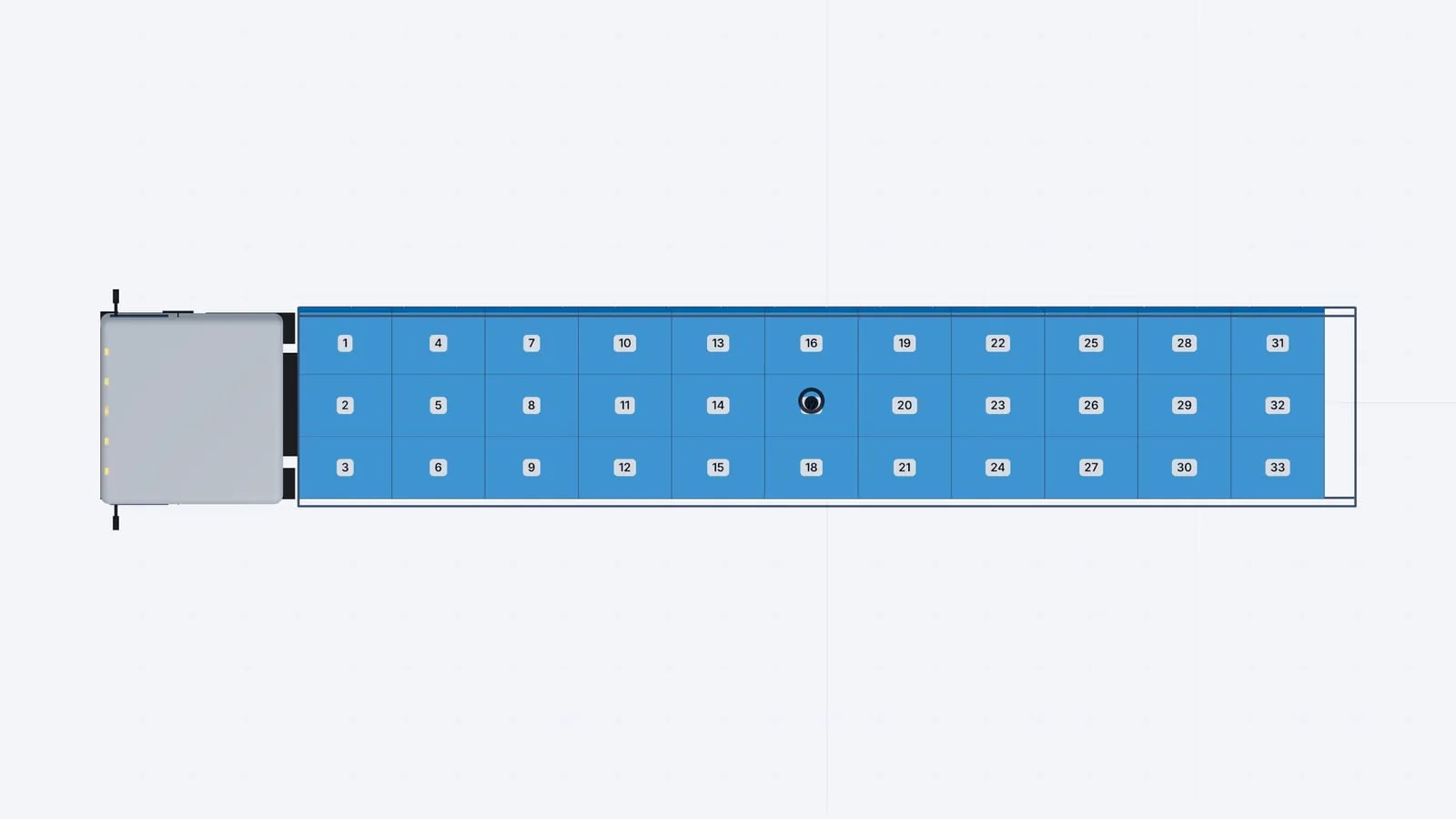
A 13.6 m trailer takes 33 Euro pallets single-stacked and 66 double-stacked if height and payload allow. See the orientations, mixed loads and the maths.
Read article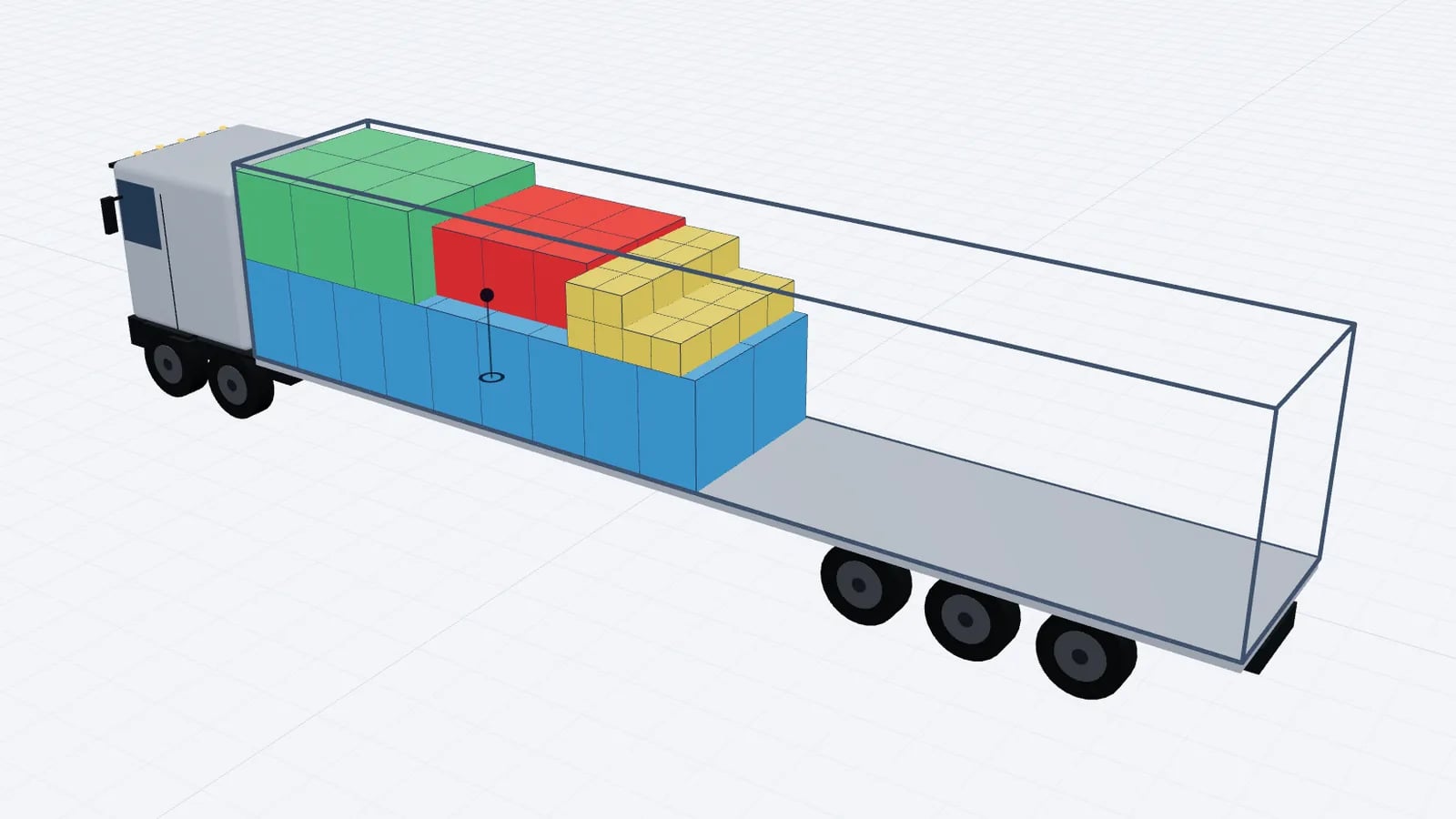
Load planning basics · · 8 min read
12 Load Planning Mistakes, What They Cost and How to Fix Them
The 12 common load planning mistakes, from outside dimensions to bunched part loads, with what each one costs in trucks, fines and claims and how to fix it.
Read article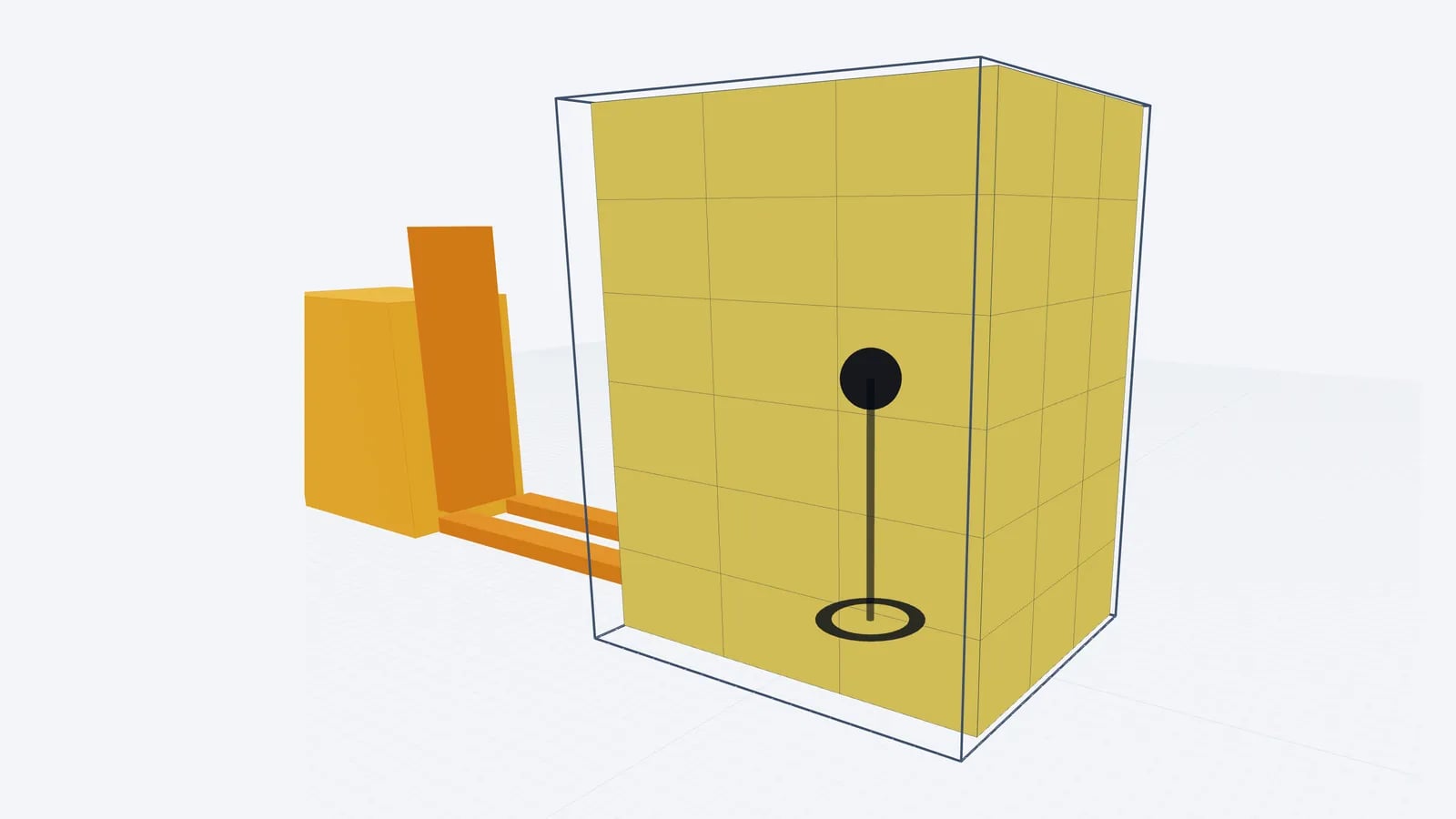
Load planning basics · · 8 min read
Ti-Hi Pallet Calculation: Cases per Layer and Layers High
What Ti-Hi means and how to calculate it: cases per layer times layers, worked on 48×40 in and 120×80 cm pallets, with height, weight and crush checks.
Read article