Pallet Weight Capacity: Static, Dynamic and Racking Loads
Pallet weight capacity explained: static, dynamic and racking ratings, typical values by pallet type, and how pallet weight affects stacking and truck payload.
Load planning basics · · 8 min read
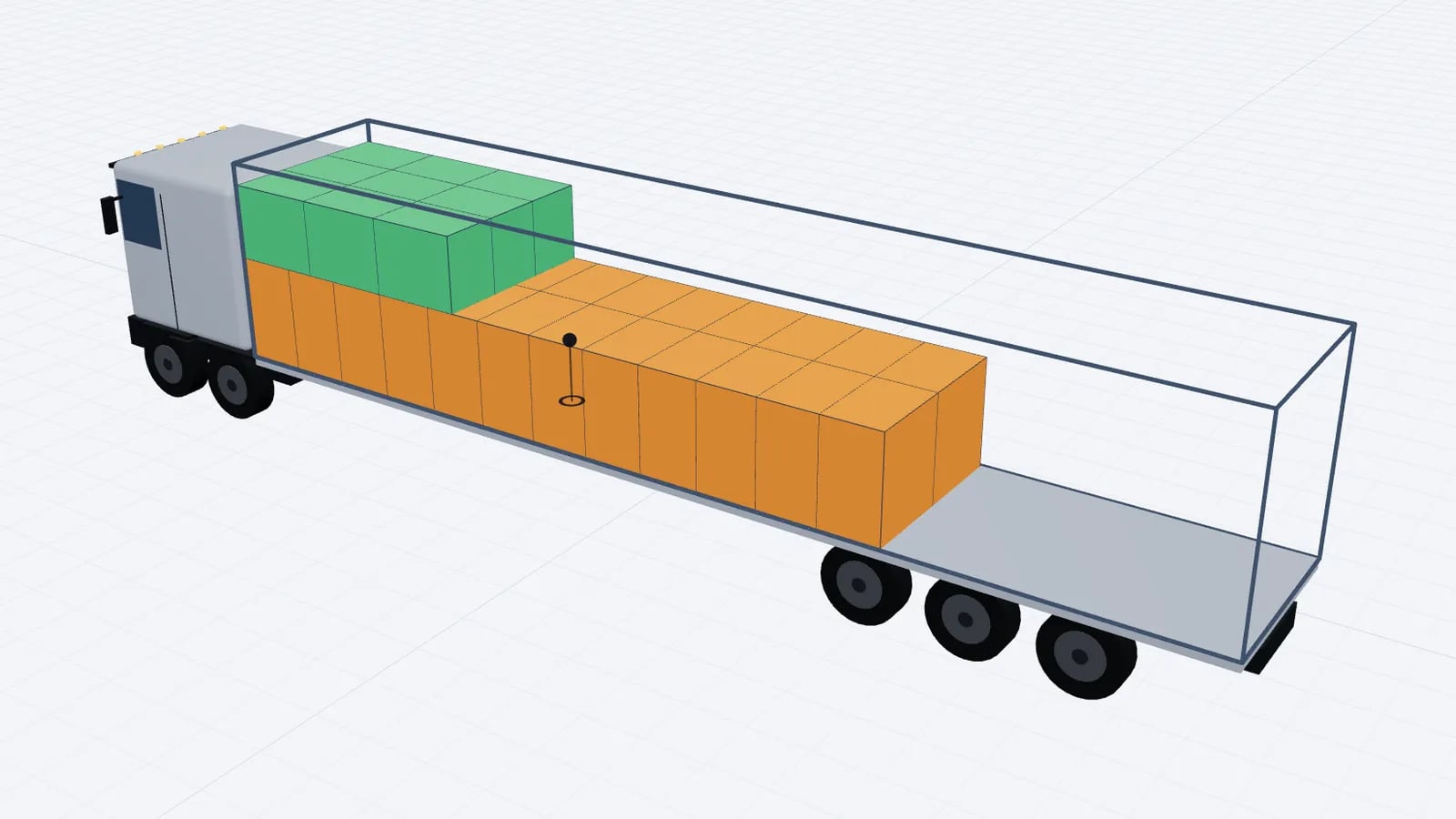
Pallet weight capacity is given as three different numbers: the static load (standing still on a flat floor), the dynamic load (being moved by a forklift or pallet truck) and the racking load (resting on two beams in a rack). For a standard EUR pallet the commonly quoted figures are about 1,500 kg dynamic and up to 4,000 kg static, while racking depends on the rack. Which number applies depends on what happens to the pallet, and the lowest one in its journey is the one that counts.
This article goes past the definitions: what each rating really assumes, typical values by pallet type, and how the pallet's own weight eats into stacking limits and the truck's payload, with worked numbers. For the pallet materials themselves, see cargo pallet types.
What each rating means in practice
- Static load is the weight the pallet can carry while standing on a flat, level and hard floor. It is the number that applies to the bottom pallet of a stack in a warehouse, and roughly to a pallet standing in a trailer once loaded.
- Dynamic load is what the pallet can carry while it is lifted and moved: on forks, on a pallet truck or on a conveyor. Bending and impacts make it much lower than static.
- Racking load is what the pallet can carry when supported only along two edges, spanning the gap between rack beams. The deck has to carry the load as a bridge, so this is often the lowest of the three.
All three normally assume a uniformly distributed load over the whole deck. A 900 kg machine standing on four small feet, or a load concentrated in the middle, is far harder on the boards than 900 kg of cartons spread edge to edge. Pallet tests to ISO 8611 work with distributed loads and safety factors; if your goods are not spread evenly, ask the pallet supplier for a rating that matches, or add a load-spreading board.
Typical pallet weight capacity by type
Pallet: EUR/EPAL 1200 x 800, wood
- Own weight
- about 25 kg
- Dynamic (typical)
- 1,500 kg
- Static (typical)
- up to 4,000 kg
- Racking (typical)
- about 1,000 to 1,500 kg, depends on rack and direction
Pallet: Industrial 1200 x 1000, wood
- Own weight
- about 30 to 35 kg
- Dynamic (typical)
- 1,250 to 1,500 kg
- Static (typical)
- 4,000 kg or more
- Racking (typical)
- depends on design
Pallet: 48 x 40 in stringer, wood
- Own weight
- about 15 to 25 kg
- Dynamic (typical)
- about 1,000 to 1,250 kg
- Static (typical)
- several tonnes
- Racking (typical)
- depends on design and direction
Pallet: Plastic, nestable
- Own weight
- 8 to 12 kg
- Dynamic (typical)
- 500 to 1,000 kg
- Static (typical)
- 1,000 to 3,000 kg
- Racking (typical)
- often not rackable
Pallet: Plastic, rackable
- Own weight
- 15 to 25 kg
- Dynamic (typical)
- 1,000 to 1,500 kg
- Static (typical)
- 3,000 to 5,000 kg
- Racking (typical)
- about 750 to 1,500 kg
Pallet: Presswood
- Own weight
- 10 to 15 kg
- Dynamic (typical)
- about 1,000 kg
- Static (typical)
- about 3,000 kg or more
- Racking (typical)
- low, check before racking
Pallet: Paper / corrugated
- Own weight
- 3 to 8 kg
- Dynamic (typical)
- 200 to 600 kg
- Static (typical)
- up to about 1,000 kg
- Racking (typical)
- not for racking
| Pallet | Own weight | Dynamic (typical) | Static (typical) | Racking (typical) |
|---|---|---|---|---|
| EUR/EPAL 1200 x 800, wood | about 25 kg | 1,500 kg | up to 4,000 kg | about 1,000 to 1,500 kg, depends on rack and direction |
| Industrial 1200 x 1000, wood | about 30 to 35 kg | 1,250 to 1,500 kg | 4,000 kg or more | depends on design |
| 48 x 40 in stringer, wood | about 15 to 25 kg | about 1,000 to 1,250 kg | several tonnes | depends on design and direction |
| Plastic, nestable | 8 to 12 kg | 500 to 1,000 kg | 1,000 to 3,000 kg | often not rackable |
| Plastic, rackable | 15 to 25 kg | 1,000 to 1,500 kg | 3,000 to 5,000 kg | about 750 to 1,500 kg |
| Presswood | 10 to 15 kg | about 1,000 kg | about 3,000 kg or more | low, check before racking |
| Paper / corrugated | 3 to 8 kg | 200 to 600 kg | up to about 1,000 kg | not for racking |
Good to know
These are typical ranges, not specifications. Two plastic pallets that look the same can differ by a factor of two. Use the rating printed on the pallet or in the supplier's data sheet, and check national rules and site safety rules for racking.
Ratings also fall as a pallet ages. A wooden pallet with a cracked board, a missing block or a protruding nail is no longer a 1,500 kg pallet. Exchange-pool rules exist for a reason: inspect before you load heavy goods, and take damaged pallets out of use.
How pallet capacity limits stacking
When pallets are stacked, the bottom pallet carries everything above it: the goods on the pallets above and their pallets. Two checks follow.
- The pallet must carry its own goods plus the full stack above within its static rating.
- The goods on the lower pallet must carry the upper pallets. In practice this is usually the tighter limit: cartons crush long before a wooden deck breaks.
Worked example. Three EUR pallets are stacked in a warehouse, each with 800 kg of goods. The bottom pallet carries its own 800 kg plus two loaded pallets of 825 kg each (800 kg goods + 25 kg pallet), so 2,450 kg in total. That is within the commonly quoted 4,000 kg static rating. But the goods on the bottom pallet carry 1,650 kg on top of them, and the cartons must be able to take that for as long as the stack stands. The pallet is fine; whether the stack is fine depends on the packaging. Stacking rules for pallets covers how to set the weight allowed on top and the support a top pallet needs.
In a truck the stack is not really static. Braking, cornering and road vibration add forces, so many shippers keep a margin below the static figure for stacked loads on the road. In EveryLoading you can put your number in the row menu as Max kg on top, or limit the column with Max items on top, and the optimizer and manual moves respect it.
Pallet weight and the truck's payload
Pallet weight capacity is about what the pallet can carry. The pallet's own weight is a different problem: it is part of the load and comes out of the vehicle's payload. On full loads, that matters.
Worked example 1: a full trailer, one layer. A 13.6 m semi-trailer takes 33 EUR pallets with a typical payload of 24,000 kg. The pallets alone weigh 33 x 25 = 825 kg. That leaves 23,175 kg for goods, or 702 kg of goods per pallet at most if the weight is spread evenly.
Worked example 2: the same trailer, double-stacked. With 66 pallets, the empty pallets weigh 1,650 kg, leaving 22,350 kg for goods, or 338 kg per pallet. Double stacking only fills a trailer when the goods are light. For heavy goods the floor runs out of payload before it runs out of space; double stacking pallets in trailers works through when it pays off.
Worked example 3: a van. A box van with a 1,000 kg payload and room for 8 EUR pallets loses 200 kg to the pallets alone. Eight pallets of 120 kg of goods each give 8 x 145 = 1,160 kg gross, already 160 kg over. Van cargo space has more on why vans run out of payload long before they run out of floor.
Tip
Always enter the gross weight per pallet (goods + pallet + wrap) in a load plan, not the net weight of the goods. The payload check, axle estimate and centre of gravity are only as good as the weights you type.
Dynamic load at the dock
The dynamic rating is the one most often exceeded without anyone noticing, because the pallet looks fine standing on the floor. Example: a 1,100 kg load of tiles is built on a light nestable plastic pallet rated 500 kg dynamic. It stands quietly in the warehouse, well within its static rating. When the forklift lifts it, the deck bends between the forks, the tiles shift and the load can break up on the forks or on the trailer floor.
- 1Find the heaviest gross weight per pallet on the order.
- 2Compare it with the pallet's dynamic rating, not the static one.
- 3If the pallet will be racked at any point, compare it with the racking rating in the direction it will span the beams.
- 4If any rating is too low, change the pallet or split the load across more pallets, then update the load plan with the new count and weights.
Racking: direction and support matter
A pallet in a beam rack spans the gap between two beams. Whether it spans along its length or across its width changes the rating, especially for stringer pallets, which should usually be racked so the stringers rest across the beams. Rack decking or support bars raise the safe load because the deck no longer works as a bridge. Racking rules are part of warehouse safety, so follow the rack maker's data and your site rules.
For load planning, racking mostly matters at origin and destination. It is one more reason to agree the pallet type with the receiver: a pallet that is fine in your trailer may be refused at a warehouse that racks everything.
Check the weight before the truck leaves
A short routine catches most problems: rating the pallet for the heaviest load, gross weights in the plan, payload with pallet tare included, and axle loads on partial loads. For the road side, how to avoid overloading fines and truck axle weight limits in the EU explain the legal limits. A quick floor-count check with the pallet fit calculator tells you how many pallets the vehicle takes; a 3D plan with real weights shows whether the payload and axles allow them. You can start with a free account in EveryLoading.
A stable unit load also protects the rating: cartons that overhang the deck or lean move the weight to the edge boards. Pallet wrapping and strapping covers how to keep the load square on its pallet.
Frequently asked questions
How much weight can a Euro pallet hold?
A sound EUR/EPAL pallet is commonly rated around 1,500 kg when being moved and up to about 4,000 kg standing on a flat floor as the bottom of a stack. Racking capacity is lower and depends on the rack.
What is the difference between static and dynamic pallet load?
Static is what the pallet carries while standing still on a level floor; dynamic is what it carries while being lifted and moved. Dynamic is always the lower figure because the deck bends on the forks.
Does the pallet's own weight count towards the truck payload?
Yes. Everything on the vehicle counts, so 33 wooden EUR pallets take roughly 825 kg of a trailer's payload before any goods are loaded.
Are plastic pallets as strong as wooden ones?
Some are stronger and some much weaker. Rackable and heavy-duty plastic pallets match or beat wood, while light nestable designs are meant for lighter loads, so always check the stated rating.
Keep reading
Load planning basics · · 8 min read
Load Planning with Mixed Pallets: Euro, Industrial, Half, US
Load planning with mixed pallets: how Euro, industrial, half and US pallets share a 13.6 m trailer, which rows to turn, and a worked example in loading metres.
Read article
Load planning basics · · 8 min read
12 Load Planning Mistakes, What They Cost and How to Fix Them
The 12 common load planning mistakes, from outside dimensions to bunched part loads, with what each one costs in trucks, fines and claims and how to fix it.
Read article
Load planning basics · · 8 min read
Ti-Hi Pallet Calculation: Cases per Layer and Layers High
What Ti-Hi means and how to calculate it: cases per layer times layers, worked on 48×40 in and 120×80 cm pallets, with height, weight and crush checks.
Read article