Event Logistics: Truck Packing for Tours and Live Events
Truck packing for tours and events: flight case sizes that fill a trailer, load-out order, dollies, weight, the same pack each leg, and a 13.6 m example.
Industry guides · · 9 min read
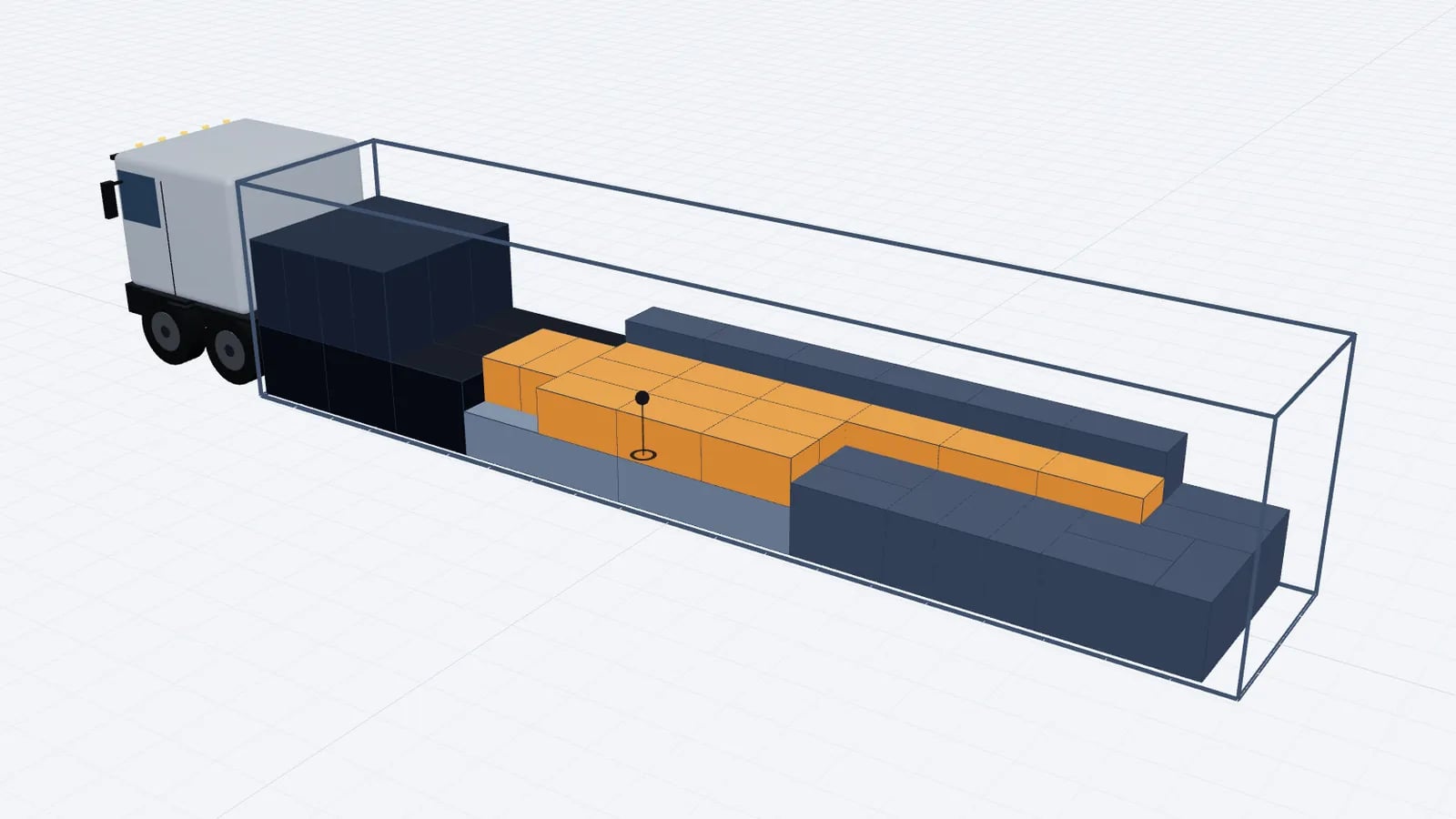
In event logistics, the truck pack decides how fast the crew can load in and out, so it is planned as carefully as the show. Cases are sized to fill the trailer width in clean rows, packed in the reverse of the order they are needed at the venue, and loaded the same way on every leg of the tour.
Why touring loads are different
Most freight is loaded once and unloaded once. A touring production is loaded and unloaded every show day, often at night, by local crew who have not seen the kit before. That changes the priorities:
- Speed beats density. A pack that is 5% tighter but takes an extra hour at load-out is a bad pack.
- Repeatability. The same case goes in the same place every night, so anyone with the pack sheet can load it.
- Order. What the riggers need first must come off first.
- Volume, not weight. Production trucks usually fill up long before they reach their payload.
Flight case sizes that pack across a trailer
A standard European semitrailer is about 245–248 cm wide inside and 13.6 m long; heights run from about 2.5 m on some curtainsiders to 2.7 m on a box trailer and 3.0 m on a mega trailer. Check the actual vehicle: side posts, tie rails and wheel arches can take a few centimetres. See semitrailer dimensions.
Cases built to a common footprint pack across that width with no gaps. The usual approach is to base sizes on 60 cm steps, which also matches the Euro pallet (120 × 80 cm) and the 120 × 60 cm 'truck size' cases that many case makers list as standard.
Case width across the trailer: 60 cm
- How many across
- 4
- Total width
- 240 cm
- Spare in a 245 cm trailer
- 5 cm
Case width across the trailer: 80 cm
- How many across
- 3
- Total width
- 240 cm
- Spare in a 245 cm trailer
- 5 cm
Case width across the trailer: 120 cm
- How many across
- 2
- Total width
- 240 cm
- Spare in a 245 cm trailer
- 5 cm
Case width across the trailer: 60 + 60 + 120 cm
- How many across
- 3
- Total width
- 240 cm
- Spare in a 245 cm trailer
- 5 cm
Case width across the trailer: 75 cm
- How many across
- 3
- Total width
- 225 cm
- Spare in a 245 cm trailer
- 20 cm
Case width across the trailer: 100 cm
- How many across
- 2
- Total width
- 200 cm
- Spare in a 245 cm trailer
- 45 cm
| Case width across the trailer | How many across | Total width | Spare in a 245 cm trailer |
|---|---|---|---|
| 60 cm | 4 | 240 cm | 5 cm |
| 80 cm | 3 | 240 cm | 5 cm |
| 120 cm | 2 | 240 cm | 5 cm |
| 60 + 60 + 120 cm | 3 | 240 cm | 5 cm |
| 75 cm | 3 | 225 cm | 20 cm |
| 100 cm | 2 | 200 cm | 45 cm |
A 75 cm case leaves a 20 cm gap that has to be filled with soft goods or strapped hard. A 100 cm case wastes almost half a metre across every row. Over 13.6 m that adds up quickly.
- Depth (along the trailer) matters less, because rows can be any length. Keeping it to 60 or 120 cm still helps mixed rows line up.
- Height decides stacking. Two cases of 110–120 cm stack to about 240 cm, which fits a 270 cm box trailer with room to lift the top case on.
- Castors add about 10–15 cm to the height. Include them in the case height on the pack sheet.
- Lids on stackable cases need recessed castor cups or skid rails so the case above sits securely.
Tip
When you buy new cases, give the case maker the trailer width and the rule (for example, every case 60, 80 or 120 cm across). It costs nothing at the design stage and saves space on every leg after.
Dolly boards and loose items
Not everything lives in a case. Speakers, risers, staging decks and cable often ride on dolly boards: flat boards with castors that hold a stack of items as one rolling unit. Treat each loaded dolly as one item with its own footprint and height.
- Size dollies to the same width steps as the cases.
- Strap the stack to the dolly, then strap the dolly to the trailer. Castors and brakes do not hold a load under braking.
Load order: last in, first out
The trailer is unloaded from the doors, so the first items needed at the venue go in last. A typical arena or theatre load-in for lighting and sound runs:
- 1Rigging: chain hoists (motors), steel, spansets. Points go in first.
- 2Truss and lighting that hang from the rig.
- 3Sound (PA hangs or stacks after the lighting rig).
- 4Video, if any.
- 5Backline and stage items, which go on stage last.
So the truck is packed in reverse: backline and stage at the nose, then sound, then lighting, with motors at the doors. Every production has its own order, and if departments have their own trucks the order applies inside each truck. Load-out at the end of the night is the same sequence backwards, and the pack sheet should show it.
Weight and axles
Production loads are rarely heavy for the vehicle. A 13.6 m semitrailer typically carries around 24 tonnes, and a full trailer of lighting and sound is often well under half that. Weight still matters in three places:
- Distribution. A row of motor cases or a stack of amplifier racks at one end can overload an axle even when the total is low. Spread the heavy rows.
- Height. Heavy cases low, light ones on top. Never put a heavy case on a case not built to carry it.
For the method, see weight distribution in a trailer.
Securing a touring load
Cases on castors roll, and a tall stack of cases can topple under braking. EN 12195-1 sets the forces a load must withstand: in the direction of travel, typically 0.8 of the load's weight forwards, 0.5 backwards and to the sides. Blocking against the front wall or the previous row, plus load bars or straps every few rows, is the usual answer. See load securing basics.
- Fill each row wall to wall so it cannot shift sideways.
- Put a load bar or strap across the back of each section, especially before a gap.
- Lock castors and turn swivel castors the same way.
The same pack every leg
On tour, the first load-out sets the pack. After that, the aim is to load the same way every night. A good pack sheet shows:
- Each truck as a top view and a side view, with rows numbered from the nose.
- Every case by name or number, where it goes and what goes on top of it.
- Which cases come off first at the venue.
- Weight per truck and any axle notes.
Print it and tape it inside the trailer door, and send it to the local crew chief before the show. When kit is added or dropped, update the sheet the same day.
Multi-venue runs and exhibitions
A tour usually takes all the kit to every venue. Some events work differently: an exhibition contractor delivers stands to several halls, a festival supplier drops stages and barriers at several sites, or a corporate production splits kit between a conference venue and a hotel. That is a multi-stop load, and the rule is the same as for any delivery run: the first stop's items by the doors, the last stop's at the nose. See multi-drop load planning.
How many trucks does the tour need?
The number of trucks is a budget question, so work it out early. Start from the kit list:
- 1List every case and dolly with its footprint, height, weight and whether it stacks.
- 2Work out the floor length each group needs in rows across the trailer.
- 3Add the groups. If the total is over 13.6 m, you need another truck or a mega trailer for the extra height.
- 4Leave a margin. Kit grows during a tour, and merch, catering or extra staging often appear late.
- 5Check driving time. Under EU Regulation 561/2006 a driver may drive 9 hours a day (10 hours twice a week), with a 45-minute break after 4.5 hours. Long overnight hops may need a second driver.
Every extra truck adds a driver, fuel, tolls and parking at each venue, so cutting one truck through a better pack often pays for the planning many times over.
Worked example: one 13.6 m trailer
A mid-size production carries lighting, rigging and sound in one trailer, 245 cm wide inside and 270 cm high. The kit list:
Item: Lighting cases
- Qty
- 24
- Size (L × W × H)
- 120 × 60 × 110 cm
- Weight each
- 180 kg
- Stacks?
- 2 high
Item: Motor cases (4 hoists each)
- Qty
- 8
- Size (L × W × H)
- 120 × 80 × 75 cm
- Weight each
- 200 kg
- Stacks?
- 2 high
Item: Truss sections in dollies
- Qty
- 10
- Size (L × W × H)
- 300 × 52 × 52 cm
- Weight each
- 35 kg
- Stacks?
- 3 high
Item: PA stacks on dolly boards
- Qty
- 9
- Size (L × W × H)
- 120 × 80 × 160 cm
- Weight each
- 350 kg
- Stacks?
- No
| Item | Qty | Size (L × W × H) | Weight each | Stacks? |
|---|---|---|---|---|
| Lighting cases | 24 | 120 × 60 × 110 cm | 180 kg | 2 high |
| Motor cases (4 hoists each) | 8 | 120 × 80 × 75 cm | 200 kg | 2 high |
| Truss sections in dollies | 10 | 300 × 52 × 52 cm | 35 kg | 3 high |
| PA stacks on dolly boards | 9 | 120 × 80 × 160 cm | 350 kg | No |
- 1Lighting: 4 across (4 × 60 = 240 cm), 2 high (220 cm) = 8 per 120 cm row. 24 ÷ 8 = 3 rows = 3.6 m.
- 2Motors: 3 across (3 × 80 = 240 cm) with the 120 cm side along the trailer, 2 high, gives 6 per 120 cm row: 8 cases need 2 rows = 2.4 m. Turned so the 120 cm side runs across, 2 across (240 cm), 2 high, gives 4 per 80 cm row: 2 rows = 1.6 m. Use the turned layout.
- 3Truss: 4 across (4 × 52 = 208 cm), 3 high (156 cm) = 12 per 300 cm. 10 sections = 1 row = 3.0 m. The 37 cm gap beside it takes cable trunks.
- 4PA: 3 across (240 cm), not stacked. 9 ÷ 3 = 3 rows = 3.6 m.
- 5Total floor length: 3.6 + 1.6 + 3.0 + 3.6 = 11.8 m, leaving 1.8 m for spares and soft goods.
- 6Weight: 4,320 + 1,600 + 350 + 3,150 = 9,420 kg, well under the payload. Volume decides this load.
- 7Order from the nose: PA, then lighting, then truss, then motors at the doors, because rigging comes off first.
Now suppose the same production adds video: 8 LED screen cases of 120 × 80 × 120 cm that stack two high. Packed 3 across with the long side along the trailer, that is 2 rows of 120 cm, 2.4 m, which does not fit the 1.8 m left. Turned 2 across, it is 2 rows of 80 cm, 1.6 m, which fits with 20 cm to spare. The truck is now full: any further kit means a second vehicle or smaller cases. A mega trailer does not help, because these cases cannot stack higher. Knowing this before the tour is budgeted is the whole point, and so is trying both orientations of every case.
Plan the truck pack in EveryLoading
The loading metre calculator gives a quick floor-length check, and the road transport planner shows the full trailer in 3D. For the general method, see how to load a truck.
Tip
In EveryLoading, add each case type as a cargo row with its size, weight and stacking rules (stackable, maximum loads on top, or floor only for cases on castors), then optimize. Give each department or venue its own delivery stop to set the unload order (see multi-stop), and check axle loads in the weight estimate. If the kit does not fit, multiple trucks (Pro) spreads it over identical trailers, and Suggest a vehicle (Pro) compares vehicle types. Save the plan as a PDF for the trailer door or send the share link to the crew chief.
Frequently asked questions
What is a truck pack in touring?
It is the fixed arrangement of cases in the trucks, and the sheet that shows it. The same case goes in the same place every night so any crew can load out quickly and the kit always fits.
What flight case sizes fit best in a trailer?
Widths that divide the roughly 245 cm inside width evenly: 60 cm (four across), 80 cm (three across) or 120 cm (two across). Cases on a 120 × 60 cm footprint are a common standard.
Which cases should go in the truck last?
The ones needed first at the venue, usually rigging and motors, so they come off first. Backline and stage items, needed last, go to the nose of the trailer.
Do production trucks run out of weight or space first?
Almost always space. A full trailer of lighting and sound is often well under half its payload, but axle loads can still be a problem if the heaviest cases sit at one end.
How do I work out how many trucks a tour needs?
Group the kit into rows across the trailer, add up the floor length of each group, and compare it with the trailer length, allowing a margin for kit that is added during the tour.
Keep reading
Industry guides · · 5 min read
Fresh Produce Transport: Planning Crates, Bins and Reefers
Fresh produce transport planning: crates and bins, temperature and ventilation in general terms, product compatibility, airflow and when produce weighs out.
Read article
Industry guides · · 6 min read
Beverage Pallet Loading: Plan for Weight Before Volume
Beverage pallets run out of payload long before the trailer is full. How to work out the pallet count, spread the weight over the axles and decide on stacking.
Read article
Industry guides · · 5 min read
Removal Truck Loading: Survey, Size and Load a Household Move
Removal truck loading for movers: turning a volume survey into the right vehicle, loading order for furniture and boxes, protection, and shared-load moves.
Read article