Side Loading vs Rear Loading: Truck Loading Methods
Truck loading methods compared: curtainsider side loading, rear dock loading and top loading, which cargo suits each, and how the load plan changes.
Road freight · · 7 min read
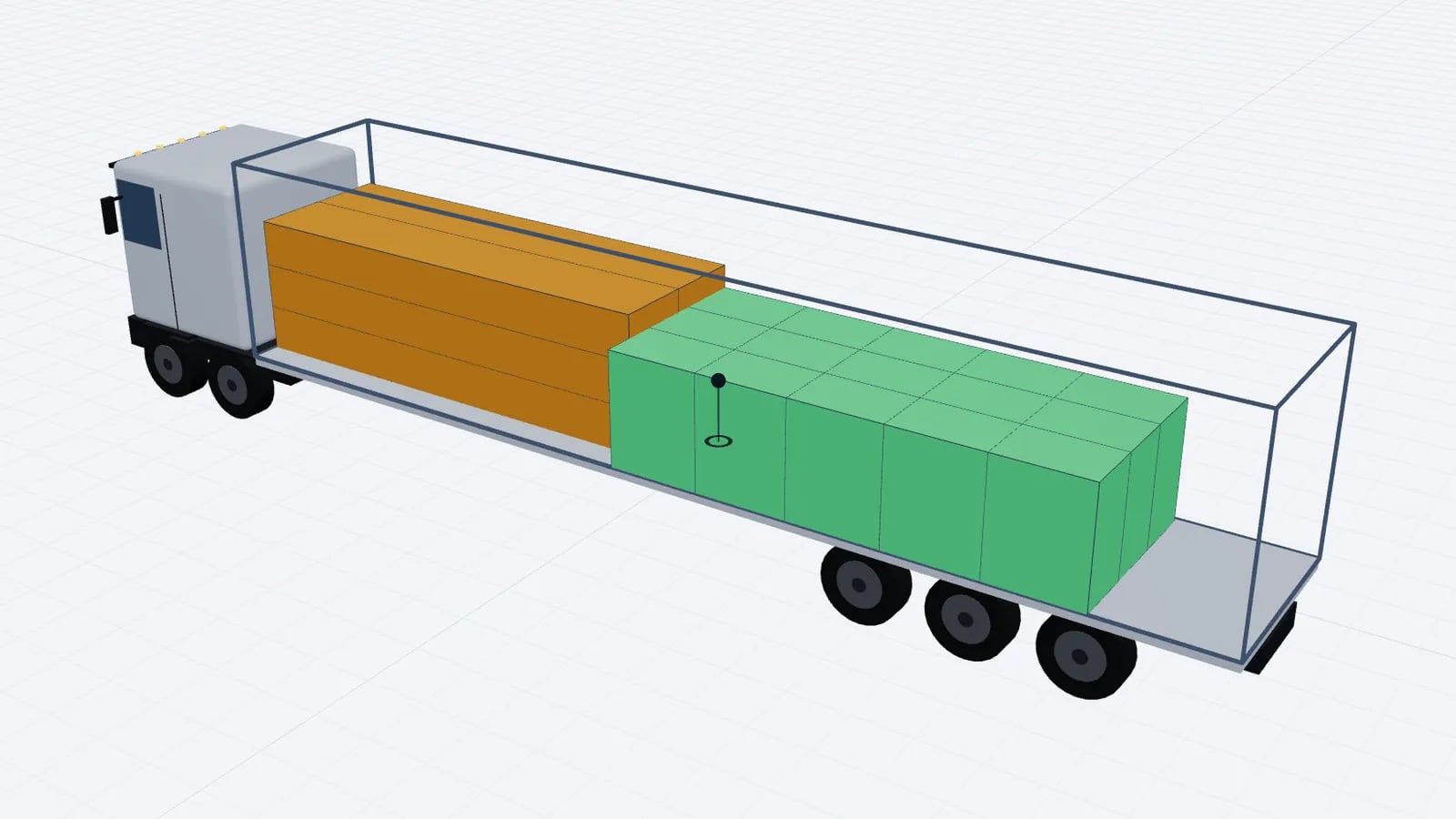
There are three main truck loading methods: rear loading through the back doors, usually at a dock; side loading from the side of a curtainsider or open trailer, usually by forklift in the yard; and top loading from above by crane into an open-top or open trailer. Rear loading suits palletised and floor-loaded goods at warehouses with docks, side loading suits long, heavy or mixed loads and sites without docks, and top loading suits goods that cannot be moved by forklift at all. The method also changes the load plan: rear loading works in rows from front to back, side loading in lanes across the width.
The three truck loading methods at a glance
Typical vehicles
- Rear loading
- Box trailers, reefers, containers, curtainsiders at a dock
- Side loading
- Curtainsiders, flatbeds, dropside rigids
- Top loading
- Open-top containers, flatbeds, tippers, open trailers with removable roof
Equipment
- Rear loading
- Forklift or pallet jack over a dock leveller
- Side loading
- Counterbalance forklift at ground level
- Top loading
- Overhead crane, mobile crane, truck-mounted crane
Access
- Rear loading
- Only through the door opening
- Side loading
- Along the full length of the open side
- Top loading
- The whole floor area from above
Needs a dock
- Rear loading
- Usually, or a ramp or tail lift
- Side loading
- No, a firm, level yard
- Top loading
- No, but a crane and clearance
Best cargo
- Rear loading
- Pallets, cartons, temperature-controlled goods
- Side loading
- Long items, heavy machinery parts, mixed pallets, multi-drop
- Top loading
- Steel coils, beams, machines, stone, bulky items
Main limitation
- Rear loading
- Door height and width; deep items are hard to reach
- Side loading
- Curtain, posts and straps take time; weather exposure
- Top loading
- Crane availability; securing from above is harder to inspect
| Rear loading | Side loading | Top loading | |
|---|---|---|---|
| Typical vehicles | Box trailers, reefers, containers, curtainsiders at a dock | Curtainsiders, flatbeds, dropside rigids | Open-top containers, flatbeds, tippers, open trailers with removable roof |
| Equipment | Forklift or pallet jack over a dock leveller | Counterbalance forklift at ground level | Overhead crane, mobile crane, truck-mounted crane |
| Access | Only through the door opening | Along the full length of the open side | The whole floor area from above |
| Needs a dock | Usually, or a ramp or tail lift | No, a firm, level yard | No, but a crane and clearance |
| Best cargo | Pallets, cartons, temperature-controlled goods | Long items, heavy machinery parts, mixed pallets, multi-drop | Steel coils, beams, machines, stone, bulky items |
| Main limitation | Door height and width; deep items are hard to reach | Curtain, posts and straps take time; weather exposure | Crane availability; securing from above is harder to inspect |
Rear loading at the dock
Rear loading is the default for warehouse distribution. The trailer backs onto a dock, a leveller bridges the gap, and a forklift or pallet jack drives inside. It is quick for standard pallets, keeps goods out of the weather, and is the only practical method for box bodies, reefers and ISO containers, which have no side doors.
- The door limits the height. The rear door frame is lower than the inside roof on most bodies. An item that fits inside may not pass through the doors. Check both.
- Work front to back. Each pallet has to pass every pallet already loaded, so the first in goes against the front wall and the last at the doors.
- Deep positions are hard to reach. Rearranging a pallet near the front wall means unloading everything behind it. A plan that fits first time matters more here than in any other method.
- Long items are awkward. Items longer than the door width must go in lengthwise, and turning them inside is often impossible.
For the full procedure, including weight over the axles and securing, see how to load a truck.
Side loading a curtainsider
A curtainsider (tautliner) has a fixed roof, a fixed front wall and sliding curtains on both sides. Open one side and a forklift can place a pallet at any position along the trailer without driving into it. Open both, and two forklifts can work at once, or one forklift can reach the far side of a wide load.
- Any position is reachable. You can load the middle of the trailer first, or swap one pallet at stop 2 without touching the rest.
- Long items go in easily. Timber, pipes, profiles and long crates can be placed lengthwise from the side.
- No dock needed. The forklift works at ground level, so side loading suits building sites, farms and factories without docks.
- Weather exposure. Goods are open to rain while the curtain is back.
- Curtains are not load restraint by default. A standard curtain is not designed to hold the load; only bodies built and certified for it (for example to EN 12642 XL) can use the sides as part of the securing. Strap the load unless the body certificate and your securing plan say otherwise.
- Posts and straps. Centre posts may need moving to reach a position, and every side strap has to be released and refitted.
Good to know
Curtainsiders can also be loaded from the rear at a dock. Many European operators use the same trailer both ways depending on the site, so the loading method belongs to the load, not just the vehicle.
Top loading by crane
Top loading lowers the cargo from above. It is the method for steel coils, long beams, precast concrete, large machines and anything too heavy or awkward for a forklift. Open-top containers have a removable tarpaulin roof for this; flatbeds and some curtainsiders with sliding roofs allow it too.
Planning for top loading starts with the crane: its capacity at the needed reach, the lifting points on the cargo, and where the slings must go so the load can be lowered without hitting the sides. Coils need cradles or coil wells, beams need dunnage under them so slings and forks can pass, and every item needs securing calculated for its weight. See machinery transport and out-of-gauge road transport for heavy and oversized loads.
Which method suits which cargo
Cargo: Standard Euro or US pallets, full loads
- Best method
- Rear at a dock
- Why
- Fast, weatherproof, works with box bodies
Cargo: Floor-loaded cartons
- Best method
- Rear
- Why
- Hand stacking needs an enclosed body; conveyors work through the back
Cargo: Chilled or frozen goods
- Best method
- Rear at a sealed dock
- Why
- Keeps the cold chain; reefers have no side doors
Cargo: Long items (over about 2.4 m)
- Best method
- Side
- Why
- Placed lengthwise without turning inside the trailer
Cargo: Mixed pallets for several stops
- Best method
- Side, or rear with careful sequencing
- Why
- Side access reaches any stop's goods
Cargo: Building materials to sites without docks
- Best method
- Side
- Why
- Forklift or truck-mounted forklift at ground level
Cargo: Machines, coils, beams over forklift capacity
- Best method
- Top
- Why
- Only a crane can lift them
| Cargo | Best method | Why |
|---|---|---|
| Standard Euro or US pallets, full loads | Rear at a dock | Fast, weatherproof, works with box bodies |
| Floor-loaded cartons | Rear | Hand stacking needs an enclosed body; conveyors work through the back |
| Chilled or frozen goods | Rear at a sealed dock | Keeps the cold chain; reefers have no side doors |
| Long items (over about 2.4 m) | Side | Placed lengthwise without turning inside the trailer |
| Mixed pallets for several stops | Side, or rear with careful sequencing | Side access reaches any stop's goods |
| Building materials to sites without docks | Side | Forklift or truck-mounted forklift at ground level |
| Machines, coils, beams over forklift capacity | Top | Only a crane can lift them |
How the load plan changes with the loading method
The same cargo produces a different good plan depending on how it goes in. The physics (weight over the axles, heavy low, no crushing) stays the same; what changes is the order and which positions are reachable.
Rear loading: rows from the front wall
The plan is read as rows from the front wall towards the doors. Multi-drop loads are sequenced by depth: the last stop goes deepest, the first stop at the doors. Every item that passes through the door must fit the door opening in the orientation it travels in, and any item that has to be turned is turned before it goes in.
Side loading: lanes along the length
The plan is read as lanes across the width, each lane reachable from one side. With side unloading, stops can be grouped by section along the trailer rather than strictly by depth: stop 1 in the rear third, stop 2 in the middle, stop 3 at the front, each accessible from the side without moving the others. Within a lane, the item nearest the open side comes off first, so on a three-across load the far-side pallet of a lane belongs to the same or a later stop. Items now have to fit the side opening as length × height rather than width × height.
Example: 30 Euro pallets for three stops in a 13.6 m curtainsider, loaded three across in 10 rows. Rear loading forces stop 3 into rows 1 to 4, stop 2 into rows 5 to 7, stop 1 into rows 8 to 10. Side loading allows the same split by section, but if stop 2 is the heaviest it can sit over the trailer axles in the rear rows, with stop 1 in the middle, because the driver reaches it from the side. That keeps the axle balance better through the trip.
Tip
In EveryLoading, set the vehicle's loading direction and door opening on the Vehicle tab. The optimizer then only uses orientations that pass the door: width × height for a rear door, length × height for a side opening. Give each cargo row a stop number and later stops are loaded deeper. The vehicle manual and multi-stop manual show the settings.
Choosing the method for a lane or a customer
- 1Start with the sites. Does every pickup and delivery point have a dock? If not, side loading or a tail lift is needed.
- 2Check the cargo. Long, heavy or crane-only items decide the method on their own.
- 3Check the temperature and security needs. Cold chain and high-value goods favour closed bodies loaded from the rear.
- 4Count the stops. Multi-drop routes with mixed goods gain most from side access.
- 5Plan the load for that method. Set the loading side and door size before you optimise, so the plan is one the crew can actually build.
Time matters too: side loading with two forklifts can beat a dock on a full load, but curtains and straps add fixed time. The minute estimates are in truck loading time, and the forklifts, levellers, ramps and tail lifts each method needs are compared in truck loading equipment. For daily road planning, see the road transport use case.
Frequently asked questions
What is side loading a truck?
Loading cargo from the side of the vehicle, usually a curtainsider or flatbed, with a forklift standing at ground level. It needs no dock and gives access to any position along the trailer.
Can a box trailer be side loaded?
Not unless it has side doors. Standard box trailers, reefers and ISO containers load only through the rear doors, so they need a dock, a ramp or a tail lift.
Are curtains strong enough to hold the load?
A standard curtain is a weather cover, not restraint. Only bodies certified for it, such as EN 12642 XL, can count the sides in the securing, and even then within the certified limits, so the load is usually strapped.
When is top loading used?
When cargo is too heavy, long or awkward for a forklift, such as steel coils, beams, stone blocks or large machines. It needs a crane and a vehicle open at the top, like an open-top container or flatbed.
Keep reading
Road freight · · 7 min read
Truck Loading Time: How Long Loading and Unloading Take
Truck loading time by method: pallets, floor-loaded cartons and side loading, with worked minute estimates, what slows docks and how planning cuts it.
Read article
Road freight · · 8 min read
Truck Loading Checklist: Before, During and Before Departure
A printable truck loading checklist for docks and drivers: what to check before loading, while loading and before departure, and why each check matters.
Read article
Road freight · · 10 min read
Out of Gauge Cargo by Road: Limits, Permits and Trailers
Out of gauge cargo on EU roads: Directive 96/53/EC limits, indivisible loads, permits, escorts, overhang marking, trailer choice, axle loads and route surveys.
Read article