How to Calculate Cargo Space: CBM, LDM, Pallets and Payload
Calculate the cargo space you need and have: CBM, loading metres, pallet places and payload, usable vs nominal space, and van, rigid and trailer examples.
Load planning basics · · 7 min read
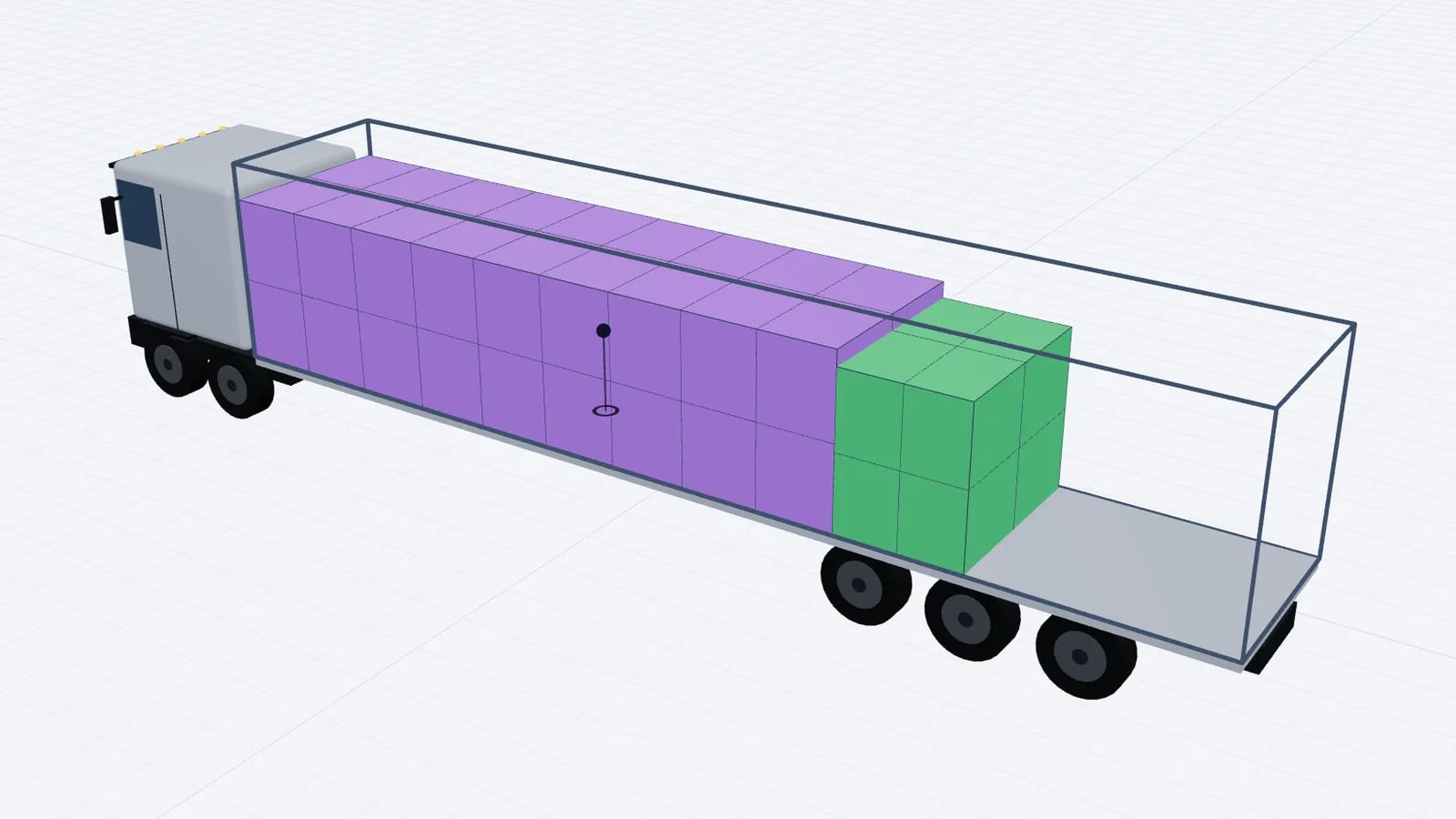
To calculate cargo space, compare four numbers for the shipment against the same four for the vehicle: volume (CBM), floor length (loading metres), pallet places and weight (payload). The shipment fits only if it fits on all four, and the tightest one decides. Volume alone is the most common mistake: a trailer can be "half full" by cubic metres and already at its weight limit, or out of floor space because the pallets cannot be stacked.
This guide brings the four measures together. For the arithmetic of each one in depth, see the CBM calculation guide and loading metres explained.
The four measures of cargo space
Measure: Volume (CBM)
- What it is
- Cubic metres the goods take up
- Formula
- L × W × H in metres, × quantity
- When it is the limit
- Light, stackable cartons; parcels; sea containers
Measure: Loading metres (LDM)
- What it is
- Metres of trailer floor used at full width
- Formula
- L × W in metres ÷ 2.4 per floor position
- When it is the limit
- Non-stackable pallets; groupage priced by LDM
Measure: Pallet places
- What it is
- Pallet footprints the floor holds in a given pattern
- Formula
- Count from the floor pattern
- When it is the limit
- Standard pallet loads
Measure: Payload
- What it is
- Weight the vehicle may carry
- Formula
- Gross vehicle limit − unladen weight
- When it is the limit
- Drinks, paper, steel, building materials
| Measure | What it is | Formula | When it is the limit |
|---|---|---|---|
| Volume (CBM) | Cubic metres the goods take up | L × W × H in metres, × quantity | Light, stackable cartons; parcels; sea containers |
| Loading metres (LDM) | Metres of trailer floor used at full width | L × W in metres ÷ 2.4 per floor position | Non-stackable pallets; groupage priced by LDM |
| Pallet places | Pallet footprints the floor holds in a given pattern | Count from the floor pattern | Standard pallet loads |
| Payload | Weight the vehicle may carry | Gross vehicle limit − unladen weight | Drinks, paper, steel, building materials |
Two more constraints apply to every load: height (the tallest item and any stack must pass the door and fit under the roof) and stackability (an item that cannot carry weight turns the space above it into air). These are why usable space is always smaller than nominal space.
Step 1: calculate the cargo space you need
- 1List every line with length, width, height, weight and quantity, using the packed size, including the pallet.
- 2Calculate volume per line. 1.20 × 0.80 × 1.50 m = 1.44 m³ per pallet. Multiply by quantity and add the lines.
- 3Calculate floor space per line. A Euro pallet is 1.2 × 0.8 = 0.96 m², or 0.4 LDM. If pallets can be stacked two high, count floor positions, not pallets.
- 4Add up the weight. Use actual weights, not estimates from the product master.
- 5Note the tallest item and anything non-stackable or floor-only. These decide how much of the height you can use.
Tip
The free CBM and loading metre calculators do steps 2 and 3 for a whole list, and the pallet fit calculator counts pallet places for a given vehicle.
Step 2: calculate the cargo space you have
Use the inside dimensions, not the outside, and check the door opening and the payload on the vehicle's documents. These are typical values for three common vehicle classes, as used in EveryLoading's presets (bodies vary by builder, so measure yours):
Vehicle: Van, 10 pallets
- Inside L × W × H
- 490 × 215 × 225 cm
- Volume
- 23.7 m³
- Euro pallet places
- 10
- Payload
- 1,200 kg
- Payload per pallet place
- 120 kg
Vehicle: Rigid truck, 18 pallets
- Inside L × W × H
- 730 × 245 × 250 cm
- Volume
- 44.7 m³
- Euro pallet places
- 18
- Payload
- 8,000 kg
- Payload per pallet place
- 444 kg
Vehicle: Semi-trailer, 33 pallets
- Inside L × W × H
- 1,360 × 245 × 270 cm
- Volume
- 90.0 m³
- Euro pallet places
- 33
- Payload
- 24,000 kg
- Payload per pallet place
- 727 kg
| Vehicle | Inside L × W × H | Volume | Euro pallet places | Payload | Payload per pallet place |
|---|---|---|---|---|---|
| Van, 10 pallets | 490 × 215 × 225 cm | 23.7 m³ | 10 | 1,200 kg | 120 kg |
| Rigid truck, 18 pallets | 730 × 245 × 250 cm | 44.7 m³ | 18 | 8,000 kg | 444 kg |
| Semi-trailer, 33 pallets | 1,360 × 245 × 270 cm | 90.0 m³ | 33 | 24,000 kg | 727 kg |
The last column is the quickest sanity check. If your pallets are heavier than the payload per pallet place, the vehicle will run out of weight before it runs out of floor. A van carrying 10 pallet places can, on average, take only 120 kg per place.
Usable vs nominal cargo space
Nominal cargo space is length × width × height of the inside. Usable cargo space is what a real load can occupy. The gap comes from:
- Pallet footprints. 33 Euro pallets cover 31.7 m² of a 33.3 m² trailer floor. The rest is too narrow for another pallet.
- Height you cannot use. Pallets 1.6 m high that cannot be stacked leave over 1 m of air under a 2.7 m roof. A full trailer of them uses 33 × 1.536 = 50.7 m³, about 56 % of the 90 m³.
- Door openings. The rear door is usually lower than the inside height, which limits the tallest item or stack you can load from the back.
- Vehicle parts. Wheel arches in vans and some trailers, a refrigeration unit at the front wall, or a second deck all take space.
- Packing tolerance. Cartons rarely fill corners and the last row exactly. Forwarders often plan loose cartons with 85–90 % of the volume.
- Securing. Gaps for load bars, airbags and dunnage.
Good to know
Utilisation figures in a plan are usually against nominal volume. A pallet load that is "full" at 56 % volume is not badly planned; it is limited by floor and stacking, not cubic metres. See container utilization for how to read the number.
Worked example 1: a van that runs out of weight
Shipment: 36 cartons of 60 × 40 × 40 cm at 20 kg, plus 2 Euro pallets of 120 × 80 × 120 cm at 250 kg.
- Volume: 36 × 0.096 = 3.46 m³, plus 2 × 1.152 = 2.30 m³, total 5.76 m³ of the van's 23.7 m³, about 24 %.
- Floor: the 2 pallets take 2 of 10 places; the cartons stack on a little over one more place.
- Weight: 36 × 20 = 720 kg, plus 500 kg, total 1,220 kg against a 1,200 kg payload.
By volume the van is three-quarters empty, but it is overloaded by 20 kg, before the driver and fuel are counted if the payload figure excludes them. The answer is a larger vehicle, such as a 7.5 t truck with around 3,000 kg payload, or moving some cartons to another delivery. Van cargo space covers vans in more detail.
Worked example 2: a rigid truck limited by floor
Shipment: 16 Euro pallets of 120 × 80 × 140 cm at 450 kg, not stackable.
- Pallet places: 16 of 18.
- LDM: 16 × 0.4 = 6.4 m of the 7.3 m floor.
- Weight: 16 × 450 = 7,200 kg of 8,000 kg.
- Volume: 16 × 1.344 = 21.5 m³ of 44.7 m³, 48 %.
It fits, with two pallet places and 800 kg spare. Add four more pallets and both floor (20 places) and weight (9,000 kg) fail at once, though volume would still be only 60 %. The next step is a 13.6 m trailer, or a split shipment. If a 20-pallet rigid is available (inside about 810 cm, payload around 10,000 kg), it carries all 20 at 9,000 kg.
Worked example 3: a 13.6 m trailer limited by payload
Shipment: 40 industrial pallets of 120 × 100 × 110 cm at 550 kg, stackable two high.
- Stacks: 40 ÷ 2 = 20 stacks, each 2.2 m high under a 2.7 m roof.
- Floor: a 13.6 m trailer takes 26 industrial pallets on the floor, so 20 stacks leave 6 positions free. LDM: 20 × 0.5 = 10.0 m.
- Weight: 40 × 550 = 22,000 kg of 24,000 kg, 92 %.
- Volume: 40 × 1.32 = 52.8 m³ of 90 m³, 59 %.
Weight is the binding limit. Six floor positions are free, but with 2,000 kg left only three more pallets fit. Because the 10 m of stacks would sit against the front wall, check where the weight falls on the axles too: a stacked part load bunched at the front can overload the tractor. See weight distribution in a trailer.
Which cargo space number to use when
| Situation | Number to lead with |
|---|---|
| Booking a full truck of standard pallets | Pallet places and payload |
| Quoting groupage or a part load | Loading metres, with a weight check |
| Booking a sea container of cartons | CBM with 85–90 % usable, then weight |
| Dense goods: drinks, paper, metal | Payload first |
| Mixed sizes, non-stackable items, several stops | A load plan, because no single number is reliable |
The last row is where formulas stop working. Mixed pallet sizes, stacking rules and stop order interact in ways that a sum cannot show. Building the load in a 3D planner shows the real fit: in EveryLoading, paste the cargo list into the Cargo tab, choose a vehicle and press Optimize; the stats bar shows volume, weight, loading metres and items that did not fit. You can start with a free account in the planner. When you book a vehicle or container, booking cargo space covers what to give the carrier.
Frequently asked questions
How do I calculate the cargo space I need?
Measure every packed item, multiply length, width and height in metres for the volume, work out the floor space or pallet places, and add up the weight. Compare each figure with the vehicle's inside size and payload.
Why does my load not fit when the volume is less than the truck's?
Volume ignores shape. Non-stackable items waste the height above them, pallets cannot use every corner of the floor, and the door may be lower than the roof, so floor space or height runs out first.
How much cargo space is in a 13.6 m trailer?
About 1,360 × 245 × 270 cm inside, roughly 90 m³, with room for 33 Euro pallets or 26 industrial pallets on the floor and a payload of around 24 tonnes. Exact figures depend on the body.
Is payload or volume more important?
Whichever runs out first. Light goods fill the volume first; dense goods such as drinks, tiles or paper reach the payload while much of the space is still empty.
Keep reading
Load planning basics · · 6 min read
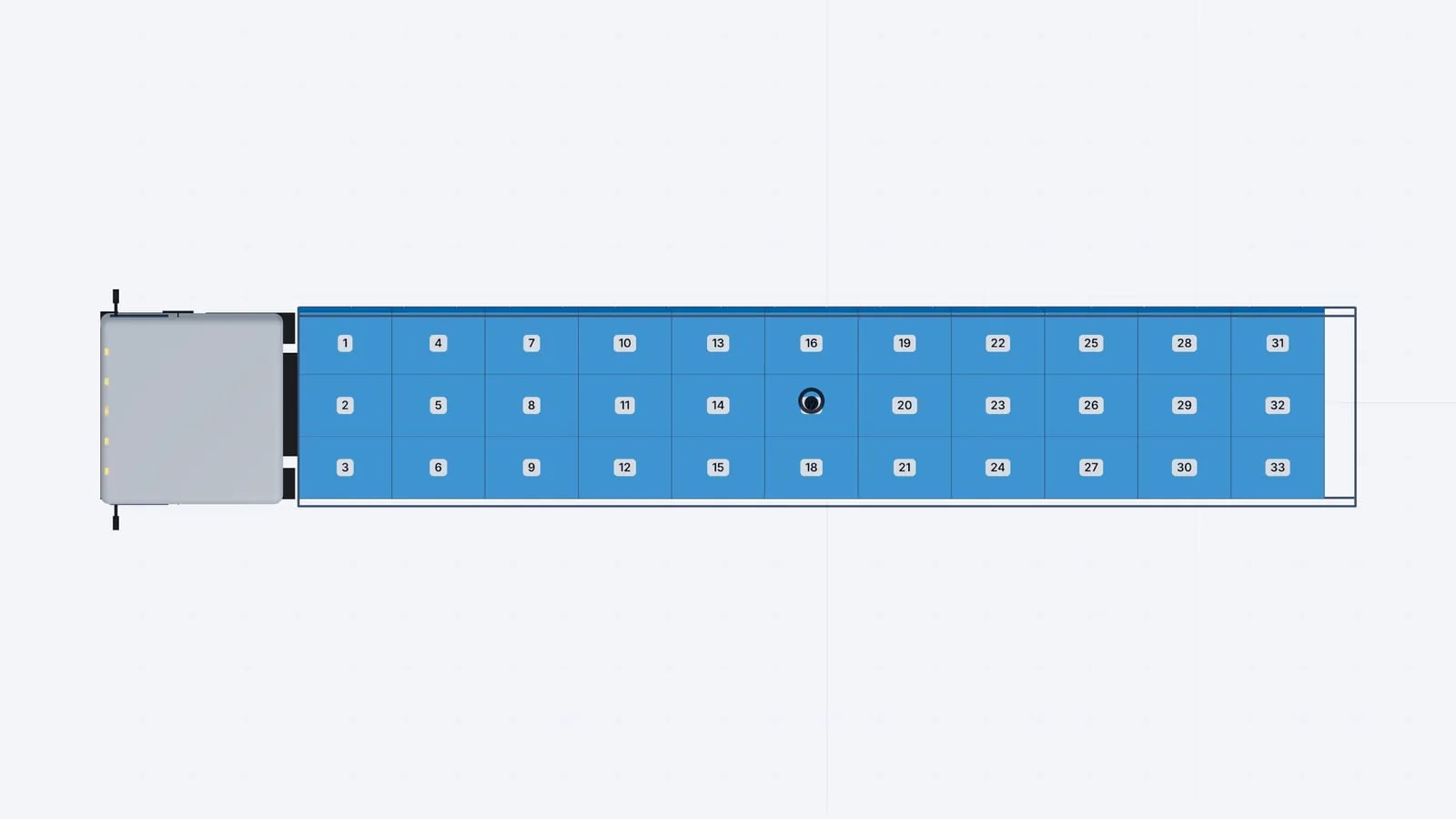
How Many Euro Pallets Fit in a Trailer? 33, 66 or Fewer
A 13.6 m trailer takes 33 Euro pallets single-stacked and 66 double-stacked if height and payload allow. See the orientations, mixed loads and the maths.
Read article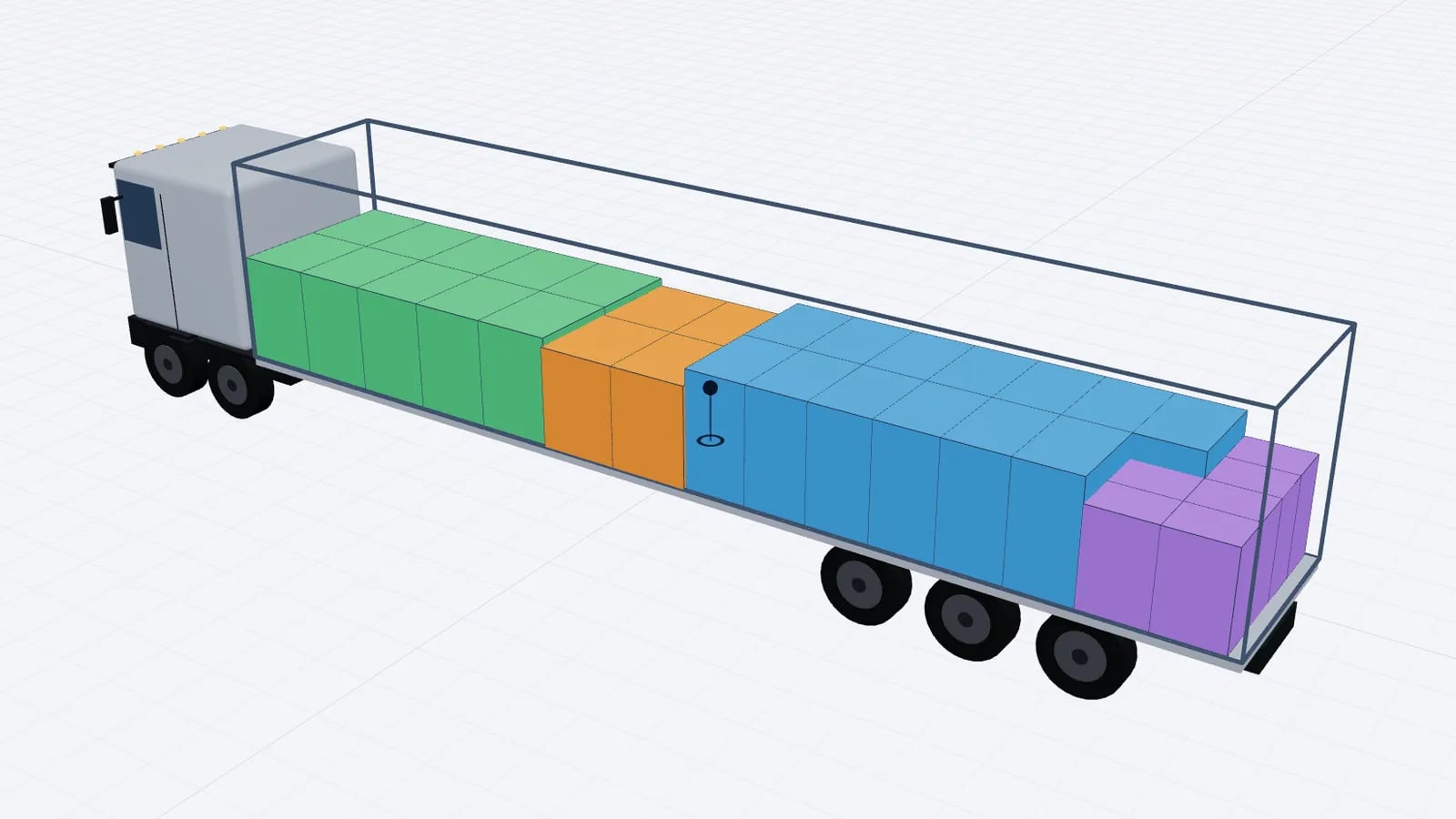
Load planning basics · · 8 min read
Load Planning with Mixed Pallets: Euro, Industrial, Half, US
Load planning with mixed pallets: how Euro, industrial, half and US pallets share a 13.6 m trailer, which rows to turn, and a worked example in loading metres.
Read article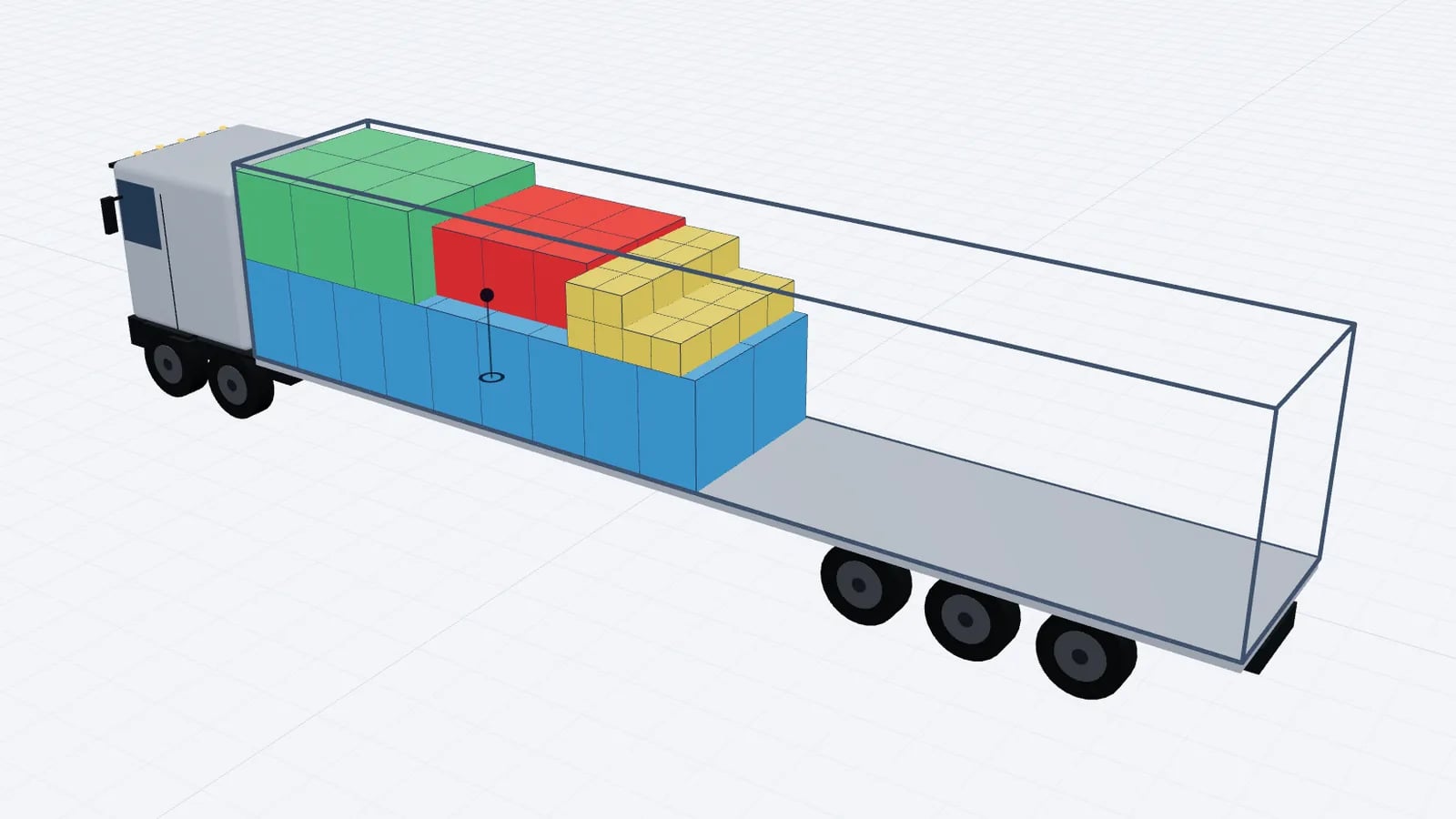
Load planning basics · · 8 min read
12 Load Planning Mistakes, What They Cost and How to Fix Them
The 12 common load planning mistakes, from outside dimensions to bunched part loads, with what each one costs in trucks, fines and claims and how to fix it.
Read article